
![Oracle Database Free]() Oracle Database Free
Oracle Database Free
Stack
Oracle Database Free (the 26ai line) - the actual Oracle Database, free for development AND production under the Oracle Free Use Terms and Conditions, within software-enforced caps: 2 cores, 2 GB RAM, 12 GB user data, one instance per
Image details
Configuration
TypeComposelinuxgvenzl/oracle-free:231521:1521/opt/oracle/oradata : oradataORACLE_PASSWORD=${ORACLE_PASSWORD}APP_USER=appAPP_USER_PASSWORD=${APP_USER_PASSWORD}unless-stoppedTemplate by deployable-sh·Source
Report issueStandalone Install
Select an install method, to see config/commands for deploying Oracle Database Free
Install on Portainer
Import all app templates into your Portainer instance, for easy 1-click deploys
- Ensure both Docker and Portainer are installed, and up-to-date
- Log into your Portainer web UI
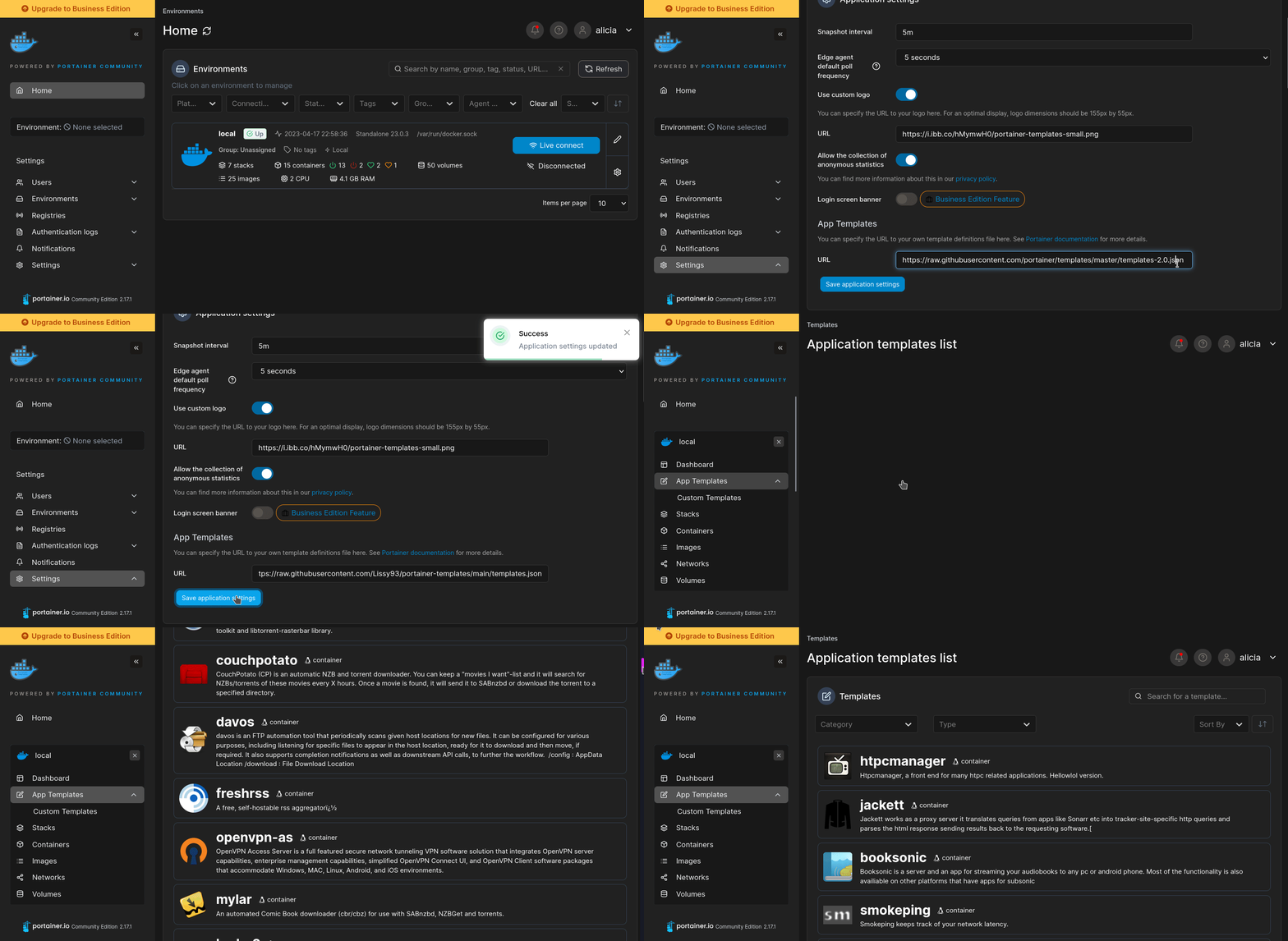
- Under Settings → App Templates, paste the below URL
- Head to Home → App Templates, and the list of apps will show up
- Select Oracle Database Free, fill in any config options, and hit Deploy
Template Import URL
https://raw.githubusercontent.com/Lissy93/portainer-templates/main/templates.json
Show Me
Original stackfile
The compose file this template deploys, straight from its repo:
name: oracle

services:
  oracle:
    image: gvenzl/oracle-free:23
    restart: unless-stopped
    environment:
      ORACLE_PASSWORD: ${ORACLE_PASSWORD}
      APP_USER: app
      APP_USER_PASSWORD: ${APP_USER_PASSWORD}
    ports:
      - "1521:1521"
    volumes:
      - oradata:/opt/oracle/oradata

volumes:
  oradata:
Or deploy it directly from the source:
git clone https://github.com/deployable-sh/stacks
cd stacks
docker compose -f oracle/compose.yaml up -d
More install options in our documentation.
oci-oracle-free
Oracle Database Free Container images.Table of Contents
- Image flavors - Environment variables - GitHub Actions - Docker Compose - Database users - Pluggable databases - Container secrets - Initialization scripts - Startup scripts - Configuration scriptsSupported tags
| Tag | Status |
|---|---|
latest-faststart | 🔵 Always Supported |
slim-faststart | 🔵 Always Supported |
full-faststart | 🔵 Always Supported |
23-faststart23-slim-faststart23-full-faststart | 🟢 Supported |
23.26.1-faststart23.26.1-slim-faststart23.26.1-full-faststart | 🟢 Supported |
23.26.0-faststart23.26.0-slim-faststart23.26.0-full-faststart | 🟡 Deprecated |
23.9-faststart23.9-slim-faststart23.9-full-faststart | 🔴 Unsupported |
23.8-faststart23.8-slim-faststart23.8-full-faststart | 🔴 Unsupported |
23.7-faststart23.7-slim-faststart23.7-full-faststart | 🔴 Unsupported |
23.6-faststart23.6-slim-faststart23.6-full-faststart | 🔴 Unsupported |
23.5-faststart23.5-slim-faststart23.5-full-faststart | 🔴 Unsupported |
23.4-faststart23.4-slim-faststart23.4-full-faststart | 🔴 Unsupported |
23.3-faststart23.3-slim-faststart23.3-full-faststart | 🔴 Unsupported |
23.2-faststart23.2-slim-faststart23.2-full-faststart | 🔴 Unsupported |
Tags
Tags in[] denote tag options, for example, 23[-slim][-faststart] means there are the following tags:2323-slim23-faststart23-slim-faststart
Support status
| Status | Meaning |
|---|---|
| 🔵 Always Supported | These images will always be present and receive bug fixes and regular updates. |
| 🟢 Supported | These images are currently supported and receive fixes and regular updates. |
| 🟡 Deprecated | These images are deprecated and will only receive bug fixes. Upgrading to a newer images is strongly advised. |
| 🔴 Unsupported | These images are unsupported, will receive no further updates and may be removed at any time. Using these images is strongly discouraged! |
Quick Start
Run a new database container (data is removed when the container is removed, but kept throughout container restarts):docker run -d -p 1521:1521 -e ORACLE_PASSWORD=<your password> gvenzl/oracle-freeRun a new persistent database container (data is kept throughout container lifecycles):
docker run -d -p 1521:1521 -e ORACLE_PASSWORD=<your password> -v oracle-volume:/opt/oracle/oradata gvenzl/oracle-freeReset database
SYS and SYSTEM passwords:docker exec <container name|id> resetPassword <your password>Oracle Database Free on Apple MacBooks with ARM M-chips
Starting with Oracle Database 23.5 Free, Oracle provides ARM ports for Oracle Database Free. Multi-platform (multi-arch) images are provided starting with 23.5.Users of these images
We are proud of the following users of these images:- Benthos
c29f81d - Hibernate Reactive
0af4ebc - Ibis
b568a81 - JobRunr
675061e - jOOQ
Twitter - Quarkus
546922c - Ruby on Rails ActiveRecord adapter
deb214d - Spring Data
3cac9d1 - Micronaut
37882de - utPLSQL
0497dcf
If you are using these images and would like to be listed as well, please open an issue on GitHub.
How to use these images
Image flavors
| Flavor | Extension | Description | Use cases |
|---|---|---|---|
| Slim | -slim | An image focussed on smallest possible image size instead of additional functionality. | Wherever small image sizes are important but advanced functionality of Oracle Database is not needed. |
| Regular | None | A well-balanced image between image size and functionality. Recommended for most use cases. | Recommended for most use cases. |
| Full | -full | An image containing all functionality as provided by the Oracle Database installation. | Best for extensions and/or customizations. |
| Faststart | -faststart | The same image flavor as above but with an already expanded and ready-to-go database inside the image. This image trades image size on disk for a faster database startup time. | Best for (automated) test scenarios where the image is pulled once and many containers are started and torn down with no need for persistence (container volumes). |
See ImageDetails.md for a full list of changes that have been made to the Oracle Database and OS installation in each individual image flavor.
Environment variables
Environment variables allow you to customize your container. These variables will only be considered during the database initialization (first container startup).ORACLE_PASSWORD
This variable is mandatory for the first container startup and specifies the password for the Oracle Database SYS and SYSTEM users.ORACLE_RANDOM_PASSWORD
Optional. Set this variable to a non-empty value, like yes, to generate a random initial password for the SYS and SYSTEM users. The generated password will be printed to stdout (ORACLE PASSWORD FOR SYS AND SYSTEM: ...).ORACLE_DATABASE
Optional. Set this variable to a non-empty string to either create a new pluggable database or plug in an existing PDB found in pdb-plug/<name>.pdb with the name specified in this variable. Multiple pluggable databases are created when providing a comma-separated list, for example, ORACLE_DATABASE=PDB1,PDB2,PDB3.Note: creating a new pluggable database will add to the initial container startup time. If you do not want that additional startup time, use the already existing
FREEPDB1 database instead.APP_USER
Optional. Set this variable to a non-empty string to create a new database schema user with the name specified in this variable. For 18c and onwards, the user will be created in the default FREEPDB1 pluggable database. If ORACLE_DATABASE has been specified, the user will also be created in that pluggable database. This variable requires APP_USER_PASSWORD or APP_USER_PASSWORD_FILE to be specified as well.APP_USER_PASSWORD
Optional. Set this variable to a non-empty string to define a password for the database schema user specified by APP_USER. This variable requires APP_USER to be specified as well.GitHub Actions
Action
These images can be used via the GitHub Setup Oracle DB Free action available on the GitHub Actions Marketplace. The basic usage can be:jobs:
test:
runs-on: ubuntu-latest
steps:
- uses: actions/checkout@v4
- uses: gvenzl/setup-oracle-free@v1
with:
app-user: <username>
app-user-password: <password>Service Container
Alternatively, the images can be used directly as a Service Container within a GitHub Actions workflow. Below is an example service definition for your GitHub Actions YAML file:services:
# Oracle service (label used to access the service container)
oracle:
# Docker Hub image (feel free to change the tag "latest" to any other available one)
image: gvenzl/oracle-free:latest
# Provide passwords and other environment variables to container
env:
ORACLE_RANDOM_PASSWORD: true
APP_USER: my_user
APP_USER_PASSWORD: password_i_should_change
# Forward Oracle port
ports:
- 1521:1521
# Provide healthcheck script options for startup
options: >-
--health-cmd healthcheck.sh
--health-interval 10s
--health-timeout 5s
--health-retries 10After your service is created, you can connect to it via the following properties:
- Hostname:
oracle (from within another container)
localhost or 127.0.0.1 (from the host directly)- Port:
1521 - Service name:
FREEPDB1 - Database App User:
my_user - Database App Password:
password_i_should_change
If you amend the variables above, here is some more useful info:
- Ports: you can access the port dynamically via
${{ job.services.oracle.ports[1521] }}. This is helpful when you do not want to specify a given port via- 1521/tcpinstead of- 1521:1521. Note that theoraclerefers to the service name in the yaml file. If you call your service differently, you will also have to changeoraclehere to that other service name. - Database Admin User:
system - Database Admin User Password:
$ORACLE_PASSWORD - Database App User:
$APP_USER - Database App User Password:
$APP_USER_PASSWORD - Example JDBC connect string with dynamic port allocation:
jdbc:oracle:thin:@localhost:${{ job.services.oracle.ports[1521] }}/FREEPDB1
Docker Compose
The images can be used in a Docker Compose setup to provide a local development database or facilitate automated testing. Below is an example service definition for your Docker Compose YAML file:version: "3.8"
services:
# Name of the Docker Compose service
oracle:
# Docker Hub image (feel free to change the tag "latest" to any other available one)
image: gvenzl/oracle-free:latest
# Forward Oracle port to localhost
ports:
- "1521:1521"
# Provide passwords and other environment variables to the container
environment:
ORACLE_PASSWORD: sys_user_password
APP_USER: my_user
APP_USER_PASSWORD: password_i_should_change
# Customize healthcheck script options for startup
healthcheck:
test: ["CMD", "healthcheck.sh"]
interval: 10s
timeout: 5s
retries: 10
start_period: 5s
start_interval: 5s
# Mount a local SQL file to initialize your schema at startup
volumes:
- my-init.sql:/container-entrypoint-initdb.d/my-init.sql:roAfter your container is up and running, you can connect to it via the following properties:
- Hostname:
oracle (from within another service defined in the compose file)
localhost or 127.0.0.1 (from the host directly)- Port:
1521 - Service name:
FREEPDB1 - Database App User:
my_user - Database App Password:
password_i_should_change
To know more about initialization scripts, please refer to the Initialization scripts section.
Database users
The image provides a built-in commandcreateAppUser to create additional Oracle Database users with standard privileges. The same command is also executed when the APP_USER environment variable is specified. If you need just one additional database user for your application, the APP_USER environment variable is the best approach. However, if you need multiple users, you can execute the command for each individual user directly:Usage:
createAppUser APP_USER APP_USER_PASSWORD [TARGET_PDB]
APP_USER: the user name of the new user
APP_USER_PASSWORD: the password for that user
TARGET_PDB: the target pluggable database the user should be created in, default FREEPDB1Example:
docker exec <container name|id> createAppUser <your app user> <your app user password> [<your target PDB>]The command can also be invoked inside initialization and/or startup scripts.
Pluggable databases
Automatically plug-in one or more PDBs by providing the<PDB_NAME>.pdb file(s) in the /pdb-plug folder inside the container and list the PDB name(s) in ORACLE_DATABASE.Container secrets
As an alternative to passing sensitive information via environment variables,_FILE may be appended to some of the previously listed environment variables, causing the initialization script to load the values for those variables from files present in the container. In particular, this can be used to load passwords from Container/Docker secrets stored in /run/secrets/<secret_name> files. For example:docker run -d --name some-oracle -e ORACLE_PASSWORD_FILE=/run/secrets/oracle-passwd gvenzl/oracle-freeThis mechanism is supported for:
APP_USER_PASSWORDORACLE_PASSWORDORACLE_DATABASE
Note: there is a significant difference in how containerization technologies handle secrets. For more information on that topic, please consult the official containerization technology documentation:
Initialization scripts
If you would like to perform additional initialization of the database running in a container, you can add one or more*.sql, *.sql.gz, *.sql.zip or *.sh files under /container-entrypoint-initdb.d (creating the directory if necessary). After the database setup is completed, these files will be executed automatically in alphabetical order.The directory can include sub-directories which will be traversed recursively in alphabetical order alongside the files. The container does not give any priority to files or directories, meaning that whatever comes next in alphabetical order will be processed next. If it is a file it will be executed, if it is a directory it will be traversed. To guarantee the order of execution, consider using a clear prefix in your file and directory names like numbers
001_, 002_. This will also make it easier for any user to understand which script is supposed to be executed in what order.The
*.sql, *.sql.gz and *.sql.zip files will be executed in SQL\*Plus as the SYS user connected to the Oracle instance (FREE). This allows users to modify instance parameters, create new pluggable databases, tablespaces, users and more as part of their initialization scripts. If you want to initialize your application schema, you first have to connect to that schema inside your initialization script! Compressed files will be uncompressed on the fly, allowing for e.g. bigger data loading scripts to save space.Executable
*.sh files will be run in a new shell process while non-executable *.sh files (files that do not have the Linux executable permission set) will be sourced into the current shell process. The main difference between these methods is that sourced shell scripts can influence the environment of the current process and should generally be avoided. However, sourcing scripts allows for execution of these scripts even if the executable flag is not set for the files containing them. This basically avoids the "why did my script not get executed" confusion.Note: scripts in
/container-entrypoint-initdb.d are only run the first time the database is initialized; any pre-existing database will be left untouched on container startup.Note: you can also put files under the
/docker-entrypoint-initdb.d directory. This is kept for backward compatibility with other widely used container images but should generally be avoided. Do not put files under /container-entrypoint-initdb.d and /docker-entrypoint-initdb.d as this would cause the same files to be executed twice!Warning: if a command within the sourced
/container-entrypoint-initdb.d scripts fails, it will cause the main entrypoint script to exit and stop the container. It also may leave the database in an incomplete initialized state. Make sure that shell scripts handle error situations gracefully and ideally do not source them!Warning: do not exit executable
/container-entrypoint-initdb.d scripts with a non-zero value (using e.g. exit 1;) unless it is desired for a container to be stopped! A non-zero return value will tell the main entrypoint script that something has gone wrong and that the container should be stopped.Example
The following example installs the countries, cities and currencies sample data set under a new userTEST into the database:[gvenzl@localhost init_scripts]$ pwd
/home/gvenzl/init_scripts
[gvenzl@localhost init_scripts]$ ls -al
total 12
drwxrwxr-x 2 gvenzl gvenzl 61 Apr 3 20:11 .
drwx------. 19 gvenzl gvenzl 4096 Apr 3 20:11 ..
-rw-rw-r-- 1 gvenzl gvenzl 134 Apr 3 20:10 1_create_user.sql
-rwxrwxr-x 1 gvenzl gvenzl 164 Apr 3 20:11 2_create_data_model.sh
[gvenzl@localhost init_scripts]$ cat 1_create_user.sql
ALTER SESSION SET CONTAINER=FREEPDB1;
CREATE USER TEST IDENTIFIED BY test QUOTA UNLIMITED ON USERS;
GRANT CONNECT, RESOURCE TO TEST;
[gvenzl@localhost init_scripts]$ cat 2_create_data_model.sh
curl -LJO https://raw.githubusercontent.com/gvenzl/sample-data/master/countries-cities-currencies/install.sql
sqlplus -s test/test@//localhost/FREEPDB1 @install.sql
rm install.sqlAs the execution happens in alphabetical order, numbering the files will guarantee the execution order. A new container started up with
/home/gvenzl/init_scripts pointing to /container-entrypoint-initdb.d will then execute the files above:docker run --name test \
> -p 1521:1521 \
> -e ORACLE_RANDOM_PASSWORD="y" \
> -v /home/gvenzl/init_scripts:/container-entrypoint-initdb.d \
> gvenzl/oracle-free:23-slim
CONTAINER: starting up...
CONTAINER: first database startup, initializing...
...
CONTAINER: Executing user-defined scripts...
CONTAINER: running /container-entrypoint-initdb.d/1_create_user.sql ...
Session altered.
User created.
Grant succeeded.
CONTAINER: DONE: running /container-entrypoint-initdb.d/1_create_user.sql
CONTAINER: running /container-entrypoint-initdb.d/2_create_data_model.sh ...
% Total % Received % Xferd Average Speed Time Time Time Current
Dload Upload Total Spent Left Speed
100 115k 100 115k 0 0 460k 0 --:--:-- --:--:-- --:--:-- 460k
Table created.
...
Table provided actual
-------------------- -------- ------
regions 7 7
countries 196 196
cities 204 204
currencies 146 146
currencies_countries 203 203
Thank you!
--------------------------------------------------------------------------------
The installation is finished, please check the verification output above!
If the 'provided' and 'actual' row counts match, the installation was successful
.
If the row counts do not match, please check the above output for error messages
.
CONTAINER: DONE: running /container-entrypoint-initdb.d/2_create_data_model.sh
CONTAINER: DONE: Executing user-defined scripts.
#########################
DATABASE IS READY TO USE!
#########################
...As a result, one can then connect to the new schema directly:
[gvenzl@localhost init_scripts]$ sqlplus test/test@//localhost/FREEPDB1

SQL> select * from countries where name = 'Austria';

COUNTRY_ID COUNTRY_CODE NAME    OFFICIAL_NAME       POPULATION AREA_SQ_KM LATITUDE LONGITUDE TIMEZONE      REGION_ID
---------- ------------ ------- ------------------- ---------- ---------- -------- --------- ------------- ---------
AUT        AT           Austria Republic of Austria    8793000      83871 47.33333  13.33333 Europe/Vienna EU

SQL>
Startup scripts
If you would like to perform additional action after the database running in a container has been started, you can add one or more*.sql, *.sql.gz, *.sql.zip or *.sh files under /container-entrypoint-startdb.d (creating the directory if necessary). After the database is up and ready for requests, these files will be executed automatically in alphabetical order.The execution order and implications are the same as with the Initialization scripts described above.
Note: you can also put files under the
/docker-entrypoint-startdb.d directory. This is kept for backward compatibility with other widely used container images but should generally be avoided. Do not put files under /container-entrypoint-startdb.d and /docker-entrypoint-startdb.d as this would cause the same files to be executed twice!Note: if the database inside the container is initialized (started for the first time), startup scripts are executed after the setup scripts.
Warning: files placed in
/container-entrypoint-startdb.d are always executed after the database in a container is started, including pre-created databases. Use this mechanism only if you wish to perform a certain task always after the database has been (re)started by the container.Configuration scripts
If you would like to change the configuration of the database, several configuration scripts can be found inconfig-scripts.Feedback
If you have questions or constructive feedback about these images, please submit a ticket at github.com/gvenzl/oci-oracle-free.Serve Oracle Database Free on your own domain behind Caddy, Nginx or Traefik. Fill in your domain and copy the result. It's a starting point, some apps need their own base URL or extra headers set too.
Proxying oracle-database-free.example.com to http://oracle:1521
Add this to your Caddyfile
oracle-database-free.example.com {
	reverse_proxy http://oracle:1521
}Check the logs first
Nine times out of ten the logs tell you exactly what went wrong.
- In Portainer, go to Containers, click the container, then Logs. Or run
docker logs <container> - Exit codes help too:
137means killed, usually out of memory.126or127means the command inside the image is broken.
Port already in use
If deployment fails with "Bind for 0.0.0.0:1521 failed: port is already allocated", something else on your server is using that port.
- Find what's using it:
sudo ss -tlnp | grep :1521 - Stop the other service, or pick a different host port. In
1521:1521only the left number is yours to change, the right one belongs to the app.
Running but the page won't load
The container is up but nothing appears in your browser.
- Use your server's real IP:
http://your-server-ip:1521. The 0.0.0.0 link Portainer shows isn't a real address. - Give it a minute after first deploy, oracle can take a while to initialise.
- Make sure your firewall allows the port, e.g.
sudo ufw allow 1521
Image won't pull
Test the pull directly on the host: docker pull gvenzl/oracle-free:23
- "manifest unknown" means the tag no longer exists.
- "toomanyrequests" is the Docker Hub rate limit. Log in with
docker loginto raise it. - "no space left on device" means a full disk. Reclaim space with
docker system prune
"exec format error"
This means the image was built for a different CPU architecture than your server.
- This image supports:
amd64, arm64 - Check yours with
uname -m: x86_64 is amd64, aarch64 is arm64. Raspberry Pi and other ARM boards are the usual culprits.
Container keeps restarting
The unless-stopped restart policy relaunches the app after every crash, so the real error can scroll past.
- Check the logs right after a restart, the last few lines before it died are the useful ones.
- Get the exit code with
docker inspect <container> --format '{{.State.ExitCode}}' - Still stuck? Redeploy once with the restart policy set to
noso the failure stays visible.
Stack won't deploy
Compose stacks fail fast on small mistakes, and Portainer shows the reason just above the editor.
- YAML only accepts spaces for indentation, a single tab breaks the whole file.
Raise an issue
Found something which isn't working as it should? Here's how to report it.
- Bug within the app: Open an issue within oracle's repo
- Template not working: Open an issue on deployable-sh/stacks
- This website not working: Open an issue on lissy93/portainer-templates
A Compose stack
Oracle Database Free is a Compose stack, a set of containers defined in one file and brought up together by Portainer, then started and stopped as a single app.
The app image
An image is the app packed up ready to go, everything Oracle Database Free needs bundled into one download. This template pulls gvenzl/oracle-free:23, which Docker fetches once (about 2.6 GB) and then starts your own copy from.
Where the image comes from
Docker pulls its images from registries, public libraries of ready-built apps. Oracle Database Free's comes from Docker Hub, published by gvenzl.
Version tags
The bit after the colon in the image name is the version tag. This one pins 23, so every redeploy gives you that exact build until you bump it yourself.
Which machines it runs on
Every image is built for particular CPU types. This one ships for amd64, arm64, so it runs on both regular x86 servers and ARM boards like a Raspberry Pi.
Ports
A port is the door the app answers on. A mapping like 1521:1521 means it's reachable on port 1521 of your server, where the left number is yours to change and the right one belongs to the app. It opens:
1521:1521
Volumes
A volume is where Oracle Database Free keeps its files so they survive an update or a restart. Without one, anything it saves would sit inside the container and vanish the moment it's recreated. This template mounts:
/opt/oracle/oradatakept in theoradatavolume Docker manages
Environment variables
Environment variables are the settings you hand over when you deploy, things like a password or a timezone. Oracle Database Free takes 3 of them, all with defaults you can leave alone or tweak:
ORACLE_PASSWORD, pulled from your own environment. SYS / SYSTEM / PDBADMIN password.APP_USER, defaults toappAPP_USER_PASSWORD, pulled from your own environment. Password for the app schema user in FREEPDB1.
Restart policy
The restart policy here is unless-stopped, so Docker restarts Oracle Database Free after a crash or reboot, but leaves it off when you stop it on purpose. You can change this on the deploy screen. The choices are no (never restart), on-failure (only after a crash), unless-stopped (restart unless you stop it), and always (bring it back no matter what).
Networking
Nothing custom is set, so Oracle Database Free sits on Docker's default bridge network: its own private space that reaches the outside world only through the ports it publishes.
Container name
Once it's deployed, Portainer names the container oracle. That's what you'll spot in the containers list and use in commands like docker logs oracle.
Platform
The platform is linux, the kind of system the container is built to run on. Docker and Portainer handle this on a normal Linux server.
Portainer app templates
Zooming out, this whole page comes from a Portainer app template: a short recipe telling Portainer how to set Oracle Database Free up. Add the template list to Portainer once, then deploying Oracle Database Free is a click rather than a wall of config.