
![MariaDB (container)]() MariaDB (container)
MariaDB (container)
Performance beyond MySQL
Image details
Configuration
TypeContainerlinuxmariadb:latest3306/tcp/var/lib/mysqlMYSQL_ROOT_PASSWORD=''Template by portainer
Report issueStandalone Install
Select an install method, to see config/commands for deploying MariaDB (container)
Install on Portainer
Import all app templates into your Portainer instance, for easy 1-click deploys
- Ensure both Docker and Portainer are installed, and up-to-date
- Log into your Portainer web UI
- Under Settings → App Templates, paste the below URL
- Head to Home → App Templates, and the list of apps will show up
- Select MariaDB (container), fill in any config options, and hit Deploy
Template Import URL
https://raw.githubusercontent.com/Lissy93/portainer-templates/main/templates.json
Show Me
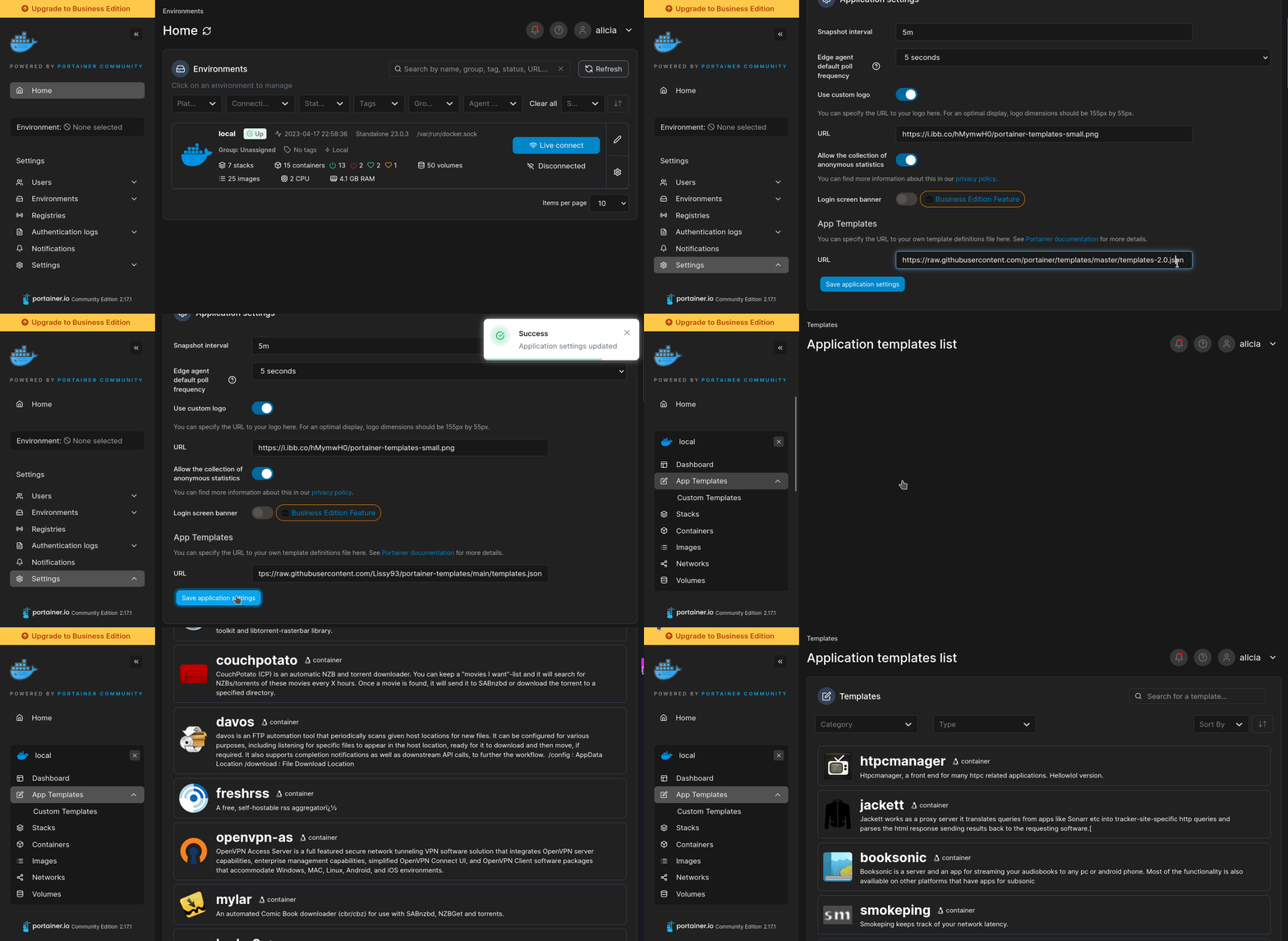
More install options in our documentation.
Quick reference
- Maintained by:
[MariaDB Foundation](https://mariadb.org), [MariaDB plc](https://mariadb.com), with contributions from our [community](https://github.com/MariaDB/mariadb-docker)- Where to get help:
[Database Adminstrators (Stack Exchange)](https://dba.stackexchange.com/questions/tagged/docker+mariadb), [MariaDB Knowledge Base](https://mariadb.com/kb/en/docker-and-mariadb/) ([Ask a Question here](https://mariadb.com/kb/en/docker-and-mariadb/ask)).Supported tags and respective Dockerfile links
Note: the description for this image is longer than the Hub length limit of 25000, so the "Supported tags" list has been trimmed to compensate. See also docker/hub-feedback#238 and docker/roadmap#475.Quick reference (cont.)
- Where to file issues:
Issues can be filed on [https://jira.mariadb.org/](https://jira.mariadb.org/) under the "MDEV" Project and "Docker" Component, or on [GitHub](https://github.com/MariaDB/mariadb-docker/issues)- Supported architectures: (more info)
[`amd64`](https://hub.docker.com/r/amd64/mariadb/), [`arm64v8`](https://hub.docker.com/r/arm64v8/mariadb/), [`ppc64le`](https://hub.docker.com/r/ppc64le/mariadb/), [`s390x`](https://hub.docker.com/r/s390x/mariadb/)- Published image artifact details:
[repo-info repo's `repos/mariadb/` directory](https://github.com/docker-library/repo-info/blob/master/repos/mariadb) ([history](https://github.com/docker-library/repo-info/commits/master/repos/mariadb))
(image metadata, transfer size, etc)- Image updates:
[official-images repo's `library/mariadb` label](https://github.com/docker-library/official-images/issues?q=label%3Alibrary%2Fmariadb)
[official-images repo's `library/mariadb` file](https://github.com/docker-library/official-images/blob/master/library/mariadb) ([history](https://github.com/docker-library/official-images/commits/master/library/mariadb))- Source of this description:
[docs repo's `mariadb/` directory](https://github.com/docker-library/docs/tree/master/mariadb) ([history](https://github.com/docker-library/docs/commits/master/mariadb))What is MariaDB?
MariaDB Server is one of the most popular database servers in the world. It's made by the original developers of MySQL and guaranteed to stay open source. Notable users include Wikipedia, DBS Bank, and ServiceNow.The intent is also to maintain high compatibility with MySQL, ensuring a library binary equivalency and exact matching with MySQL APIs and commands. MariaDB developers continue to develop new features and improve performance to better serve its users.

How to use this image
The mariadb has a number of tags, and of note islatest, as the latest stable version, and lts, as the last long term support release.Image architecture requirements:
| MariaDB version | Base | Release | amd64 / x86-64 | aarch64 / arm64 | ppc64le | s390x |
|---|---|---|---|---|---|---|
| 10.6 / 10.11 | Ubuntu LTS | 22.04 | x86-64 baseline | ARMv8-A | POWER9+ | z13+ |
| 11.4 - 12.3 | Ubuntu LTS | 24.04 | x86-64 baseline | ARMv8-A | POWER9+ | z13+ |
| 13.0+ | Ubuntu LTS | 26.04 | x86-64 baseline | ARMv8-A | POWER9+ | z15+ |
| 10.6 - 11.8 | RHEL / UBI | 9 | x86-64-v2 | ARMv8.0-A | POWER9 | z14 |
| 12.3+ | RHEL / UBI | 10 | x86-64-v3 | ARMv8.0-A | POWER10+ | z15+ |
Running the container
Configuration
Port binding
By default, the database running within the container will listen on port 3306. You can expose the container port 3306 to the host port 3306 with the-p 3306:3306 argument to docker run, like the command below:$ docker run --name some-mariadb -p 3306:3306 mariadb:latestStarting using a minimal configuration
The environment variables required to use this image involves the setting of the root user password:$ docker run --detach --name some-mariadb --env MARIADB_ROOT_PASSWORD=my-secret-pw mariadb:latestor:
$ docker run --detach --name some-mariadb --env MARIADB_ALLOW_EMPTY_ROOT_PASSWORD=1 mariadb:latestor:
$ docker run --detach --name some-mariadb --env MARIADB_RANDOM_ROOT_PASSWORD=1 mariadb:latest... where the container logs will contain the generated root password.
... via docker compose
Example compose.yaml for mariadb:# Use root/example as user/password credentials
services:
db:
image: mariadb
restart: always
environment:
MARIADB_ROOT_PASSWORD: example
adminer:
image: adminer
restart: always
ports:
- 8080:8080Run
docker compose up, wait for it to initialize completely, and visit http://localhost:8080 or http://host-ip:8080 (as appropriate).Start a mariadb server instance with user, password and database
Starting a MariaDB instance with a user, password, and a database:$ docker run --detach --name some-mariadb --env MARIADB_USER=example-user --env MARIADB_PASSWORD=my_cool_secret --env MARIADB_DATABASE=exmple-database --env MARIADB_ROOT_PASSWORD=my-secret-pw mariadb:latestStart a mariadb server instance in a network
As applications talk to MariaDB, MariaDB needs to start in the same network as the application:$ docker network create some-network
$ docker run --detach --network some-network --name some-mariadb --env MARIADB_USER=example-user --env MARIADB_PASSWORD=my_cool_secret --env MARIADB_ROOT_PASSWORD=my-secret-pw mariadb:latest
$ docker run --detach --network some-network --name some-application --env APP_DB_HOST=some-mariadb --env APP_DB_USER=example-user --env APP_DB_PASSWD=my_cool_secret some-application... where
some-network is a newly created network (other than bridge as the default network), some-mariadb is the name you want to assign to your container, my-secret-pw is the password to be set for the MariaDB root user. See the list above for relevant tags to match your needs and environment. some-application and then environment variable APP_DB_HOST, APP_DB_USER and APP_DB_PASSWD are the application's configuration for its database connection.Connect to MariaDB from the MariaDB command line client
The following command starts anothermariadb container instance and runs the mariadb command line client against your original mariadb container, allowing you to execute SQL statements against your database instance:$ docker run -it --network some-network --rm mariadb mariadb -h some-mariadb -u example-user... where
some-mariadb is the name of your original mariadb container (connected to the some-network Docker network).This image can also be used as a client for non-Docker or remote instances:
$ docker run -it --rm mariadb mariadb --host <server container IP> --user example-user --password --database testThat will give you a standard MariaDB prompt. You can test it with:
MariaDB [test]> \s
--------------
mariadb from 12.3.3-MariaDB, client 15.2 for debian-linux-gnu (x86_64) using  EditLine wrapper

Connection id:		5
Current database:	test
Current user:		[email protected]
SSL:			Cipher in use is TLS_AES_256_GCM_SHA384, cert is OK
Current pager:		stdout
Using outfile:		''
Using delimiter:	;
Server:			MariaDB
Server version:		12.3.3-MariaDB-ubu2404 mariadb.org binary distribution
Protocol version:	10
Connection:		m via TCP/IP
Server characterset:	utf8mb4
Db     characterset:	utf8mb4
Client characterset:	utf8mb4
Conn.  characterset:	utf8mb4
TCP port:		3306
Uptime:			3 min 7 sec

Threads: 1  Questions: 12  Slow queries: 0  Opens: 17  Open tables: 10  Queries per second avg: 0.064
--------------
... which will give you the version and connection information. You can then use
exit to leave the MariaDB command line client and the client container.More information about the MariaDB command-line client can be found in the MariaDB Documentation : MariaDB Command Line Client.
Container shell access
Thedocker exec command allows you to run commands inside the running container. The following command line will give you a bash shell inside your mariadb container:$ docker exec -it some-mariadb bashMariaDB-Backup
As MariaDB-Backup is highly coupled with the server version, it can be useful to use themariadb-backup in the mariadb container of an explicit version:$ docker run --volume /backup-volume:/backup --rm mariadb:10.6.15 mariadb-backup --helpContainer viewing MariaDB logs
The log is available through Docker's container log:$ docker logs some-mariadbUsing a custom MariaDB configuration file
Custom configuration files should end in.cnf and be mounted read only at the directory /etc/mysql/conf.d. These files should contain the minimal changes from the MariaDB workload required for your application/environment. A MariaDB configuration file will have a [mariadb] group followed by variable = value settings per Setting Server System Variables or option-prefix-variable.The
mariadb image configuration contains the Ubuntu MariaDB variables with two custom changes for the container:These disable the authentication of
user@hostname users. To re-enable the skip-name-resolve use disable-skip-name-resolve as variable or argument. When enabled, the host-cache-size should be sufficient for the number of containers connecting to the mariadb.To view the resulting configuration of your
mariadb container:$ docker run --name some-mariadb -v /my/custom:/etc/mysql/conf.d --rm mariadb:latest my_print_defaults --mariadbdConfiguration without a cnf file
Many configuration options can be passed as flags to mariadbd. This will give you the flexibility to customize the container without needing a cnf file. For example, if you want to run on port 3808 just run the following:$ docker run --name some-mariadb -e MARIADB_ROOT_PASSWORD=my-secret-pw -d mariadb:latest --port 3808If you would like to see a complete list of available options, just run:
$ docker run --rm mariadb:latest --verbose --helpEnvironment Variables
When you start themariadb image, you can adjust the initialization of the MariaDB instance by passing one or more environment variables on the docker run command line. Do note that all of the variables, except MARIADB_AUTO_UPGRADE, will have no effect if you start the container with a data directory that already contains a database. I.e. any pre-existing database will always be left untouched on container startup.One of
MARIADB_RANDOM_ROOT_PASSWORD, MARIADB_ROOT_PASSWORD_HASH, MARIADB_ROOT_PASSWORD or MARIADB_ALLOW_EMPTY_ROOT_PASSWORD (or equivalents, including *_FILE), is required. The other environment variables are optional.There is a large list of environment variables and the complete list is documented on MariaDB's Knowledge Base : MariaDB Server Docker Official Image Environment Variables.
MARIADB_AUTO_UPGRADE
When this environment variable is set, this will run the mariadb-upgrade, if needed, so any changes in the MariaDB system tables required to expose new features will be made. This may impeed some downgrade options. Unless the environment variable MARIADB_DISABLE_UPGRADE_BACKUP is set, there will be a backup of the system tables created as system_mysql_backup_*.sql.zst in the top level of the data directory to assist in the downgrade if needed.Secrets
As an alternative to passing sensitive information via environment variables,_FILE may be appended to the previously listed environment variables, causing the initialization script to load the values for those variables from files present in the container. In particular, this can be used to load passwords from Docker secrets stored in /run/secrets/<secret_name> files. For example:$ docker run --name some-mysql -e MARIADB_ROOT_PASSWORD_FILE=/run/secrets/mariadb-root -d mariadb:latestInitializing the database contents
When a container is started for the first time, a new database with the specified name will be created and initialized with the provided configuration variables. Furthermore, it will execute files with extensions.sh, .sql, .sql.gz, .sql.xz and .sql.zst that are found in /docker-entrypoint-initdb.d. Files will be executed in alphabetical order. .sh files without file execute permission are sourced rather than executed. You can easily populate your mariadb services by mounting a SQL dump into that directory and provide custom images with contributed data. SQL files will be imported by default to the database specified by the MARIADB_DATABASE variable.Caveats
Where to Store Data
Important note: There are several ways to store data used by applications that run in Docker containers. We encourage users of themariadb images to familiarize themselves with the options available, including:- Use a named volume using the container manager to manage the storage of your database data by writing the database files to disk on the host system using its own internal volume management. This is the default and is easy and fairly transparent to the user. The downside is that the files may be hard to locate for tools and applications that run directly on the host system, i.e. outside containers.
- Create a data directory on the host system (outside the container) and mount this to a directory visible from inside the container. This places the database files in a known location on the host system, and makes it easy for tools and applications on the host system to access the files. The downside is that the user needs to make sure that the directory exists, and that e.g. directory permissions and other security mechanisms on the host system are set up correctly.
The Docker documentation is a good starting point for understanding the different storage options and variations, and there are multiple blogs and forum postings that discuss and give advice in this area. We will simply show the basic procedure here for the latter option above:
- Create a data directory on a suitable volume on your host system, e.g.
/my/own/datadir. - Start your
mariadbcontainer like this:
```console
$ docker run --name some-mariadb -v /my/own/datadir:/var/lib/mysql:Z -e MARIADB_ROOT_PASSWORD=my-secret-pw -d mariadb:latest
```-v /my/own/datadir:/var/lib/mysql:Z part of the command mounts the /my/own/datadir directory from the underlying host system as /var/lib/mysql inside the container, where MariaDB by default will write its data files.No connections until MariaDB init completes
If there is no database initialized when the container starts, then a default database will be created. While this is the expected behavior, this means that it will not accept incoming connections until such initialization completes. This may cause issues when using automation tools, such asdocker compose, which start several containers simultaneously.Health/Liveness/Readiness Checking
See the "Official Images" FAQ for why there is no defaultHEALTHCHECK directive. However, you can use the healthcheck.sh script to choose from a (non-exhaustive) list of tests to check for whatever you consider health/liveness/readiness. Refer to the MariaDB Documentation : Using Healthcheck.sh to learn about how to use it and which exact tests are provided.Usage against an existing database
If you start yourmariadb container instance with a data directory that already contains a database (specifically, a mysql subdirectory), no environment variables that control initialization will be needed or examined, and no pre-existing databases will be changed. The only exception is the non-default MARIADB_AUTO_UPGRADE environment variable, that might cause mysql_upgrade/mariadb-upgrade to run, which might change the system tables.Backups and Restores
Backing up and restoring databases is important in containers too. The documentation on how to do this can be found on the MariaDB Documentation : Container Backup and Restoration.Frequently Asked Questions / How to reset root and user passwords
This is documented on MariaDB Documentation : Frequenty Asked Questions of Docker Official Image.How to install MariaDB plugins
This is documented on MariaDB Documentation : Adding Plugins to the Docker Official Image.Related Images
Compose File Examples
Example compose files using thismariadb are located in https://github.com/MariaDB/mariadb-docker in the /examples folder.License
View license information for the software contained in this image.As with all Docker images, these likely also contain other software which may be under other licenses (such as Bash, etc from the base distribution, along with any direct or indirect dependencies of the primary software being contained).
Some additional license information which was able to be auto-detected might be found in the
repo-info repository's mariadb/ directory.As for any pre-built image usage, it is the image user's responsibility to ensure that any use of this image complies with any relevant licenses for all software contained within.
Serve MariaDB (container) on your own domain behind Caddy, Nginx or Traefik. Fill in your domain and copy the result. It's a starting point, some apps need their own base URL or extra headers set too.
Proxying mariadb-container.example.com to http://mariadb-container:3306
Add this to your Caddyfile
mariadb-container.example.com {
	reverse_proxy http://mariadb-container:3306
}Check the logs first
Nine times out of ten the logs tell you exactly what went wrong.
- In Portainer, go to Containers, click the container, then Logs. Or run
docker logs <container> - Exit codes help too:
137means killed, usually out of memory.126or127means the command inside the image is broken.
Published on a random port
This template exposes 3306/tcp without setting a host port,
so Docker picks a random free one on every deploy.
- Find it in the Ports column of Portainer's container list, or with
docker port <container>
Image won't pull
Test the pull directly on the host: docker pull mariadb:latest
- "manifest unknown" means the tag no longer exists. This template uses
latest, so try pinning a specific version instead. - "toomanyrequests" is the Docker Hub rate limit. Log in with
docker loginto raise it. - "no space left on device" means a full disk. Reclaim space with
docker system prune
"exec format error"
This means the image was built for a different CPU architecture than your server.
- This image supports:
amd64, ppc64le, s390x, arm64/v8 - Check yours with
uname -m: x86_64 is amd64, aarch64 is arm64. Raspberry Pi and other ARM boards are the usual culprits.
Required settings are blank
MYSQL_ROOT_PASSWORD has no default value, and the app may crash or misbehave if left empty.
- Fill it in on the deploy screen before hitting deploy.
Raise an issue
Found something which isn't working as it should? Here's how to report it.
- Bug within the app: Open an issue within the app's repo
- Template not working: Open an issue on portainer/templates
- This website not working: Open an issue on lissy93/portainer-templates
A single container
MariaDB (container) runs as one container, the simplest kind of app here. Just the one image to pull and nothing else wired up alongside it.
The app image
An image is the app packed up ready to go, everything MariaDB (container) needs bundled into one download. This template pulls mariadb:latest, which Docker fetches once (about 158 MB) and then starts your own copy from.
Where the image comes from
Docker pulls its images from registries, public libraries of ready-built apps. MariaDB (container)'s comes from Docker Hub as one of its official, curated images.
Version tags
The bit after the colon in the image name is the version tag. Here it's latest, which always points at the newest build, so a redeploy can bump you to a newer release without you asking. Newest right now is 13.0.2-ubi10. Pin a specific tag if you would rather stay on one version.
Which machines it runs on
Every image is built for particular CPU types. This one ships for amd64, ppc64le, s390x, arm64/v8, so it runs on both regular x86 servers and ARM boards like a Raspberry Pi.
Ports
A port is the door the app answers on. Here the app exposes a port but leaves the host side blank, so Docker picks a free one for you. It opens:
3306, published on a random host port
Volumes
A volume is where MariaDB (container) keeps its files so they survive an update or a restart. Without one, anything it saves would sit inside the container and vanish the moment it's recreated. This template mounts:
/var/lib/mysqlas a volume Docker manages for you
Environment variables
Environment variables are the settings you hand over when you deploy, things like a password or a timezone. MariaDB (container) takes 1 of them, and one needs a value before it'll start properly:
MYSQL_ROOT_PASSWORD, needs a value. Root password
Networking
Nothing custom is set, so MariaDB (container) sits on Docker's default bridge network: its own private space that reaches the outside world only through the ports it publishes.
Platform
The platform is linux, the kind of system the container is built to run on. Docker and Portainer handle this on a normal Linux server.
Portainer app templates
Zooming out, this whole page comes from a Portainer app template: a short recipe telling Portainer how to set MariaDB (container) up. Add the template list to Portainer once, then deploying MariaDB (container) is a click rather than a wall of config.