
![FluxDown]() FluxDown
FluxDown
Container
Multi-protocol download manager with a web UI. Handles HTTP/HTTPS, FTP, BitTorrent (DHT/magnet), eD2K/Kad, HLS and DASH, with dynamic file segmentation, token-bucket rate limiting and SQLite-backed resume. Exposes an aria2-compatible JSON-RPC API. GitHub: zerx-lab/FluxDown
Image details
Source details
Configuration
TypeContainerlinuxghcr.io/zerx-lab/fluxdown-server:0.2.317800:17800/tcp/data/root/DownloadsTZ=UTCunless-stoppedNotes
docker logs <container> 2>&1 | grep -i token. The management API and the built-in MCP endpoint both require this token. Web UI is served on port 17800.Standalone Install
Select an install method, to see config/commands for deploying FluxDown
Install on Portainer
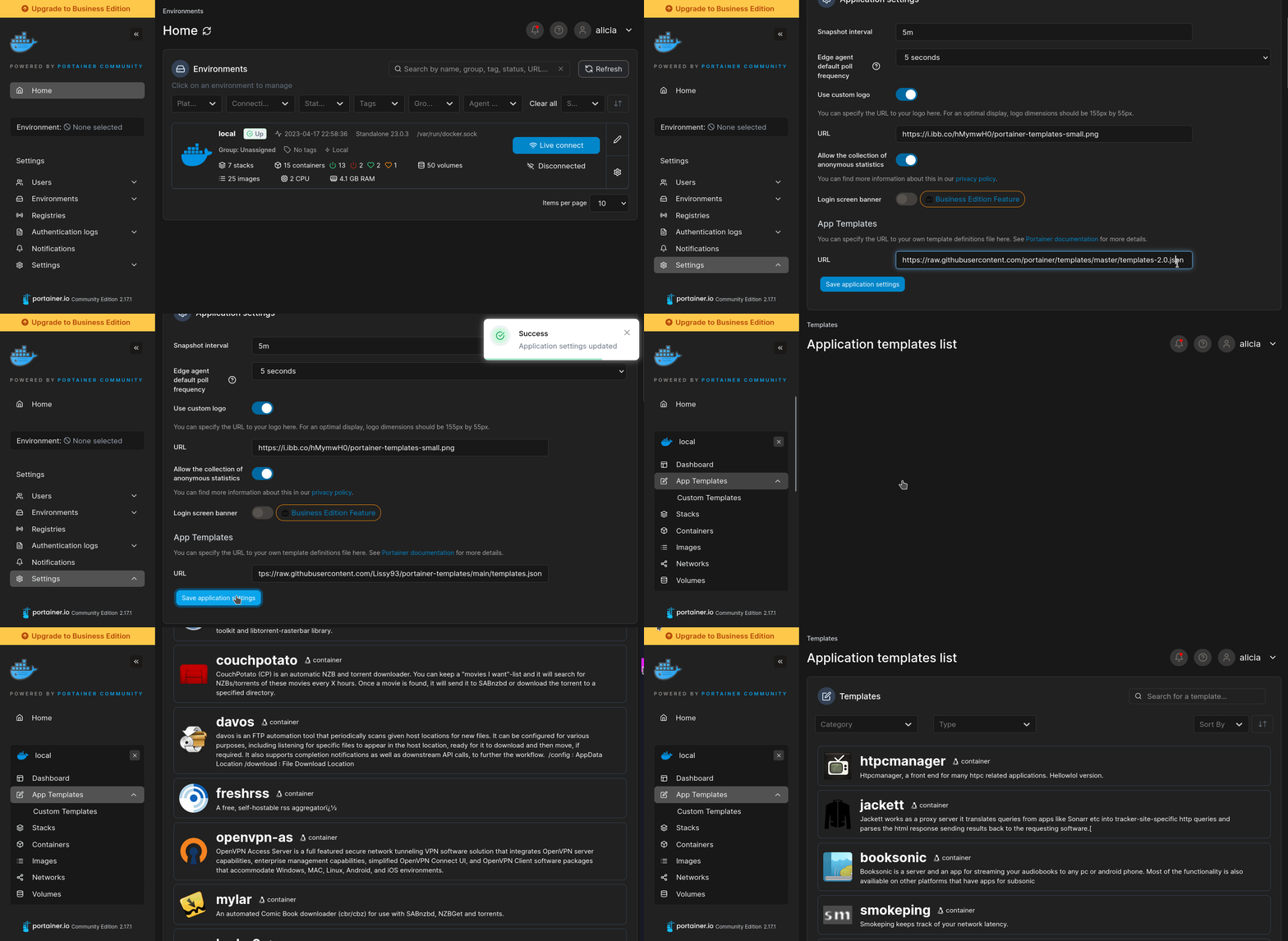
Import all app templates into your Portainer instance, for easy 1-click deploys
- Ensure both Docker and Portainer are installed, and up-to-date
- Log into your Portainer web UI
- Under Settings → App Templates, paste the below URL
- Head to Home → App Templates, and the list of apps will show up
- Select FluxDown, fill in any config options, and hit Deploy
Template Import URL
https://raw.githubusercontent.com/Lissy93/portainer-templates/main/templates.json
Show Me
More install options in our documentation, or see zerx-lab/FluxDown for app-specific guidance.

FluxDown
Downloads, Supercharged.
A blazing fast, multi-protocol download manager — the free & open-source IDM alternative.















Website · Download · Changelog · FAQ · Feedback
English | 简体中文
Highlights
- Dynamic download acceleration — Rust + Tokio engine with adaptive segmentation and slow-segment rescue
- Multi-protocol — HTTP/HTTPS, FTP, BitTorrent, eD2K, HLS & DASH streaming
- One engine, multiple clients — native GPUI desktop, Kotlin Android and SwiftUI iOS apps, React Web UI and CLI
- Browser integration — Chrome / Edge / Firefox extension with a 3-layer interception engine, plus a userscript
- AI-agent ready — built-in MCP (Model Context Protocol) server: let Claude, Cursor & other AI clients manage your downloads
- Automation & remote management — RSS subscriptions, scheduled queues, webhooks, plugins and optional FluxCloud device collaboration
- Local-first — free and open source, no ads, no account required for local downloads; resumable state stored locally by default
Features
| Feature | Description |
|---|---|
| Rust-Powered Engine | Shared Rust + Tokio engine, independent of UI and FFI, used by desktop, mobile, server and standalone CLI hosts |
| Smart Segmentation | Segments split dynamically at runtime; idle workers take over slow segments |
| Multi-Protocol | Dedicated engines for HTTP/HTTPS, FTP, BitTorrent (DHT/UPnP/magnet), eD2K (server + Kad DHT source finding, MD4 verification), HLS (AES-decrypt) and DASH |
| Queues & Speed Control | Named queues, scheduling and token-bucket global rate limiting |
| Persistence & Resume | SQLite with WAL by default; server deployments can use PostgreSQL; recover downloads from persisted state |
| Browser Integration | Download interception, streaming media sniffing, Alt+Click bypass, right-click send and connection diagnostics |
| Desktop & Web UI | GPUI desktop and React Web management, light/dark themes, custom themes, task details and segment visualization; desktop tray keeps the service available after the UI closes |
| RSS & Automation | Feed filters, unattended downloads, JavaScript plugins, managed FFmpeg/yt-dlp components and task-event webhooks |
| Remote Devices | Optional FluxCloud account, settings sync and remote task management, plus LAN device pairing and direct connections |
| APIs & CLI | REST/OpenAPI, aria2-compatible JSON-RPC, MCP with 12 tools, and a CLI for scripts or standalone downloads |
Privacy: local downloads do not require a FluxCloud account. Cloud features are optional. Anonymous installation and daily-active statistics are controlled by
analytics_enabled and can be disabled; they do not collect download/task information. This is not a zero-telemetry application.FluxDown vs. IDM
| FluxDown | IDM | |
|---|---|---|
| Price | Free & open source | $24.95 + renewals |
| Open source | Yes (AGPL-3.0) | No |
| Platforms | Windows / macOS / Linux / NAS / Android | Windows only |
| BitTorrent & magnet | Yes | No |
| eD2K / eMule links | Yes | No |
| HLS / DASH streaming | Yes | Partial |
| Dynamic segmentation | Yes | Yes |
| Browser extension | Chrome / Edge / Firefox | Yes |
| Ads | None | — |
Installation
Grab the latest build from GitHub Releases or fluxdown.com:| Platform | Packages |
|---|---|
| Windows (x64 / ARM64) | setup.exe installer · portable .zip |
| macOS (Intel / Apple Silicon) | .dmg · portable .tar.gz |
| Linux (x64) | .AppImage · .deb · Arch .pkg.tar.zst · portable .tar.gz |
| Android (arm64-v8a / armeabi-v7a / x8664) | per-ABI .apk · universal .apk |
| NAS / Server (headless, x64 / ARM64) | Docker · Synology DSM 6/7 .spk · QNAP .qpkg · OpenWrt .apk (25.12+) / .ipk · Unraid CA template · CasaOS / ZimaOS app store |
Browser Extension
Install the extension so FluxDown takes over browser downloads automatically:


The extension connects to the desktop agent through Native Messaging. A Tampermonkey userscript is also available.
NAS / Server
The current headless service isfluxdown-agent --server + fluxdownd, with an embedded Web UI. The Docker image retains the name ghcr.io/zerx-lab/fluxdown-server.From a checkout, use the supplied Compose configuration:
docker compose -f docker/docker-compose.yml up -dOpen
http://<server>:17800/ and set an access key in the first-run wizard. The key must contain 8–128 visible ASCII characters, including both a letter and a digit. Set it up on a trusted network before exposing the service; use an HTTPS reverse proxy for remote access.- Server mode listens on
0.0.0.0:17800by default; override it withFLUXDOWN_BIND. - For unattended setup, supply
FLUXDOWN_TOKENthrough your deployment environment or secret manager, not a committed file. It initializes the key only if one has not already been set. - Persist
/datafor the database, logs and access key, and/root/Downloadsfor downloads. The supplied Compose file uses a named data volume anddocker/downloads/on the host. - Prefer SSD/cache storage for
/dataif download disks need to sleep. - Native deployments must keep
fluxdown-agentandfluxdowndin the same directory.
CLI & HTTP APIs
Thefluxdown CLI connects to the running desktop or server HTTP API by default. On desktop, enable the management API in Settings → API Service first. Supply the access key via FLUXDOWN_TOKEN; use FLUXDOWN_URL or --url to select a remote server.fluxdown ping
fluxdown add "https://example.com/file.zip"
fluxdown --json list
# Standalone mode: embed the engine instead of connecting to a service
fluxdown add --local "https://example.com/file.zip"Standalone mode cannot share a data directory with a running engine: stop the service using that directory first.
| Interface | Endpoint | Purpose |
|---|---|---|
| REST management API | /api/v1/ | Tasks, queues, RSS and other management operations |
| OpenAPI | /api/v1/openapi.json | Machine-readable API schema |
| aria2-compatible JSON-RPC | /jsonrpc (HTTP / WebSocket) | Integration with aria2-compatible clients |
| MCP | /mcp | AI-agent tools |
| Official UI protocol | /rpc (WebSocket) | GPUI/Web gateway; distinct from the aria2 API |
Desktop defaults to
127.0.0.1:17800, with management API and MCP disabled until enabled. Server mode enables both by default and requires an access key. See the OpenAPI specification for the REST contract.MCP Server (Model Context Protocol)
FluxDown ships a built-in MCP server so AI agents (Claude Desktop, Cursor, Cline, …) can manage downloads via the Model Context Protocol. It implements a stateless Streamable HTTP subset (JSON-RPC 2.0 overPOST /mcp) on the same API port — no separate MCP process needed.- Endpoint:
http://127.0.0.1:17800/mcpfor the default desktop configuration; use your server address for headless deployments - Auth: Bearer token (
Authorization: Bearer <token>orX-FluxDown-Token), shared with the management API - Enable: Settings → API Service → toggle MCP endpoint (a token is generated automatically); the headless server enables it by default
Tools (12)
| Tool | Description |
|---|---|
downloadadd | Create a download task (HTTP/HTTPS, FTP, magnet, BitTorrent) |
downloadlist | List tasks with progress/speed/status, optional status filter |
downloadget | Get a single task by ID |
downloadpause / downloadresume | Pause / resume one task |
downloadpauseall / downloadresumeall | Pause / resume all tasks |
downloadremove | Remove a task, optionally deleting downloaded files |
queuelist | List named queues and their configuration |
rsslist | List RSS subscriptions with their configuration and runtime state |
rssadd | Subscribe to an RSS feed and start polling it on a schedule |
rssremove | Delete an RSS subscription and the items it collected |
Client configuration
{
  "mcpServers": {
    "fluxdown": {
      "url": "http://127.0.0.1:17800/mcp",
      "headers": { "Authorization": "Bearer <your-token>" }
    }
  }
}
The MCP layer is implemented in
native/api/src/mcp.rs on top of the same ApiHost trait that powers the REST management API and aria2-compatible JSON-RPC.Architecture
One Rust download engine, multiple hosts and clients. Desktop usesfluxdown-desktop → fluxdown-agent → fluxdownd; headless deployments reuse the agent and daemon with a React Web UI. Native Android and iOS clients connect through UniFFI (native/mobile), using an embedded agent and daemon for local downloads or /rpc for remote hosts.flowchart TD
UI["GPUI desktop"] -->|"WebSocket /rpc"| AGENT["fluxdown-agent — UI gateway and desktop shell"]
WEB["React Web UI"] -->|"WebSocket /rpc"| AGENT
EXT["Browser Extension (WXT)"] -->|Native Messaging| NMH["fluxdown_nmh"]
NMH --> AGENT
CLI["fluxdown CLI"] -->|"HTTP API"| AGENT
AGENT -->|"Authenticated JSON-RPC"| DAEMON["fluxdownd — download core"]
DAEMON --> ENGINE["fluxdown_engine"]
MOBILE["Native Android / iOS"] -->|"UniFFI"| CORE["fluxdown_mobile"]
CORE -->|"embedded or remote"| AGENT
LOCAL["fluxdown add --local"] --> ENGINE
ENGINE --> PROTOCOLS["HTTP/HTTPS, FTP, BitTorrent, eD2K, HLS, DASH"]
ENGINE --> DB[("SQLite / PostgreSQL")]- Daemon owns downloads: engine, download database, queues, RSS, plugins and webhooks.
- Agent owns integration: UI gateway, FluxCloud account/sync, device collaboration, browser capture and desktop tray/lifecycle.
- Shared contracts:
native/protocoldefines transport-independent DTOs, methods and events;native/apiexposes REST, aria2 and MCP throughApiHost, without depending on the engine. - Engine independence:
EventSinkandHostSelectionconnect the engine to hosts. Only one engine may write to a data directory at a time; the diagram shows alternative hosts, not concurrent writers.
| Layer | Tech | Path |
|---|---|---|
| Desktop UI | Rust + GPUI; app composition and capability crates | crates/, crates/app/ |
| Agent / daemon | UI gateway and headless host / download core | native/agent/, native/daemon/ |
| Shared protocol / HTTP API | JSON-RPC DTOs / REST, aria2, MCP adapters | native/protocol/, native/api/ |
| Download engine | Rust + Tokio, no UI or FFI dependencies | native/engine/ |
| Mobile UI / bridge | Kotlin + Jetpack Compose / SwiftUI + UniFFI | mobile/Android/, mobile/FluxDown/, native/mobile/ |
| Web management UI | React + TypeScript + Vite | web/ |
| CLI | HTTP client or embedded engine | native/cli/ |
| Browser integration | WXT + TypeScript, Native Messaging, userscript | fluxDown/, native/nmh/, userscript/ |
| Website | Astro + React | website-v2/ |
Building from Source
Start with the Rust toolchain and your platform's native build tools (MSVC on Windows, Xcode command-line tools on macOS). Linux desktop builds also need graphics, audio and tray development libraries; the maintained Ubuntu package list is in CI. Bun is needed for the Web UI. Android uses Android Studio's JBR, Android SDK/NDK andcargo-ndk; iOS uses Xcode.# Clone the development branch (main = active development, stable = stable releases)
git clone -b main https://github.com/zerx-lab/FluxDown.git
cd FluxDownDesktop (GPUI)
# Build desktop UI, agent, daemon and browser relay, then launch
cargo desktop-dev

# Build only (also stages a signed development .app on macOS)
cargo desktop-dev --build-only
The launcher reuses an existing desktop/service instance rather than forcibly restarting it. Quit the UI and stop its services before testing changes to running code.
Headless server & Web UI
# Build the Web UI BEFORE building the agent
cd web
bun install --frozen-lockfile
bun run build
cd ..

cargo build -p fluxdown_daemon
cargo run -p fluxdown_agent --features web-ui -- --server
The
web-ui feature embeds web/dist into the agent binary at compile time. After changing the frontend, rebuild the Web UI and then the agent. FLUXDOWN_WEBROOT optionally serves a directory from disk instead.For frontend development, run
cd web && bun run dev in a second terminal while the server is running: Vite listens on port 5173 and proxies backend requests to port 17800.CLI
cargo build -p fluxdown_cli
cargo run -p fluxdown_cli -- ping
Native mobile
Android lives inmobile/Android; iOS lives in mobile/FluxDown. Both use the shared Rust core in native/mobile and shared translations in assets/i18n.# Android: use Android Studio's JBR as JAVA_HOME
(cd mobile/Android && ./gradlew :core:testDebugUnitTest :bridge:testDebugUnitTest :app:assembleDebug)
# iOS: from repository root
mobile/FluxDown/scripts/build-core.sh
(cd mobile/FluxDown && xcodebuild build -project FluxDown.xcodeproj -scheme FluxDown -destination 'generic/platform=iOS Simulator')Official Android releases use the native project's
ANDROID_NATIVE_* signing credentials. They cannot be installed over the old Flutter APK; back up needed data before uninstalling the old app. The retired Flutter SDK, Rinf and hub are no longer build prerequisites. Shared assets, legacy desktop data/theme upgrade compatibility and the website's legacy theme editor remain supported.Running tests
cargo test -p fluxdown_engine        # Engine tests
cargo test -p fluxdown_api           # HTTP / aria2 / MCP contracts
cargo test -p fluxdown_agent         # Gateway / server
cargo test -p fluxdown_cli           # CLI
cd web && bun test && cd ..          # Web UI
cargo test -p fluxdown_mobile        # Shared native mobile core
Contributing & Community
- Bug reports / feature requests — GitHub Issues or the website feedback page
- QQ Group — 832143651
Pull requests are welcome! Branch off
main and target main — it is the development branch, while stable only tracks stable releases (maintainers advance it from main). Before submitting, please make sure:cargo fmt --check
cargo clippy --workspace --all-targets -- -D warningsSee CONTRIBUTING.md for the full workflow.
License
Distributed under the GNU Affero General Public License v3.0.If FluxDown saves you time, consider giving it a Star — it helps more people discover the project.
Made by zerx-lab
Serve FluxDown on your own domain behind Caddy, Nginx or Traefik. Fill in your domain and copy the result. It's a starting point, some apps need their own base URL or extra headers set too.
Proxying fluxdown.example.com to http://fluxdown:17800
Add this to your Caddyfile
fluxdown.example.com {
	reverse_proxy http://fluxdown:17800
}Check the logs first
Nine times out of ten the logs tell you exactly what went wrong.
- In Portainer, go to Containers, click the container, then Logs. Or run
docker logs fluxdown - Exit codes help too:
137means killed, usually out of memory.126or127means the command inside the image is broken.
Port already in use
If deployment fails with "Bind for 0.0.0.0:17800 failed: port is already allocated", something else on your server is using that port.
- Find what's using it:
sudo ss -tlnp | grep :17800 - Stop the other service, or pick a different host port. In
17800:17800only the left number is yours to change, the right one belongs to the app.
Running but the page won't load
The container is up but nothing appears in your browser.
- Use your server's real IP:
http://your-server-ip:17800. The 0.0.0.0 link Portainer shows isn't a real address. - Give it a minute after first deploy, fluxdown can take a while to initialise.
- Make sure your firewall allows the port, e.g.
sudo ufw allow 17800
Image won't pull
Test the pull directly on the host: docker pull ghcr.io/zerx-lab/fluxdown-server:0.2.3
- "manifest unknown" means the tag no longer exists.
- "toomanyrequests" is the Docker Hub rate limit. Log in with
docker loginto raise it. - "no space left on device" means a full disk. Reclaim space with
docker system prune
"exec format error"
This means the image was built for a different CPU architecture than your server.
- This image supports:
amd64, arm64 - Check yours with
uname -m: x86_64 is amd64, aarch64 is arm64. Raspberry Pi and other ARM boards are the usual culprits.
Container keeps restarting
The unless-stopped restart policy relaunches the app after every crash, so the real error can scroll past.
- Check the logs right after a restart, the last few lines before it died are the useful ones.
- Get the exit code with
docker inspect fluxdown --format '{{.State.ExitCode}}' - Still stuck? Redeploy once with the restart policy set to
noso the failure stays visible.
Raise an issue
Found something which isn't working as it should? Here's how to report it.
- Bug within the app: Open an issue on zerx-lab/FluxDown
- Template not working: Open an issue within the template's repo
- This website not working: Open an issue on lissy93/portainer-templates
A single container
FluxDown runs as one container, the simplest kind of app here. Just the one image to pull and nothing else wired up alongside it.
The app image
An image is the app packed up ready to go, everything FluxDown needs bundled into one download. This template pulls ghcr.io/zerx-lab/fluxdown-server:0.2.3, which Docker fetches once (about 43 MB) and then starts your own copy from.
Where the image comes from
Docker pulls its images from registries, public libraries of ready-built apps. FluxDown's comes from the GitHub Container Registry, published by zerx-lab.
Version tags
The bit after the colon in the image name is the version tag. This one pins 0.2.3, so every redeploy gives you that exact build until you bump it yourself.
Which machines it runs on
Every image is built for particular CPU types. This one ships for amd64, arm64, so it runs on both regular x86 servers and ARM boards like a Raspberry Pi.
Ports
A port is the door the app answers on. A mapping like 17800:17800 means it's reachable on port 17800 of your server, where the left number is yours to change and the right one belongs to the app. It opens:
17800:17800
Volumes
A volume is where FluxDown keeps its files so they survive an update or a restart. Without one, anything it saves would sit inside the container and vanish the moment it's recreated. This template mounts:
/dataas a volume Docker manages for you/root/Downloadsas a volume Docker manages for you
Environment variables
Environment variables are the settings you hand over when you deploy, things like a password or a timezone. FluxDown takes 1 of them, all with defaults you can leave alone or tweak:
TZ, defaults toUTC. Timezone
Restart policy
The restart policy here is unless-stopped, so Docker restarts FluxDown after a crash or reboot, but leaves it off when you stop it on purpose. You can change this on the deploy screen. The choices are no (never restart), on-failure (only after a crash), unless-stopped (restart unless you stop it), and always (bring it back no matter what).
Networking
Nothing custom is set, so FluxDown sits on Docker's default bridge network: its own private space that reaches the outside world only through the ports it publishes.
Container name
Once it's deployed, Portainer names the container fluxdown. That's what you'll spot in the containers list and use in commands like docker logs fluxdown.
Platform
The platform is linux, the kind of system the container is built to run on. Docker and Portainer handle this on a normal Linux server.
Open source license
FluxDown is open source, released under the AGPL-3.0 license. In plain terms the code is out in the open, so you're free to run it and change it to fit what you need.
Portainer app templates
Zooming out, this whole page comes from a Portainer app template: a short recipe telling Portainer how to set FluxDown up. Add the template list to Portainer once, then deploying FluxDown is a click rather than a wall of config.