
Baserow (stack)
Open source no-code database and Airtable alternative.Create your own online database without technical experience. Our user friendly no-code tool gives you the powers of a developer without leaving your browser.
Image details
Source details
Configuration
TypeComposelinuxbaserow/baserow:latest280:802443:443/baserow/data : /portainer/Files/AppData/Config/baserowTZ=Europe/Athensunless-stoppedStandalone Install
Select an install method, to see config/commands for deploying Baserow (stack)
Install on Portainer
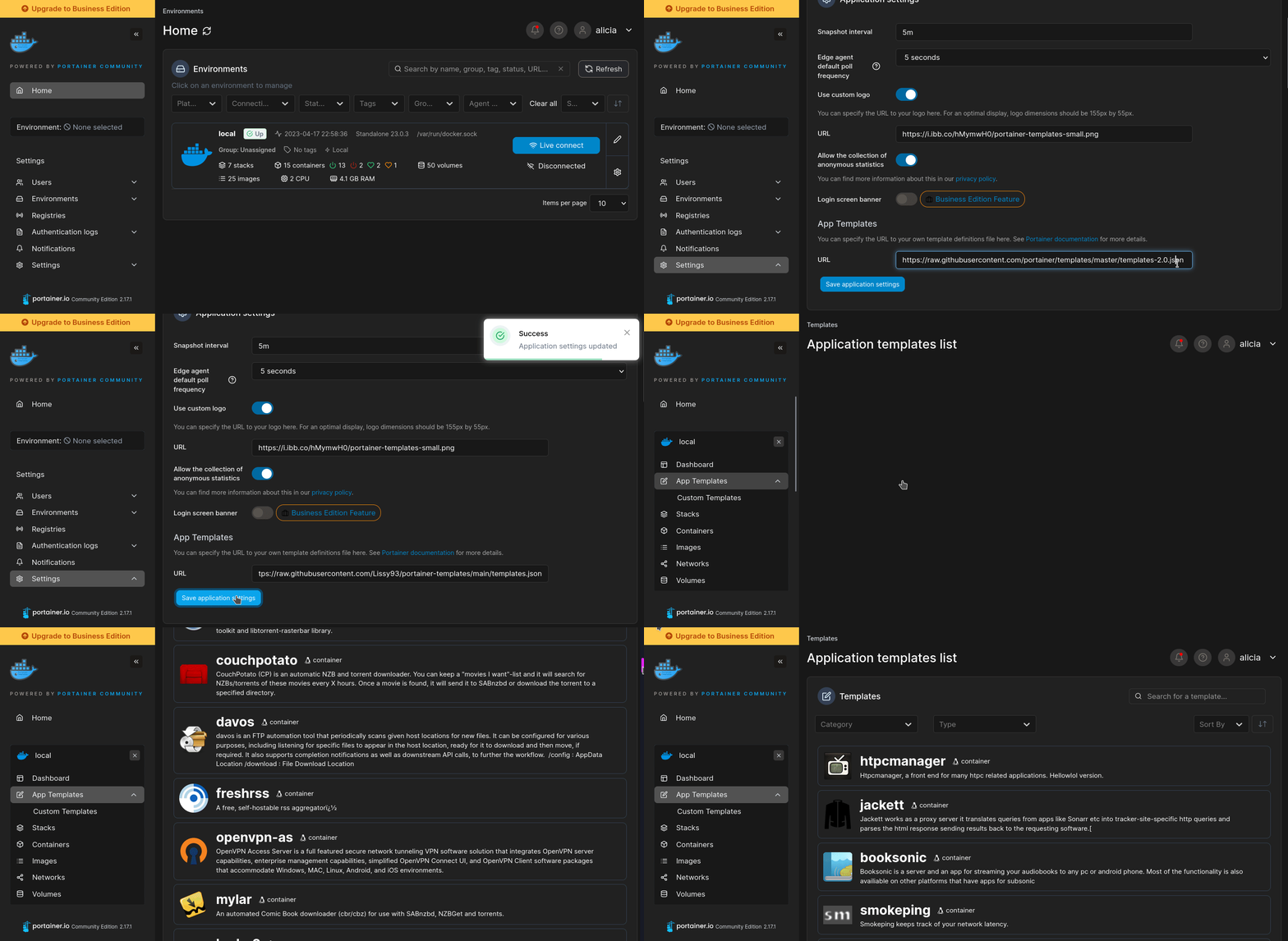
Import all app templates into your Portainer instance, for easy 1-click deploys
- Ensure both Docker and Portainer are installed, and up-to-date
- Log into your Portainer web UI
- Under Settings → App Templates, paste the below URL
- Head to Home → App Templates, and the list of apps will show up
- Select Baserow (stack), fill in any config options, and hit Deploy
Template Import URL
https://raw.githubusercontent.com/Lissy93/portainer-templates/main/templates.json
Show Me
Original stackfile
The compose file this template deploys, straight from its repo:
services:
  baserow:
    image: baserow/baserow:latest
    container_name: baserow
    environment:
      - TZ=Europe/Athens
    volumes:
      - /portainer/Files/AppData/Config/baserow:/baserow/data
    ports:
      - 280:80  #changed from default 80
      - 2443:443
    restart: unless-stopped
Or deploy it directly from the source:
git clone https://github.com/xneo1/portainer_templates
cd portainer_templates
docker compose -f Template/Stack/baserow.yml up -d
More install options in our documentation, or see baserow/baserow for app-specific guidance.
Baserow is an open source no-code database tool and Airtable alternative.
Create your own online database without technical experience. Our user-friendly no-code tool gives you the powers of a developer without leaving your browser.- A spreadsheet database hybrid combining ease of use and powerful data organization.
- Easily self-hosted with no storage restrictions or sign-up on https://baserow.io to
- Alternative to Airtable.
- Open-core with all non-premium and non-enterprise features under
- Headless and API first.
- Uses popular frameworks and tools like Django,
docker run -v baserow_data:/baserow/data -p 80:80 -p 443:443 baserow/baserow:2.4.0Quick Reference
- Maintained By: baserow.io
- Get Support At: The Baserow Community Forums
- Source Code Available At: github.com/baserow/baserow
- Docs At: baserow.io/docs
- License: Open-Core with all non-premium and non-enterprise code under the MIT
Supported tags and Dockerfile Links
Tagged by Baserow version. This is a bleeding edge image from our development branch, use at your own risk.Quick Start
Run the command below to start a Baserow server running locally listening on port80.
You will only be able to connect to Baserow from the machine running the server via
http://localhost.docker run \
-d \
--name baserow \
-e BASEROW_PUBLIC_URL=http://localhost \
-v baserow_data:/baserow/data \
-p 80:80 \
-p 443:443 \
--restart unless-stopped \
baserow/baserow:2.4.0- Change
BASEROW_PUBLIC_URLtohttps://YOUR_DOMAINorhttp://YOUR_IPto enable
- Add
-e BASEROW_CADDY_ADDRESSES=:443to enable
- Optionally add
-e DATABASE_URL=postgresql://user:pwd@host:port/dbto use an external
- Optionally add
-e REDIS_URL=redis://user:pwd@host:portto use an external Redis.
There is a security flaw with docker and the ufw firewall.
By default docker when exposing ports on 0.0.0.0 will bypass any ufw firewall rules
and expose the above container publicly from your machine on its network. If this
is not intended then run with the following ports instead:
-p 127.0.0.1:80:80 -p 127.0.0.1:443:443 which makes your Baserow only accessible
from the machine it is running on.
Please see https://github.com/chaifeng/ufw-docker for more information and how to
setup ufw to work securely with docker.Image Feature Overview
Thebaserow/baserow:2.4.0 image by default runs all of Baserow's various services in
a single container for maximum ease of use.This image is designed for simple single server deployments or simple container deployment services such as Google Cloud Run.
If you are instead looking for images which are better suited for horizontal scaling (e.g. when using K8S) then please instead use our baserow/backend and baserow/web-frontend images instead which deploy each Baserow service in its own container independently.
A quick summary of its features are:
- Runs a Postgres database and Redis server by default internally and stores all data in
/baserow/data folder inside the container.- Set
DATABASE_URLor theDATABASE_...variables to disable the internal postgres
- Set
REDIS_URLor theREDIS_...variables to disable the internal redis and instead
- Runs all services behind a pre-configured Caddy reverse proxy. Set
BASEROW_CADDY_ADDRESSES to https://YOUR_DOMAIN.com and it will
automatically enable https
for
you and store the keys and certs in /baserow/data/caddy.- Provides a CLI for execing admin commands against a running Baserow container or
Upgrading from a previous version
- It is recommended that you backup your data before upgrading, see the Backup sections
below for more details on how to do this.- Stop your existing Baserow container:
docker stop baserow- Bump the image version in the
docker runcommand you usually use to run your
Baserow and start up a brand-new container:# We haven't yet deleted the old Baserow container so you need to start this new one
# with a different name to prevent an error like:
# `response from daemon: Conflict. The container name "/baserow" is already in use by
# container`
docker run \
-d \
--name baserow_version_REPLACE_WITH_NEW_VERSION \
# YOUR STANDARD ARGS HERE
baserow/baserow:REPLACE_WITH_LATEST_VERSION- Baserow will automatically upgrade itself on startup, follow the logs to monitor it:
docker logs -f baserow_version_REPLACE_WITH_NEW_VERSION- Once you see the following log line your Baserow upgraded and is now available again:
[BASEROW-WATCHER][2022-05-10 08:44:46] Baserow is now available at ...- Make sure your Baserow has been successfully upgraded by visiting it and checking
everything is working as expected and your data is still present.- If everything works you can now remove the old Baserow container.
WARNING: If you have not been using a volume to persist the /baserow/data folder
inside the container this will delete all of your Baserow data stored in this
container permanently.docker rm baserowUpgrading PostgreSQL database from a previous version
On November 2023 PostgreSQL released a final update for version 11 of the database together with an end-of-life notice for this version. This means, that PostgreSQL 11 will no longer receive security and bug fixes.If you are using an embedded PostgreSQL database (an embedded one is when you do not provide
POSTGRESQL_* environment variables when launching Baserow, as opposed to an external one, where you provide connection details to your external PostgreSQL instance), and if you restart or try to run a new Baserow instance, if your data was initialized with PostgreSQL version 11, you'll notice that it doesn't start up anymore and raises an error because you need to upgrade your data directory to be compatible with PostgreSQL version 15. Baserow provides an image to automatically upgrade your data directory to PostgreSQL version 15, which is now the version officially supported by Baserow.If you don't want to upgrade at this point in time, jump to Legacy PostgreSQL version section below. Although, be aware, that we will only support PostgreSQL 11 for a limited amount of time and that this version won't receive official updates from PostgreSQL anymore.
Upgrade process
To upgrade your data directory to be compatible with PostgreSQL 15, follow these steps:CAUTION: before doing this, make sure to Back up your Baserow instance to avoid potential data loss.
- Make sure there are no Baserow instances running with
docker ps. If Baserow is running, stop the container withdocker stop baserow. - Run this command to run a Docker image which will automatically update your data directory to be compatible with PostgreSQL version 15:
docker run \
  --name baserow-pgautoupgrade \
  # ALL THE ARGUMENTS YOU NORMALLY ADD TO YOUR BASEROW INSTANCE
  --restart no \
baserow/baserow-pgautoupgrade:1.30.1- If the upgrade was successful, the container should exit with a success message, you can now start Baserow as you did before.
- If the upgrade wasn't successful, the upgrade image should output verbose logs of where exactly it failed. In that case, copy all of the log output and refer to Baserow community or contact us for further assistance.
Legacy PostgreSQL version
Starting from January 1, 2025, we will no longer create new images with PostgreSQL 11. If you are using the embedded PostgreSQL version in a Baserow version before 1.30 and want to upgrade to the latest version, you must first use the latestpgautoupgrade image to upgrade PostgreSQL to version 15, and then upgrade to the latest version of Baserow. If you do not wish to upgrade PostgreSQL, version 1.30.1 is the last image we provide with PostgreSQL 11, but it will not receive any updates.To run the latest Baserow image that uses the legacy PostgreSQL 11 version, use the following command:
docker run \
  --name baserow-pg11 \
  # ALL THE ARGUMENTS YOU NORMALLY ADD TO YOUR BASEROW INSTANCE
  --restart unless-stopped \
  baserow/baserow-pg11:1.30.1
Example Commands
See Configuring Baserow for more detailed information on all the other environment variables you can configure.Using a Domain with automatic https
If you have a domain name and have correctly configured DNS then you can run the following command to make Baserow available at the domain with automatic https provided by Caddy.Append ,http://localhost to BASEROWCADDYADDRESSES if you still want to be able to
access your server from the machine it is running on using http://localhost. See
Caddy's Address Docs
for all supported values for BASEROWCADDYADDRESSES.docker run \
-d \
--name baserow \
-e BASEROW_PUBLIC_URL=https://www.REPLACE_WITH_YOUR_DOMAIN.com \
-e BASEROW_CADDY_ADDRESSES=:443 \
-v baserow_data:/baserow/data \
-p 80:80 \
-p 443:443 \
--restart unless-stopped \
baserow/baserow:2.4.0Behind a reverse proxy already handling ssl
docker run \
  -d \
  --name baserow \
  -e BASEROW_PUBLIC_URL=https://www.yourdomain.com \
  -v baserow_data:/baserow/data \
  -p 80:80 \
  --restart unless-stopped \
  baserow/baserow:2.4.0
On a nonstandard HTTP port
docker run \
  -d \
  --name baserow \
  -e BASEROW_PUBLIC_URL=https://www.yourdomain.com:3001 \
  -v baserow_data:/baserow/data \
  -p 3001:80 \
  --restart unless-stopped \
  baserow/baserow:2.4.0
With an external PostgresSQL server
docker run \
  -d \
  --name baserow \
  -e BASEROW_PUBLIC_URL=https://www.yourdomain.com \
  -e DATABASE_HOST=TODO \
  -e DATABASE_NAME=TODO \
  -e DATABASE_USER=TODO \
  -e DATABASE_PASSWORD=TODO \
  -e DATABASE_PORT=TODO \
  -v baserow_data:/baserow/data \
  -p 80:80 \
  -p 443:443 \
  --restart unless-stopped \
  baserow/baserow:2.4.0
With an external Redis server
docker run \
  -d \
  --name baserow \
  -e BASEROW_PUBLIC_URL=https://www.yourdomain.com \
  -e REDIS_HOST=TODO \
  -e REDIS_USER=TODO \
  -e REDIS_PASSWORD=TODO \
  -e REDIS_PORT=TODO \
  -e REDIS_PROTOCOL=TODO \
  -e REDIS_SSL_CERT_REQS=TODO \
  -e REDIS_SSL_CA_CERTS=TODO \
  -v baserow_data:/baserow/data \
  -p 80:80 \
  -p 443:443 \
  --restart unless-stopped \
  baserow/baserow:2.4.0
With an external email server
docker run \
  -d \
  --name baserow \
  -e BASEROW_PUBLIC_URL=https://www.yourdomain.com \
  -e EMAIL_SMTP=True \
  -e EMAIL_SMTP_HOST=TODO \
  -e EMAIL_SMTP_PORT=TODO \
  -e EMAIL_SMTP_USER=TODO \
  -e EMAIL_SMTP_PASSWORD=TODO \
  -e EMAIL_SMTP_USE_TLS= \
  -v baserow_data:/baserow/data \
  -p 80:80 \
  -p 443:443 \
  --restart unless-stopped \
  baserow/baserow:2.4.0
With a Postgresql server running on the same host as the Baserow docker container
This is assuming you are using the postgresql server bundled by ubuntu. If not then you will have to find the correct locations for the config files for your OS.- Find out what version of postgresql is installed by running
`sudo ls /etc/postgresql/`- Open
/etc/postgresql/YOUR_PSQL_VERSION/main/postgresql.conffor editing as root - Find the commented out
# listen_addressesline. - Change it to be:
`listen_addresses = '*' # what IP address(es) to listen on;`- Open
/etc/postgresql/YOUR_PSQL_VERSION/main/pg_hba.conffor editing as root - Add the following line to the end which will allow docker containers to connect.
`host all all 172.17.0.0/16 md5`- Restart postgres to load in the config changes.
`sudo systemctl restart postgresql`- Check the logs do not have errors by running
`sudo less /var/log/postgresql/postgresql-YOUR_PSQL_VERSION-main.log`- Run Baserow like so:
docker run \
  -d \
  --name baserow \
  --add-host host.docker.internal:host-gateway \
  -e BASEROW_PUBLIC_URL=http://localhost \
  -e DATABASE_HOST=host.docker.internal \
  -e DATABASE_PORT=5432 \
  -e DATABASE_NAME=YOUR_DATABASE_NAME \
  -e DATABASE_USER=YOUR_DATABASE_USERNAME \
  -e DATABASE_PASSWORD=REPLACE_WITH_YOUR_DATABASE_PASSWORD \
  --restart unless-stopped \
  -v baserow_data:/baserow/data \
  -p 80:80 \
  -p 443:443 \
  baserow/baserow:2.4.0
Supply secrets using files
TheDATABASE_PASSWORD, SECRET_KEY and REDIS_PASSWORD environment variables can
instead be loaded using a file by using the *_FILE variants:echo "your_redis_password" > .your_redis_password
echo "your_secret_key" > .your_secret_key
echo "your_pg_password" > .your_pg_password
docker run \
-d \
--name baserow \
-e BASEROW_PUBLIC_URL=http://localhost \
-e REDIS_PASSWORD_FILE=/baserow/.your_redis_password \
-e SECRET_KEY_FILE=/baserow/.your_secret_key \
-e DATABASE_PASSWORD_FILE=/baserow/.your_pg_password \
-e EMAIL_SMTP_PASSWORD_FILE=/baserow/.your_smtp_password \
--restart unless-stopped \
-v $PWD/.your_redis_password:/baserow/.your_redis_password \
-v $PWD/.your_secret_key:/baserow/.your_secret_key \
-v $PWD/.your_pg_password:/baserow/.your_pg_password \
-v baserow_data:/baserow/data \
-p 80:80 \
-p 443:443 \
baserow/baserow:2.4.0Start just the embedded database
If you want to directly access the embedded Postgresql database then you can run:docker run -it \
--rm \
--name baserow \
-p 5432:5432 \
-v baserow_data:/baserow/data \
baserow/baserow:2.4.0 \
start-only-db
# Now get the password from
docker exec -it baserow cat /baserow/data/.pgpass
# Finally connect on your host machine to the Baserow postgres database at port 5432
# the password above with the username `baserow`.Application builder domains
The build in Caddy server is configured to automatically handle additional application builder domains. Depending on the environment variables, it will also automatically fetch SSL certificates for those domains. Note that theBASEROW_CADDY_ADDRESSES
environment variable must be :80 or :443 to allow multiple domains. If you have set
a URL there, it won't work.By default, it will accept requests of any domain over the http protocol, which is perfect if you have a proxy in front of Baserow. If
BASEROW_CADDY_ADDRESSES starts
with https protocol or is :443, then it will redirect http requests to https, and
will handle the SSL certificate part automatically. This is recommended when the
container is directly exposed to the internet.Run a one off command on the database
If you want to run a one off backend command against your Baserow data volume without starting Baserow normally you can do so with thebackend-cmd-with-db argument like so:docker run -it \
--rm \
--name baserow \
-v baserow_data:/baserow/data \
baserow/baserow:2.4.0 \
backend-cmd-with-db manage dbshellStateless Deployment for Horizontal Scaling
This image can also be configured to deploy Baserow in a horizontally scalable way. We recommend you first consider using ourbaserow/backend and baserow/web-frontend
single service per container images
on K8S/Helm.
However, if you just want to easily horizontally scale Baserow on something like
AWS ECS or Google Cloud Run then the baserow/baserow can be used.Prerequisites
To deploy this image in a horizontally scalable way you need to ensure all state is stored externally and not inside containers or volumes. To do this you will need a:- A PostgreSQL Database
- A Redis
- One of the following services to upload and download user files from:
1. AWS S3 or compatable service
2. Google Cloud Storage
3. Azure Cloud Storage bucket
4. Some sort of a shared volume that can be mounted into every single container
Recommended Environment Variables
With this image we recommend you set the following environment variables to scale it horizontally.See our Configuration Docs for more details on the following environment variables.
- All relevant
DATABASE_*env vars need to be set to point Baserow at an external
postgres- All relevant
REDIS_*env vars need to be set to point Baserow at an external redis DISABLE_VOLUME_CHECK=yesneeds to be set as this image has a
check for less technical users that `/baserow/data` is mounted to an external
volume on startup. Instead, you want your containers to be stateless and so this
check needs to be disabled.AWS_*/GC_*/AZURE_*env vars need to be set connecting Baserow to an external
file storage service.
 1. **Important** The URLs of files uploaded to these buckets needs to be accessible
directly from browser of your Baserow users.- Ensure the containers always have CPU time allocated as they have periodic
background tasks triggered by an internal CRON service.Scaling Options
This image has the following "horizontal scaling" environment variables:BASEROW_AMOUNT_OF_GUNICORN_WORKERSthis controls the number of REST API
workers (the things that do most of the API work) per container.BASEROW_AMOUNT_OF_WORKERScontrols the number of background task celery
runners, these run realtime collaboration tasks, cleanup jobs and other slow tasks
like big file exports/imports.
 1. If you are scaling many of these containers you probably only need one or two
    of these background workers per container as they will all pool together and
collect background tasks submitted from any other container via Redis.- You can make the image launch fewer internal processes and hence reduce memory usage
by setting `BASEROW_RUN_MINIMAL=yes` AND `BASEROW_AMOUNT_OF_WORKERS=1`.
 1. This will cause this image to only launch a single celery task
    process which handles both the fast and slow queues. The consequence of this is
    that there is only one process handling tasks per container and so a slow task
    such as a snapshot of a large Baserow database might delay a fast queue task
    like sending a realtime row updated signal to all users looking at a table.
Backing up and Restoring Baserow
Baserow stores all of its persistent data in the/baserow/data directory by default.
We strongly recommend you mount a docker volume into this location to persist Baserows
data so you do not lose it if you accidentally delete your Baserow container.The backup and restore operations discussed below are best done on a Baserow server which is not being used.
Backup all of Baserow
Note, that this only works if you're not using an external PostgreSQL server. This will backup:- Baserows postgres database (This will be a raw copy of the PGDATA dir and hence not
easily portable, see the section below on how to backup just the postgres db in a
more portable way.)- The Caddy config and data, this will include any runtime config changes you might
have made to the caddy server and any SSL certificates/keys automatically setup by
Caddy.- The Redis servers state. This is not strictly needed.
- This will backup user-uploaded files as well, but only if you've not configured external file storage.
Otherwise if you remove the Baserow container you will lose all of your data.
The command below assumes you have been running Baserow with the
-v baserow_data:/baserow/data volume. Please change this argument accordingly if you
have mounted the /baserow/data folder differently.# Ensure Baserow is stopped first before taking a backup.
docker stop baserow
docker run --rm -v baserow_data:/baserow/data -v $PWD:/backup ubuntu tar cvf /backup/backup.tar /baserow/dataRestore all of Baserow
# Ensure Baserow is stopped first before taking a backup.
docker stop baserow
docker run --rm -v baserow_data:/baserow/data -v $PWD:/backup ubuntu tar cvf /backup/backup.tar /baserow/data
docker run --rm -v new_baserow_data_volume:/results -v $PWD:/backup ubuntu bash -c "mkdir -p /results/ && cd /results && tar xvf /backup/backup.tar --strip 2"
# Now launch Baserow using the new data volume with your normal run command:
docker run -v new_baserow_data_volume:/baserow/data .....Backup only Baserow's Postgres database
Please ensure you only back-up a Baserow database which is not actively being used by a running Baserow instance or any other process which is making changes to the database.Baserow stores all of its own data in Postgres. To backup just this database you can run the command below.
# First read the help message for this command
docker run -it --rm -v baserow_data:/baserow/data baserow/baserow:2.4.0 \
   backend-cmd-with-db backup --help

# Stop Baserow instance
docker stop baserow

# The command below backs up Baserow to the backups folder in the baserow_data volume:
docker run -it --rm -v baserow_data:/baserow/data baserow/baserow:2.4.0 \
   backend-cmd-with-db backup -f /baserow/data/backups/backup.tar.gz

# Or backup to a file on your host instead run something like:
docker run -it --rm -v baserow_data:/baserow/data -v $PWD:/baserow/host \
baserow/baserow:2.4.0 backend-cmd-with-db backup -f /baserow/host/backup.tar.gzServe Baserow (stack) on your own domain behind Caddy, Nginx or Traefik. Fill in your domain and copy the result. It's a starting point, some apps need their own base URL or extra headers set too.
Proxying baserow-stack.example.com to http://baserow:80
Add this to your Caddyfile
baserow-stack.example.com {
	reverse_proxy http://baserow:80
}Check the logs first
Nine times out of ten the logs tell you exactly what went wrong.
- In Portainer, go to Containers, click the container, then Logs. Or run
docker logs <container> - Exit codes help too:
137means killed, usually out of memory.126or127means the command inside the image is broken.
Port already in use
If deployment fails with "Bind for 0.0.0.0:280 failed: port is already allocated", something else on your server is using that port.
- Find what's using it:
sudo ss -tlnp | grep :280 - Stop the other service, or pick a different host port. In
280:80only the left number is yours to change, the right one belongs to the app.
Running but the page won't load
The container is up but nothing appears in your browser.
- Use your server's real IP:
http://your-server-ip:280. The 0.0.0.0 link Portainer shows isn't a real address. - Give it a minute after first deploy, baserow can take a while to initialise.
- Make sure your firewall allows the port, e.g.
sudo ufw allow 280
Permission denied on volumes
If the logs show "permission denied", the app can't write to its data folder on the host.
- Fix the ownership:
sudo chown -R 1000:1000 /portainer/Files/AppData/Config/baserow
Image won't pull
Test the pull directly on the host: docker pull baserow/baserow:latest
- "manifest unknown" means the tag no longer exists. This template uses
latest, so try pinning a specific version instead. - "toomanyrequests" is the Docker Hub rate limit. Log in with
docker loginto raise it. - "no space left on device" means a full disk. Reclaim space with
docker system prune
"exec format error"
This means the image was built for a different CPU architecture than your server.
- This image supports:
amd64, arm64 - Check yours with
uname -m: x86_64 is amd64, aarch64 is arm64. Raspberry Pi and other ARM boards are the usual culprits.
Container keeps restarting
The unless-stopped restart policy relaunches the app after every crash, so the real error can scroll past.
- Check the logs right after a restart, the last few lines before it died are the useful ones.
- Get the exit code with
docker inspect <container> --format '{{.State.ExitCode}}' - Still stuck? Redeploy once with the restart policy set to
noso the failure stays visible.
Stack won't deploy
Compose stacks fail fast on small mistakes, and Portainer shows the reason just above the editor.
- YAML only accepts spaces for indentation, a single tab breaks the whole file.
Raise an issue
Found something which isn't working as it should? Here's how to report it.
- Bug within the app: Open an issue on baserow/baserow
- Template not working: Open an issue on xneo1/portainer_templates
- This website not working: Open an issue on lissy93/portainer-templates
A Compose stack
Baserow (stack) is a Compose stack, a set of containers defined in one file and brought up together by Portainer, then started and stopped as a single app.
The app image
An image is the app packed up ready to go, everything Baserow (stack) needs bundled into one download. This template pulls baserow/baserow:latest, which Docker fetches once (about 595 MB) and then starts your own copy from.
Where the image comes from
Docker pulls its images from registries, public libraries of ready-built apps. Baserow (stack)'s comes from Docker Hub, published by baserow.
Version tags
The bit after the colon in the image name is the version tag. Here it's latest, which always points at the newest build, so a redeploy can bump you to a newer release without you asking. Newest right now is 2.4.0. Pin a specific tag if you would rather stay on one version.
Which machines it runs on
Every image is built for particular CPU types. This one ships for amd64, arm64, so it runs on both regular x86 servers and ARM boards like a Raspberry Pi.
Ports
A port is the door the app answers on. A mapping like 280:80 means it's reachable on port 280 of your server, where the left number is yours to change and the right one belongs to the app. Once it's running, open http://your-server-ip:280 in a browser. It opens:
280:80, likely the web interface2443:443, likely the web interface
Volumes
A volume is where Baserow (stack) keeps its files so they survive an update or a restart. Without one, anything it saves would sit inside the container and vanish the moment it's recreated. This template mounts:
/baserow/datafrom/portainer/Files/AppData/Config/baserowon the host
Environment variables
Environment variables are the settings you hand over when you deploy, things like a password or a timezone. Baserow (stack) takes 1 of them, all with defaults you can leave alone or tweak:
TZ, defaults toEurope/Athens
Restart policy
The restart policy here is unless-stopped, so Docker restarts Baserow (stack) after a crash or reboot, but leaves it off when you stop it on purpose. You can change this on the deploy screen. The choices are no (never restart), on-failure (only after a crash), unless-stopped (restart unless you stop it), and always (bring it back no matter what).
Networking
Nothing custom is set, so Baserow (stack) sits on Docker's default bridge network: its own private space that reaches the outside world only through the ports it publishes.
Container name
Once it's deployed, Portainer names the container baserow. That's what you'll spot in the containers list and use in commands like docker logs baserow.
Platform
The platform is linux, the kind of system the container is built to run on. Docker and Portainer handle this on a normal Linux server.
Portainer app templates
Zooming out, this whole page comes from a Portainer app template: a short recipe telling Portainer how to set Baserow (stack) up. Add the template list to Portainer once, then deploying Baserow (stack) is a click rather than a wall of config.