
![Sematext Docker Agent (swarm)]() Sematext Docker Agent (swarm)
Sematext Docker Agent (swarm)
Collect logs, metrics and docker events
Image details
Source details
Configuration
TypeSwarmlinuxsematext/sematext-agent-dockerLOGSENE_TOKEN=$LOGSENE_TOKENSPM_TOKEN=$SPM_TOKENalwaysStandalone Install
Select an install method, to see config/commands for deploying Sematext Docker Agent (swarm)
Install on Portainer
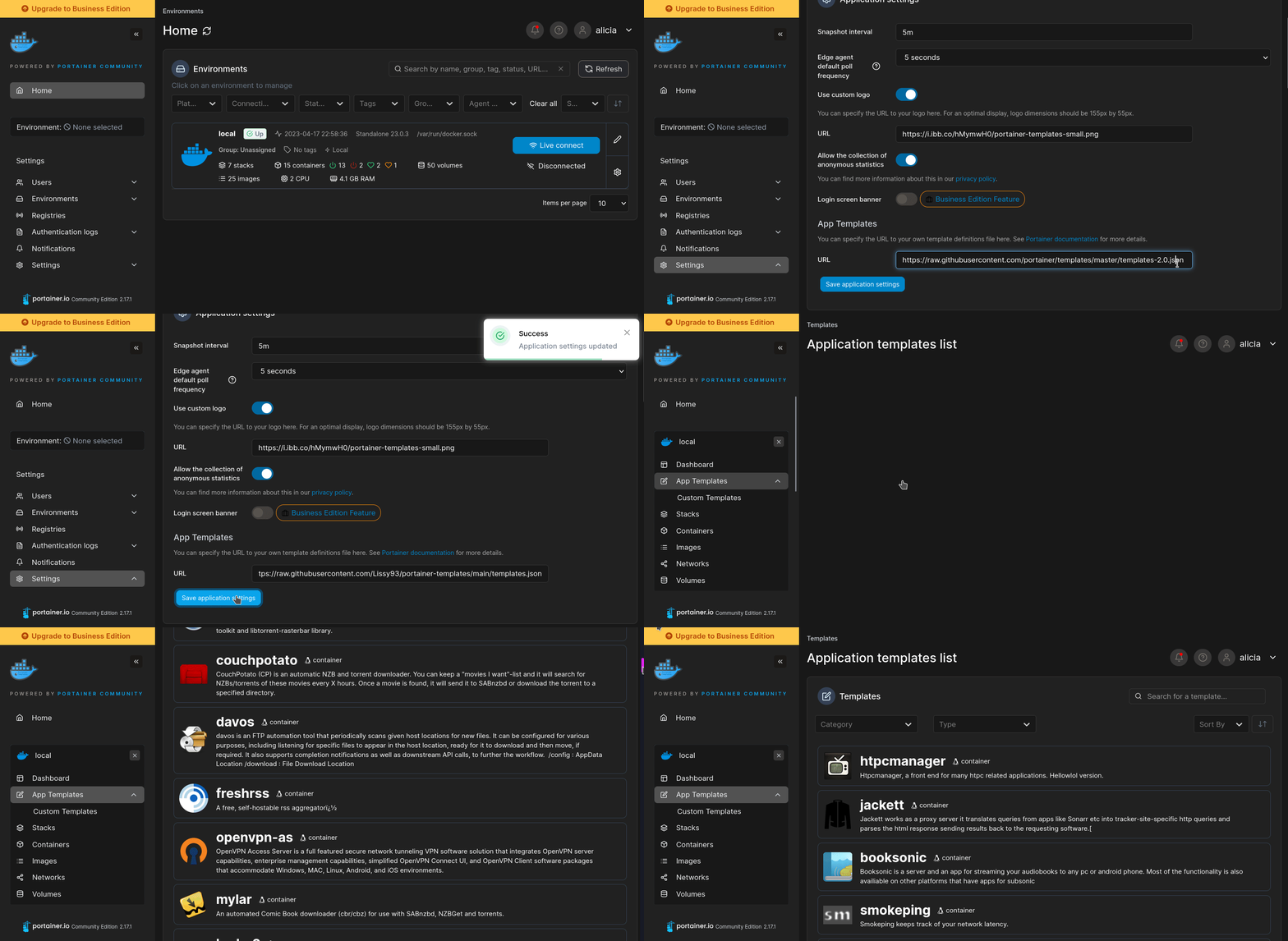
Import all app templates into your Portainer instance, for easy 1-click deploys
- Ensure both Docker and Portainer are installed, and up-to-date
- Log into your Portainer web UI
- Under Settings → App Templates, paste the below URL
- Head to Home → App Templates, and the list of apps will show up
- Select Sematext Docker Agent (swarm), fill in any config options, and hit Deploy
Template Import URL
https://raw.githubusercontent.com/Lissy93/portainer-templates/main/templates.json
Show Me
Original stackfile
The swarm stack file this template deploys, straight from its repo:
version: '3.2'
services:
  sematext-agent-docker:
    image: sematext/sematext-agent-docker
    deploy:
      mode: global
      restart_policy:
        condition: any
    environment:
      - LOGSENE_TOKEN=$LOGSENE_TOKEN
      - SPM_TOKEN=$SPM_TOKEN
    restart: always
    volumes:
      - type: bind
        source: /var/run/docker.sock
        target: /var/run/docker.sock
Or deploy it directly from the source:
git clone https://github.com/portainer/templates
cd templates
docker stack deploy -c stacks/sematext-agent-docker/docker-stack.yml sematext-docker-agent-swarm
More install options in our documentation, or see sematext/sematext-agent-docker for app-specific guidance.
This image is deprecated
Please use sematext/agent for monitoring and sematext/logagent for log collection.Both images are available as Docker certified images:
See the following posts for more details:
Sematext Agent for Docker
|||| |---|------------|------------| | |
| 
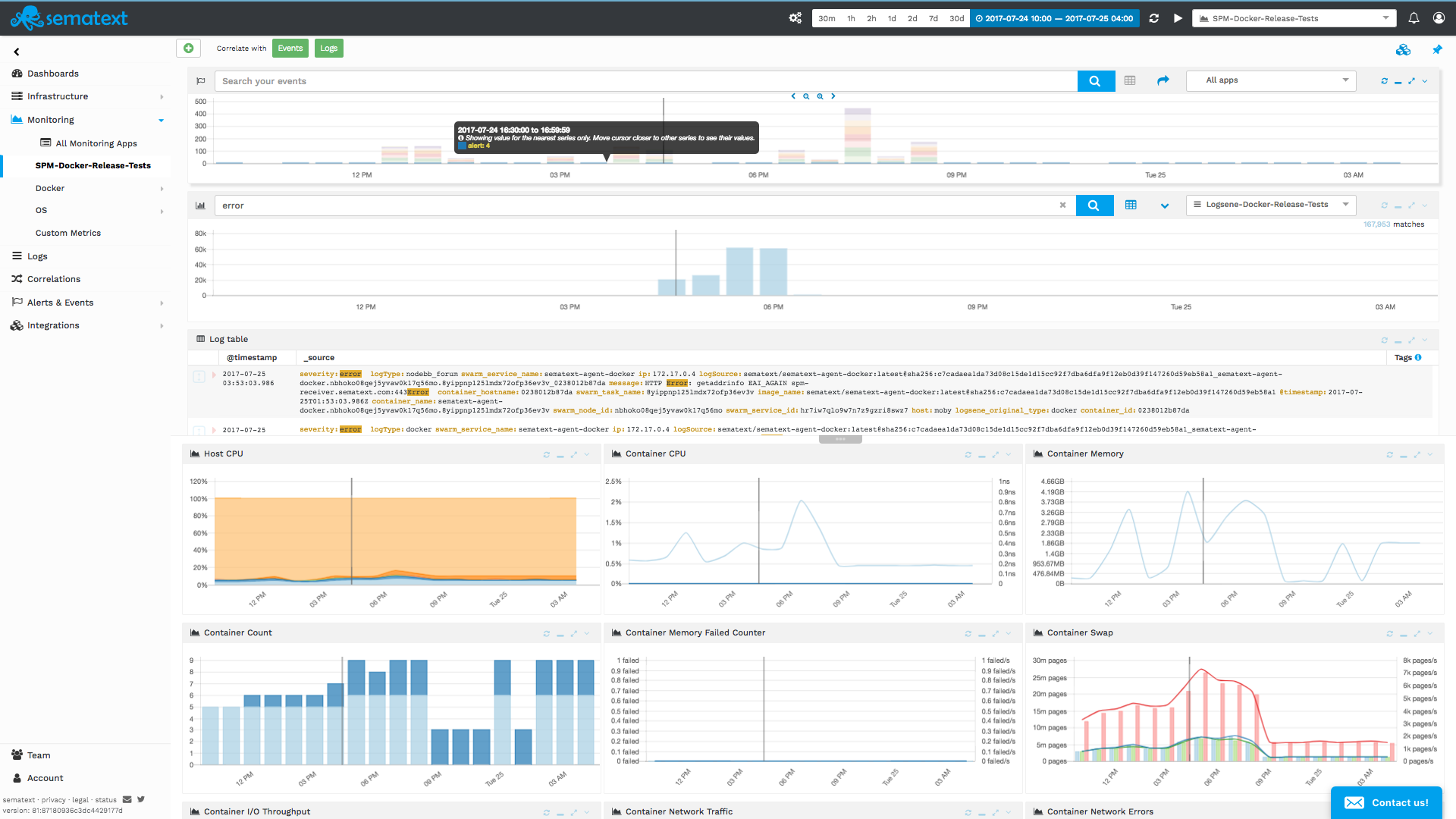
Sematext Agent for Docker collects Metrics, Events and Logs from the Docker API for Docker Monitoring & Logging & Hosted Elastic Stack. Works with CoreOS, Rancher, Docker Swarm, Kubernetes, Apache Mesos, Hashicorp Nomad, Amazon ECS, ... see the installation.
Quickstart
- Get free Sematext account
Create a Monitoring App of type "Docker" for Docker metrics. Copy its App Token.
Optionally, [create a Logs App](https://apps.sematext.com/ui/integrations)- Run the image using individual App tokens for your Monitoring and Logs Apps
```
docker pull sematext/sematext-agent-docker
docker run -d --name sematext-agent-docker -e SPM_TOKEN=YOUR_SPM_TOKEN -e LOGSENE_TOKEN=YOUR_LOGSENE_TOKEN -v /var/run/docker.sock:/var/run/docker.sock sematext/sematext-agent-docker
```

You’ll see your Docker metrics in [Sematext Cloud](https://sematext.com/cloud) after about a minute. - Watch metrics, search container logs, use anomaly detection for logs and metrics, create email reports and much more ...
Certified and Public images
There are several places to obtain Sematext Docker Agent images:- Docker Certified images in Docker Store
docker pull store/sematext/sematext-agent-docker
```

2. Red Hat certified images in [Red Hat Container Catalog](https://access.redhat.com/containers/?tab=overview&platform=docker#/registry.connect.redhat.com/sematext/sematext-agent-docker)3. Public images from [Docker Hub](https://hub.docker.com/r/sematext/sematext-agent-docker/) Support
- Sematext Docker Agent Homepage
- Sematext Docker Agent Documentation
- Chat with us via Sematext Cloud UI or drop an e-mail to [email protected]
Check the logs first
Nine times out of ten the logs tell you exactly what went wrong.
- In Portainer, go to Containers, click the container, then Logs. Or run
docker logs <container> - Exit codes help too:
137means killed, usually out of memory.126or127means the command inside the image is broken.
Image won't pull
Test the pull directly on the host: docker pull sematext/sematext-agent-docker
- "manifest unknown" means the tag no longer exists. This template uses
latest, so try pinning a specific version instead. - "toomanyrequests" is the Docker Hub rate limit. Log in with
docker loginto raise it. - "no space left on device" means a full disk. Reclaim space with
docker system prune
"exec format error"
This means the image was built for a different CPU architecture than your server.
- This image supports:
amd64, arm - Check yours with
uname -m: x86_64 is amd64, aarch64 is arm64. Raspberry Pi and other ARM boards are the usual culprits.
Container keeps restarting
The always restart policy relaunches the app after every crash, so the real error can scroll past.
- Check the logs right after a restart, the last few lines before it died are the useful ones.
- Get the exit code with
docker inspect <container> --format '{{.State.ExitCode}}' - Still stuck? Redeploy once with the restart policy set to
noso the failure stays visible.
Stack won't deploy
Compose stacks fail fast on small mistakes, and Portainer shows the reason just above the editor.
- YAML only accepts spaces for indentation, a single tab breaks the whole file.
Raise an issue
Found something which isn't working as it should? Here's how to report it.
- Bug within the app: Open an issue on sematext/sematext-agent-docker
- Template not working: Open an issue on portainer/templates
- This website not working: Open an issue on lissy93/portainer-templates
A Swarm stack
Sematext Docker Agent (swarm) is a Swarm stack. Swarm is Docker's own way of running apps across more than one machine, so Portainer can spread it over a cluster and move it elsewhere if a server drops out.
The app image
An image is the app packed up ready to go, everything Sematext Docker Agent (swarm) needs bundled into one download. This template pulls sematext/sematext-agent-docker, which Docker fetches once (about 89 MB) and then starts your own copy from.
Where the image comes from
Docker pulls its images from registries, public libraries of ready-built apps. Sematext Docker Agent (swarm)'s comes from Docker Hub, published by sematext.
Version tags
The bit after the colon in the image name is the version tag. Here it's latest, which always points at the newest build, so a redeploy can bump you to a newer release without you asking. Newest right now is 1.31.74. Pin a specific tag if you would rather stay on one version.
Which machines it runs on
Every image is built for particular CPU types. This one ships for amd64, arm, so it runs on both regular x86 servers and ARM boards like a Raspberry Pi.
No stored data
This template doesn't mount any storage, so whatever Sematext Docker Agent (swarm) writes stays inside the container and is wiped if it's recreated or updated. That's fine for something stateless, but add a volume before trusting it with anything you want to keep.
Environment variables
Environment variables are the settings you hand over when you deploy, things like a password or a timezone. Sematext Docker Agent (swarm) takes 2 of them, all with defaults you can leave alone or tweak:
LOGSENE_TOKEN, defaults to$LOGSENE_TOKEN. Logs tokenSPM_TOKEN, defaults to$SPM_TOKEN. SPM monitoring token
Restart policy
The restart policy here is always, so Docker brings Sematext Docker Agent (swarm) back up after a crash and again when the server reboots. Good for anything you want running around the clock. You can change this on the deploy screen. The choices are no (never restart), on-failure (only after a crash), unless-stopped (restart unless you stop it), and always (bring it back no matter what).
Networking
Nothing custom is set, so Sematext Docker Agent (swarm) sits on Docker's default bridge network: its own private space that reaches the outside world only through the ports it publishes.
Container name
Once it's deployed, Portainer names the container sematext-agent-docker. That's what you'll spot in the containers list and use in commands like docker logs sematext-agent-docker.
Platform
The platform is linux, the kind of system the container is built to run on. Docker and Portainer handle this on a normal Linux server.
Open source license
Sematext Docker Agent (swarm) is open source, released under the Apache-2.0 license. In plain terms the code is out in the open, so you're free to run it and change it to fit what you need.
Portainer app templates
Zooming out, this whole page comes from a Portainer app template: a short recipe telling Portainer how to set Sematext Docker Agent (swarm) up. Add the template list to Portainer once, then deploying Sematext Docker Agent (swarm) is a click rather than a wall of config.