
![OpnForm]() OpnForm
OpnForm
Stack
OpnForm is an open-source form builder. It's an alternative to products like Typeform, JotForm, Tally etc.
Image details
Source details
Configuration
TypeComposelinuxjhumanj/opnform8380:80/persist : /portainer/Files/AppData/Config/opnformStandalone Install
Select an install method, to see config/commands for deploying OpnForm
Install on Portainer
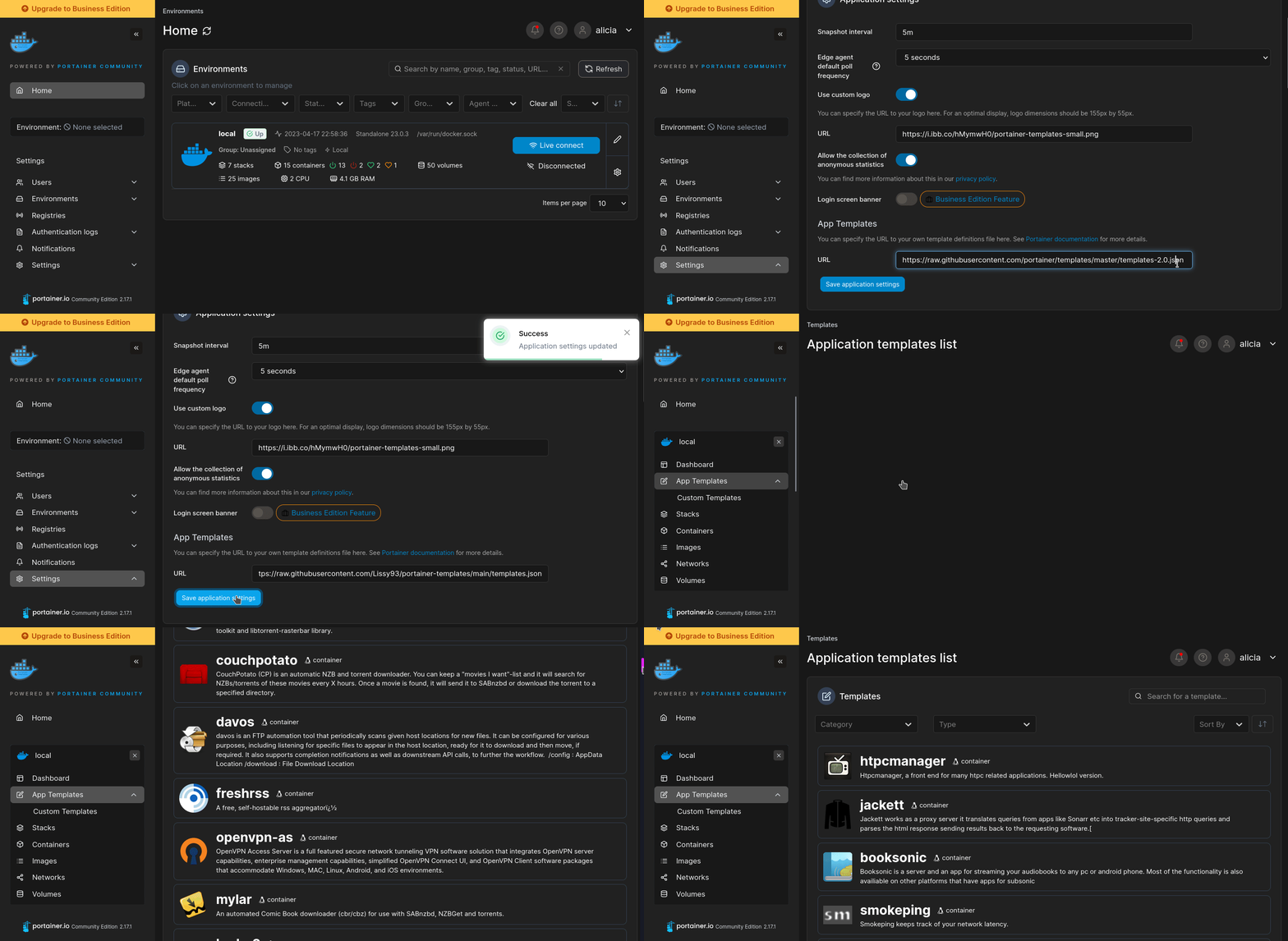
Import all app templates into your Portainer instance, for easy 1-click deploys
- Ensure both Docker and Portainer are installed, and up-to-date
- Log into your Portainer web UI
- Under Settings → App Templates, paste the below URL
- Head to Home → App Templates, and the list of apps will show up
- Select OpnForm, fill in any config options, and hit Deploy
Template Import URL
https://raw.githubusercontent.com/Lissy93/portainer-templates/main/templates.json
Show Me
Original stackfile
The compose file this template deploys, straight from its repo:
services:
  opnform:
    container_name: opnform
    volumes:
      - /portainer/Files/AppData/Config/opnform:/persist
    ports:
      - 8380:80
    image: jhumanj/opnform
networks: {}
Or deploy it directly from the source:
git clone https://github.com/xneo1/portainer_templates
cd portainer_templates
docker compose -f Template/Stack/opnform.yml up -d
More install options in our documentation, or see jhumanj/opnform for app-specific guidance.
OpnForm









OpnForm is an open-source form builder.
Get Started
The easiest way to get started with OpnForm is to sign up for our managed service in the Cloud. You get support, backups, upgrades, and more. Your data is safe and secure, and you don't need to worry about maintenance or infrastructure. Check out our quick overview of cloud vs self-hosting.Key Features
- 🚀 No-code builder with unlimited forms & submissions
- 📝 Various input types: Text, Date, URL, File uploads & much more
- 🌐 Embed anywhere
- 📧 Email notifications
- 💬 Integrations (Slack, Webhooks, Discord)
- 🧠 Form logic & customization
- 🛡️ Captcha protection
- 📊 Form analytics
For a complete list of features and detailed documentation, visit our Technical Documentation.
AI agents and MCP
OpnForm's remote MCP server lets AI agents create and preview a private form draft without requiring a login. OAuth adds workspace-aware form management and read-only submission search, statistics, and exports. The installable portable and native plugin package lives inplugins/opnform/. See the MCP integration guide.Quick Start
The easiest way to get started with OpnForm is through our official managed service in the Cloud.For self-hosted installations, please refer to our Deployment Guides. For local development, we provide a minimal Docker-based setup - check out our Docker Development Guide.
The client
npm run build also checks the public form bundle size and eager dependencies. This check reads .nuxt/dist/client/_nuxt, independently of Nitro's deployment output directory (including AWS Amplify's .amplify-hosting). Run its regression tests from client/ with node --test scripts/check-public-form-bundle.test.mjs.Form list performance
The dashboard fetches lightweight summaries in batches of 50. The API keeps its default page size of 10 and its maximum of 100 for other callers. It paginates forms before loading view and completed-submission counts for the returned IDs. Historical views use an index onform_statistics.form_id, and the aggregate is explicitly aliased as total_views_count so the model uses the preloaded value.The index migration runs outside a transaction and uses
CREATE INDEX CONCURRENTLY on PostgreSQL to keep writes available. It also recovers an invalid index left by an interrupted build. Run this migration through Laravel normally; do not wrap it in an external transaction. MySQL and SQLite use the standard schema index migration.Codex worktrees
Codex creates an isolated local environment for each worktree. It uses a dedicated PostgreSQL Docker volume and local Laravel/Nuxt processes, so sibling worktrees do not share ports, data, or API configuration.Use the Codex
Start app, Reset DB, and Stop app actions when available. You can also run the scripts directly:./scripts/codex-worktree-setup.sh
./scripts/codex-worktree-up.shThe startup command prints the worktree-specific URL. Opening its root URL automatically signs in the local Codex admin (
[email protected] / Abcd@1234). The seed also creates three forms, including five completed submissions across two public forms, so the dashboard and submission screens are immediately useful. Reset only the current worktree database with:./scripts/codex-worktree-reset-db.shRun the browser suite against the running worktree with:
./scripts/codex-worktree-test-e2e.shPDF template fields
The PDF editor removes zones linked to deleted fields and lists them before you continue. Save the template to keep the cleanup. Mappings retain field names when created or saved, so deleted fields can still be identified. Older mappings without a saved name appear as “Deleted field” with their page number.Support & Community
If you need help or have questions, please join our Discord community. For more information and assistance, check out the following resources:License
OpnForm is open-source under the GNU Affero General Public License Version 3 (AGPLv3) or any later version. You can find it here.Dual Licensing
OpnForm uses a dual-license model to make the project sustainable:- Core OpnForm (AGPL-3.0): The main application is free and open-source under AGPLv3, giving you the freedom to use, modify, and distribute it.
- Enterprise Edition (Proprietary): Advanced features under
api/app/Enterprise/are available under our Enterprise License and Enterprise Terms. These features help fund ongoing development and keep OpnForm sustainable.
By offering Enterprise features alongside our open-source core, we can continue to invest in making OpnForm better for everyone while keeping the project financially sustainable.
Serve OpnForm on your own domain behind Caddy, Nginx or Traefik. Fill in your domain and copy the result. It's a starting point, some apps need their own base URL or extra headers set too.
Proxying opnform.example.com to http://opnform:80
Add this to your Caddyfile
opnform.example.com {
	reverse_proxy http://opnform:80
}Check the logs first
Nine times out of ten the logs tell you exactly what went wrong.
- In Portainer, go to Containers, click the container, then Logs. Or run
docker logs <container> - Exit codes help too:
137means killed, usually out of memory.126or127means the command inside the image is broken.
Port already in use
If deployment fails with "Bind for 0.0.0.0:8380 failed: port is already allocated", something else on your server is using that port.
- Find what's using it:
sudo ss -tlnp | grep :8380 - Stop the other service, or pick a different host port. In
8380:80only the left number is yours to change, the right one belongs to the app.
Running but the page won't load
The container is up but nothing appears in your browser.
- Use your server's real IP:
http://your-server-ip:8380. The 0.0.0.0 link Portainer shows isn't a real address. - Give it a minute after first deploy, opnform can take a while to initialise.
- Make sure your firewall allows the port, e.g.
sudo ufw allow 8380
Permission denied on volumes
If the logs show "permission denied", the app can't write to its data folder on the host.
- Fix the ownership:
sudo chown -R 1000:1000 /portainer/Files/AppData/Config/opnform
Image won't pull
Test the pull directly on the host: docker pull jhumanj/opnform
- "manifest unknown" means the tag no longer exists. This template uses
latest, so try pinning a specific version instead. - "toomanyrequests" is the Docker Hub rate limit. Log in with
docker loginto raise it. - "no space left on device" means a full disk. Reclaim space with
docker system prune
"exec format error"
This means the image was built for a different CPU architecture than your server.
- This image supports:
amd64 - Check yours with
uname -m: x86_64 is amd64, aarch64 is arm64. Raspberry Pi and other ARM boards are the usual culprits.
Stack won't deploy
Compose stacks fail fast on small mistakes, and Portainer shows the reason just above the editor.
- YAML only accepts spaces for indentation, a single tab breaks the whole file.
Raise an issue
Found something which isn't working as it should? Here's how to report it.
- Bug within the app: Open an issue on jhumanj/opnform
- Template not working: Open an issue on xneo1/portainer_templates
- This website not working: Open an issue on lissy93/portainer-templates
A Compose stack
OpnForm is a Compose stack, a set of containers defined in one file and brought up together by Portainer, then started and stopped as a single app.
The app image
An image is the app packed up ready to go, everything OpnForm needs bundled into one download. This template pulls jhumanj/opnform, which Docker fetches once (about 434 MB) and then starts your own copy from.
Where the image comes from
Docker pulls its images from registries, public libraries of ready-built apps. OpnForm's comes from Docker Hub, published by jhumanj.
Version tags
The bit after the colon in the image name is the version tag. Here it's latest, which always points at the newest build, so a redeploy can bump you to a newer release without you asking. Newest right now is 1.2.6. Pin a specific tag if you would rather stay on one version.
Which machines it runs on
Every image is built for particular CPU types. This one ships for amd64, so it runs on regular x86 PCs and servers, though not ARM boards like a Raspberry Pi.
Ports
A port is the door the app answers on. A mapping like 8380:80 means it's reachable on port 8380 of your server, where the left number is yours to change and the right one belongs to the app. Once it's running, open http://your-server-ip:8380 in a browser. It opens:
8380:80, likely the web interface
Volumes
A volume is where OpnForm keeps its files so they survive an update or a restart. Without one, anything it saves would sit inside the container and vanish the moment it's recreated. This template mounts:
/persistfrom/portainer/Files/AppData/Config/opnformon the host
Networking
Nothing custom is set, so OpnForm sits on Docker's default bridge network: its own private space that reaches the outside world only through the ports it publishes.
Container name
Once it's deployed, Portainer names the container opnform. That's what you'll spot in the containers list and use in commands like docker logs opnform.
Platform
The platform is linux, the kind of system the container is built to run on. Docker and Portainer handle this on a normal Linux server.
Portainer app templates
Zooming out, this whole page comes from a Portainer app template: a short recipe telling Portainer how to set OpnForm up. Add the template list to Portainer once, then deploying OpnForm is a click rather than a wall of config.