
![FoundryVTT Server]() FoundryVTT Server
FoundryVTT Server
Container
This docker image provides the FoundryVTT system for hosting your own virtual table top games.
Image details
Configuration
TypeContainerlinuxfelddy/foundryvtt:release30000:30000/tcp/data : /portainer/Files/AppData/Config/foundryvttFOUNDRY_USERNAME=JohnFOUNDRY_PASSWORD=passwordFOUNDRY_ADMIN_KEY=changemeCONTAINER_PRESERVE_CONFIG=trueunless-stoppedTemplate by novaspirit
Report issueNotes
Check our Github page: https://github.com/pi-hosted/pi-hosted
Official Webpage: https://foundryvtt.com/
Official Docker Documentation: https://hub.docker.com/r/felddy/foundryvtt
Standalone Install
Select an install method, to see config/commands for deploying FoundryVTT Server
Install on Portainer
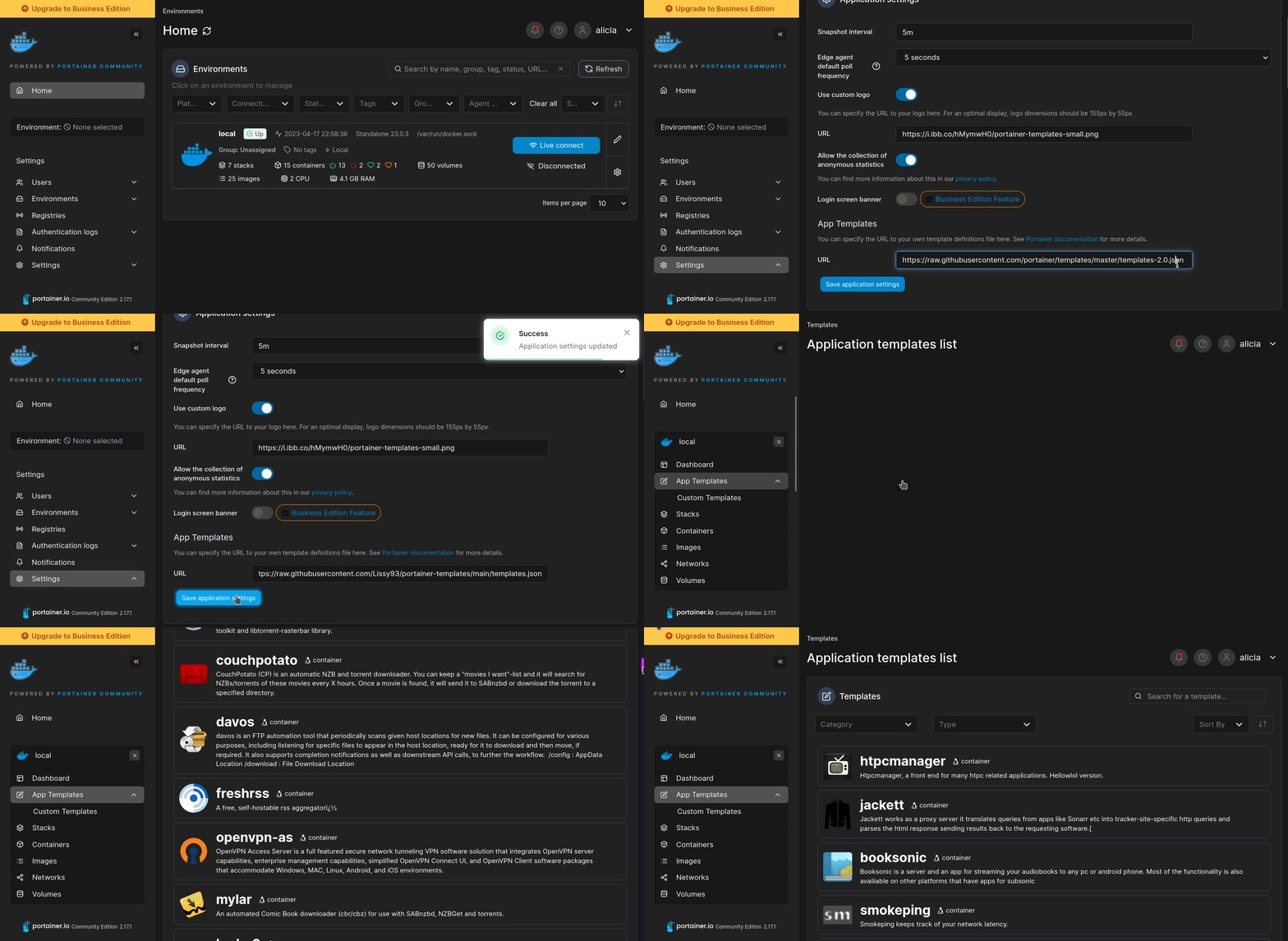
Import all app templates into your Portainer instance, for easy 1-click deploys
- Ensure both Docker and Portainer are installed, and up-to-date
- Log into your Portainer web UI
- Under Settings → App Templates, paste the below URL
- Head to Home → App Templates, and the list of apps will show up
- Select FoundryVTT Server, fill in any config options, and hit Deploy
Template Import URL
https://raw.githubusercontent.com/Lissy93/portainer-templates/main/templates.json
Show Me
More install options in our documentation.
foundryvtt-docker #





You can get a Foundry Virtual Tabletop instance up and running in minutes using this container. This Docker container is designed to be secure, reliable, compact, and simple to use. It only requires that you provide the credentials or URL needed to download a Foundry Virtual Tabletop distribution.
Prerequisites ##
- An OCI-compatible container runtime such as Kubernetes,
- A FoundryVTT.com account with a purchased
Running ##
Running with Docker and credentials ###
You can use the following command to start up a Foundry Virtual Tabletop server. Your foundryvtt.com credentials are required so the container can install and license your server.docker run \
--env FOUNDRY_USERNAME='<your_username>' \
--env FOUNDRY_PASSWORD='<your_password>' \
--publish 30000:30000/tcp \
--volume <your_data_dir>:/data \
ghcr.io/felddy/foundryvtt:14!TIP If you are usingbash, or a similar shell, consider pre-pending the Docker command with a space to prevent your credentials from being committed to the shell history list. See:HISTCONTROL
Running with Docker and a temporary URL ###
Alternatively, you may acquire a temporary download URL from your user profile page on the Foundry website.- Navigate to the
Purchased Software Licensespage. - Change the
Operating Systemmenu item toNode.js. - Click the
🔗 Timed URLbutton to obtain the temporary URL. - Use the following command to start up a Foundry Virtual Tabletop server:
docker run \
  --env FOUNDRY_RELEASE_URL='<temporary_url>' \
  --publish 30000:30000/tcp \
  --volume <your_data_dir>:/data \
  ghcr.io/felddy/foundryvtt:14
Configuration management ###
Configuration options are specified using environment variables. It is highly recommended that you usedocker compose or
similar container orchestration to manage your server's configuration. A
compose.yml file, like the example below, is a reliable way to start
and maintain a container while capturing its configurations.Each time the container starts it generates the configuration files needed by Foundry Virtual Tabletop using the values of the environment variables. That means changes made in the server's configuration GUI will not persist between container restarts. If you would like to disable the regeneration of these configuration files, set
CONTAINER_PRESERVE_CONFIG to true.!IMPORTANT Always set a stablehostnamein yourcompose.yml(or--hostnameindocker run). Foundry binds its software license to the container hostname. If no hostname is set, Docker assigns a random container ID on each start, causing license verification to fail after every restart.
- Create a
compose.ymlfile similar to the one below. Provide
your credentials as values to the environment variables:

 ```yaml
 ---
 services:
   foundry:
     image: ghcr.io/felddy/foundryvtt:14
     hostname: my_foundry_host
     volumes:
       - type: bind
         source: <your_data_dir>
         target: /data
     environment:
       - FOUNDRY_USERNAME=<your_username>
       - FOUNDRY_PASSWORD=<your_password>
       - FOUNDRY_ADMIN_KEY=atropos
       - FOUNDRY_TELEMETRY=true
     ports:
       - target: 30000
         published: 30000
         protocol: tcp
```- Start the container and detach:
```console
docker compose up --detach
```- Access the web application at:
If all goes well you should be prompted with the license agreement, and then "admin access key" set with the
FOUNDRY_ADMIN_KEY variable.Using secrets ##
This container also supports passing sensitive values via Docker secrets. Passing sensitive values like your credentials can be more secure using secrets than using environment variables. Your secrets json file can have any name. This example usessecrets.json. Regardless of the name you choose it must be targeted to
config.json within the container as in the example below. See the
secrets section below for a table of all supported secret keys.- To use secrets, create a
secrets.jsonfile containing the values you want set:
```json
{
  "foundry_admin_key": "atropos",
  "foundry_password": "your_password",
  "foundry_username": "your_username"
}
```- Then add the secret to your
compose.ymlfile:
```yaml
---
secrets:
  config_json:
    file: secrets.json

services:
  foundry:
    image: ghcr.io/felddy/foundryvtt:14
    hostname: my_foundry_host
    volumes:
      - type: bind
        source: <your_data_dir>
        target: /data
    environment:
    ports:
      - target: 30000
        published: 30000
        protocol: tcp
    secrets:
      - source: config_json
        target: config.json
```
Updating your container ##
The Foundry "Update Software" tab is disabled by default in this container. To upgrade to a new version of Foundry pull an updated image version.Updating with Docker Compose ###
- Pull the new image from the registry:
```console
docker compose pull
```- Recreate the running container:
```console
docker compose up --detach
```
Updating with Docker ###
- Stop the running container:
```console
docker stop <container_id>
```- Pull the new image:
```console
docker pull ghcr.io/felddy/foundryvtt:14
```- Follow the previous instructions for running the container above.
Image tags ##
The images of this container are tagged with semantic versions that align with the version and build of Foundry Virtual Tabletop that they support.!TIP
It is recommended that users use the major version tag: :14 Using the major
tag will ensure that you receive the most recent version of the software that
is compatible with your saved data, and prevents inadvertent upgrades to a new
major version.| Image:tag | Description |
|---|---|
ghcr.io/felddy/foundryvtt:14 | The most recent image matching the major version number. Most users will use this tag. |
ghcr.io/felddy/foundryvtt:14.368 | The most recent image matching the major and minor version numbers. |
ghcr.io/felddy/foundryvtt:14.368.0 | An exact image version. |
ghcr.io/felddy/foundryvtt:release | The most recent image from the stable channel. These images are considered stable, and well-tested. The latest tag always points to the same version as release. |
ghcr.io/felddy/foundryvtt:latest | Same as the release tag. Why does latest == release? |
See the packages page for a complete list of available tags.
!NOTE
Stable releases are also mirrored to Docker
Hub and can be
referenced using the full registry path: docker.io/felddy/foundryvtt:14Volumes ##
| Mount point | Purpose |
|---|---|
/data | Configuration, data, and log storage. |
Ports ##
The following ports are exposed by this container:| Port | Purpose |
|---|---|
30000 | Foundry Virtual Tabletop server web interface |
Environment variables ##
Required variable combinations ###
One of the three combinations of environment variables listed below must be set in order for the container to locate and install a Foundry Virtual Tabletop distribution. Although all variables may be specified together, they are evaluated in the following order of precedence:1.
FOUNDRY_RELEASE_URL, or
1. FOUNDRY_USERNAME and FOUNDRY_PASSWORD, or
1. CONTAINER_CACHECredentials variables ####
| Name | Purpose |
|---|---|
FOUNDRYPASSWORD | Account password for foundryvtt.com. Required for downloading an application distribution. |
FOUNDRYUSERNAME | Account username or email address for foundryvtt.com. Required for downloading an application distribution. |
Note:
FOUNDRY_USERNAME and FOUNDRY_PASSWORD may be set using
secrets instead of environment variables.Presigned URL variable ####
| Name | Purpose |
|---|---|
FOUNDRYRELEASEURL | The presigned URL generated from the user's profile. Required for downloading an application distribution. |
Optional variables ###
| Name | Purpose | Default |
|---|---|---|
CONTAINERCACHE | Set a path to cache downloads of the Foundry distribution archive and speed up subsequent container startups. The path should be in /data or another persistent mount point in the container. Set to "" to disable.Note: When the cache is disabled the container will sleep indefinitely on failure rather than exiting, to prevent a restart loop. A distribution can be pre-downloaded and placed into a cache directory. The distribution's name must be of the form: foundryvtt-14.368.zip | /data/containercache |
CONTAINERCACHESIZE | Set the maximum number of distribution versions to keep in the cache. The minimum is 1. When the limit is exceeded, the oldest versions (lowest version numbers) are removed first. Unset to disable cache size management and keep all versions. | |
CONTAINERPATCHES | Set a path to a directory of shell scripts to be sourced after Foundry is installed but before it is started. The path should be in /data or another persistent mount point in the container. e.g.; /data/containerpatches Patch files are sourced in lexicographic order. CONTAINERPATCHES are processed after CONTAINERPATCHURLS. | |
CONTAINERPATCHURLS | Set to a space-delimited list of URLs to be sourced after Foundry is installed but before it is started. Patch URLs are sourced in the order specified. CONTAINERPATCHURLS are processed before CONTAINERPATCHES. ⚠️ Only use patch URLs from trusted sources! | |
CONTAINERPRESERVECONFIG | Normally new options.json and admin.txt files are generated by the container at each startup. Setting this to true prevents the container from modifying these files when they exist. If they do not exist, they will be created as normal. | false |
CONTAINERUMASK | Control the default permissions on new files and directories created by Foundry VTT. Set the umask to "0002" if you need new files to be writable by other users in the same group as the foundry user. If this is empty or not set, the umask will not be changed (the system default is "0022"). | |
CONTAINERURLFETCHRETRY | Number of times to retry fetching the presigned URL using exponential back off. This behavior is useful in continuous integration environments where multiple parallel workflows can exceed the rate-limit of the URL generation service. | 0 |
CONTAINERVERBOSE | Set to true to enable verbose logging for the container utility scripts. | false |
FOUNDRYADMINKEY | Admin password to be applied at startup. If omitted the admin password will be cleared. May be set using secrets. | |
FOUNDRYAWSCONFIG | An absolute or relative path that points to the awsConfig.json or true for AWS environment variable credentials evaluation usage. | null |
FOUNDRYCOMPRESSWEBSOCKET | Set to true to enable compression of data sent from the server to the client via websocket. This is recommended for network performance. | false |
FOUNDRYCSSTHEME | Choose the CSS theme for the setup page. Valid values are dark, fantasy, and scifi. | dark |
FOUNDRYDEMOCONFIG | Demo mode allows you to configure a world which will be automatically launched and reset at a frequency of your choosing. When the world is reset, it is deactivated. The source data for the world is restored to its original state using a provided .zip file, and the next reset is automatically scheduled. See: Configuring demo mode. | |
FOUNDRYDELETENEDB | Set to true to automatically delete legacy NeDB .db files after they have been migrated to the LevelDB format introduced in Version 11. Enabling this recovers disk space but removes the ability to roll back to a pre-migration state. Only relevant for data volumes previously used with Foundry Version 10 or earlier. | false |
FOUNDRYHOSTNAME | A custom hostname to use in place of the host machine's public IP address when displaying the address of the game session. This allows for reverse proxies or DNS servers to modify the public address. | null |
FOUNDRYHOTRELOAD | Set to true to allow packages to hot-reload certain assets, such as CSS, HTML, and localization files without a full refresh. This setting is only recommended for developers. | false |
FOUNDRYIPDISCOVERY | Allow the Foundry server to discover and report the accessibility of the host machine's public IP address and port. Setting this to false may reduce server startup time in instances where this discovery would timeout. | true |
FOUNDRYLANGUAGE | The default application language and module which provides the core translation files. | en.core |
FOUNDRYLOCALHOSTNAME | Override the local network address used for invitation links, mirroring the functionality of the FOUNDRYHOSTNAME option which configures the external address. | null |
FOUNDRYLICENSEKEY | The license key to install. e.g.; AAAA-BBBB-CCCC-DDDD-EEEE-FFFF If left unset, a license key will be fetched when using account authentication. If multiple license keys are associated with an account, one will be chosen at random. Specific licenses can be selected by passing in an integer index. The first license key being 1. May be set using secrets. | |
FOUNDRYLOGSIZE | The maximum size a log file can reach before it is rotated. Units must be included. e.g.; 1024k, 64m, 1g. | |
FOUNDRYMAXLOGS | The maximum number of log files to retain before older ones are deleted. | |
FOUNDRYMINIFYSTATICFILES | Set to true to reduce network traffic by serving minified static JavaScript and CSS files. Enabling this setting is recommended for most users, but module developers may wish to disable it. | false |
FOUNDRYNOBACKUPS | Set to true to disable the automatic backup of world data that Foundry creates before performing major version migrations. Users with an external backup strategy or constrained storage may wish to enable this. | false |
FOUNDRYPASSWORDSALT | Custom salt string to be applied to the admin password instead of the default salt string. May be set using secrets. | null |
FOUNDRYPROTOCOL | If left unset Foundry VTT will bind to IPv4 and IPv6 interfaces. To limit to IPv4 only, set to 4. To limit to IPv6 only set to 6. | null |
FOUNDRYPROXYPORT | Inform the Foundry server that the software is running behind a reverse proxy on some other port. This allows the invitation links created to the game to include the correct external port. | null |
FOUNDRYPROXYSSL | Indicates whether the software is running behind a reverse proxy that uses SSL. This allows invitation links and A/V functionality to work as if the Foundry server had SSL configured directly. | false |
FOUNDRYROUTEPREFIX | A string path which is appended to the base hostname to serve Foundry VTT content from a specific namespace. For example setting this to demo will result in data being served from http://x.x.x.x:30000/demo/. | null |
FOUNDRYSERVICECONFIG | The absolute path inside the container to a service configuration file. Must be set together with FOUNDRYSERVICEKEY. | null |
FOUNDRYSERVICEKEY | Used in conjunction with FOUNDRYSERVICECONFIG. Setting this without FOUNDRYSERVICECONFIG will cause the container to exit with an error. | |
FOUNDRYSSLCERT | An absolute or relative path that points towards a SSL certificate file which is used jointly with the sslKey option to enable SSL and https connections. If both options are provided, the server will start using HTTPS automatically. | null |
FOUNDRYSSLKEY | An absolute or relative path that points towards a SSL key file which is used jointly with the sslCert option to enable SSL and https connections. If both options are provided, the server will start using HTTPS automatically. | null |
FOUNDRYTELEMETRY | Set to true to enable FoundryVTT telemetry, false to disable. This option allows the collection of anonymous usage data to help improve FoundryVTT. It is recommended to explicitly set this value. Leaving this unset will cause Foundry to prompt the user to make a choice on every launch. | |
FOUNDRYTEMPDIR | An absolute path to a directory used for temporary storage of package .zip archives while they are being downloaded and installed. When set, archives land outside the user data directory, so only the unpacked content counts against data volume space. Useful for hosts with constrained /data storage. | |
FOUNDRYUNIXSOCKET | An absolute path to a Unix domain socket for the server listener. When set, Foundry binds to the socket instead of the TCP port, which is useful for local reverse-proxy configurations (e.g. nginx or caddy via socket). If both a port and a socket path are configured, the socket takes precedence. | null |
FOUNDRYUPNP | Allow Universal Plug and Play to automatically request port forwarding for the Foundry server port to your local network address. | false |
FOUNDRYUPNPLEASEDURATION | Sets the Universal Plug and Play lease duration, allowing for the possibility of permanent leases for routers which do not support temporary leases. To define an indefinite lease duration set the value to 0. | null |
FOUNDRYVERSION | Version of Foundry Virtual Tabletop to install. | 14.368 |
FOUNDRYWORLD | The directory name of the world to launch at system start. | null |
TZ | Container TZ database name | UTC |
PROXY | Proxy settings to use during container initialization and by Foundry at runtime. See proxy-from-env for the list of supported environment variable names. See proxy-agent for list of supported proxy protocols. | null |
Node.js variables ###
Any Node.js variables (NODE_*) supplied to the container will be passed to the underlying Node.js
server running FoundryVTT. Listed below are some variables that are
particularly useful.| Name | Purpose |
|---|---|
NODEDEBUG | ,-separated list of core modules that should print debug information. |
NODEEXTRACACERTS | When set, the well known "root" CAs (like VeriSign) will be extended with the extra certificates. The file should consist of one or more trusted certificates in PEM format. A message will be emitted (once) with process.emitWarning() if the file is missing or malformed, but any errors are otherwise ignored. |
NODEOPTIONS | A space-separated list of command-line options that are interpreted before command-line options, so command-line options will override or compound after anything supplied. Node.js will exit with an error if an option that is not allowed in the environment is used, such as -p or a script file. |
NODETLSREJECTUNAUTHORIZED | If the value equals 0, certificate validation is disabled for TLS connections. This makes TLS, and HTTPS by extension, insecure. ⚠️ The use of this environment variable is strongly discouraged. |
Secrets ##
| Filename | Key | Purpose |
|---|---|---|
config.json | foundryadminkey | Overrides FOUNDRYADMINKEY environment variable. |
config.json | foundrylicensekey | Overrides FOUNDRYLICENSEKEY environment variable. |
config.json | foundrypassword | Overrides FOUNDRYPASSWORD environment variable. |
config.json | foundrypasswordsalt | Overrides FOUNDRYPASSWORDSALT environment variable. |
config.json | foundryservicekey | Overrides FOUNDRYSERVICEKEY environment variable. |
config.json Serve FoundryVTT Server on your own domain behind Caddy, Nginx or Traefik. Fill in your domain and copy the result. It's a starting point, some apps need their own base URL or extra headers set too.
Proxying foundryvtt-server.example.com to http://FoundryVTT:30000
Add this to your Caddyfile
foundryvtt-server.example.com {
	reverse_proxy http://FoundryVTT:30000
}Check the logs first
Nine times out of ten the logs tell you exactly what went wrong.
- In Portainer, go to Containers, click the container, then Logs. Or run
docker logs FoundryVTT - Exit codes help too:
137means killed, usually out of memory.126or127means the command inside the image is broken.
Port already in use
If deployment fails with "Bind for 0.0.0.0:30000 failed: port is already allocated", something else on your server is using that port.
- Find what's using it:
sudo ss -tlnp | grep :30000 - Stop the other service, or pick a different host port. In
30000:30000only the left number is yours to change, the right one belongs to the app.
Running but the page won't load
The container is up but nothing appears in your browser.
- Use your server's real IP:
http://your-server-ip:30000. The 0.0.0.0 link Portainer shows isn't a real address. - Give it a minute after first deploy, FoundryVTT can take a while to initialise.
- Make sure your firewall allows the port, e.g.
sudo ufw allow 30000
Permission denied on volumes
If the logs show "permission denied", the app can't write to its data folder on the host.
- Fix the ownership:
sudo chown -R 1000:1000 /portainer/Files/AppData/Config/foundryvtt
Image won't pull
Test the pull directly on the host: docker pull felddy/foundryvtt:release
- "manifest unknown" means the tag no longer exists.
- "toomanyrequests" is the Docker Hub rate limit. Log in with
docker loginto raise it. - "no space left on device" means a full disk. Reclaim space with
docker system prune
"exec format error"
This means the image was built for a different CPU architecture than your server.
- This image supports:
amd64, arm64, arm/v7, ppc64le, s390x - Check yours with
uname -m: x86_64 is amd64, aarch64 is arm64. Raspberry Pi and other ARM boards are the usual culprits.
Container keeps restarting
The unless-stopped restart policy relaunches the app after every crash, so the real error can scroll past.
- Check the logs right after a restart, the last few lines before it died are the useful ones.
- Get the exit code with
docker inspect FoundryVTT --format '{{.State.ExitCode}}' - Still stuck? Redeploy once with the restart policy set to
noso the failure stays visible.
Raise an issue
Found something which isn't working as it should? Here's how to report it.
- Bug within the app: Open an issue within FoundryVTT's repo
- Template not working: Open an issue on novaspirit/pi-hosted
- This website not working: Open an issue on lissy93/portainer-templates
A single container
FoundryVTT Server runs as one container, the simplest kind of app here. Just the one image to pull and nothing else wired up alongside it.
The app image
An image is the app packed up ready to go, everything FoundryVTT Server needs bundled into one download. This template pulls felddy/foundryvtt:release, which Docker fetches once (about 110 MB) and then starts your own copy from.
Where the image comes from
Docker pulls its images from registries, public libraries of ready-built apps. FoundryVTT Server's comes from Docker Hub, published by felddy.
Version tags
The bit after the colon in the image name is the version tag. This one pins release, so every redeploy gives you that exact build until you bump it yourself.
Which machines it runs on
Every image is built for particular CPU types. This one ships for amd64, arm64, arm/v7, ppc64le, s390x, so it runs on both regular x86 servers and ARM boards like a Raspberry Pi.
Ports
A port is the door the app answers on. A mapping like 30000:30000 means it's reachable on port 30000 of your server, where the left number is yours to change and the right one belongs to the app. It opens:
30000:30000
Volumes
A volume is where FoundryVTT Server keeps its files so they survive an update or a restart. Without one, anything it saves would sit inside the container and vanish the moment it's recreated. This template mounts:
/datafrom/portainer/Files/AppData/Config/foundryvtton the host
Environment variables
Environment variables are the settings you hand over when you deploy, things like a password or a timezone. FoundryVTT Server takes 4 of them, all with defaults you can leave alone or tweak:
FOUNDRY_USERNAME, defaults toJohn. Foundry Account NameFOUNDRY_PASSWORD, defaults topassword. Foundry PasswordFOUNDRY_ADMIN_KEY, defaults tochangeme. Instance Admin PasswordCONTAINER_PRESERVE_CONFIG, defaults totrue
Restart policy
The restart policy here is unless-stopped, so Docker restarts FoundryVTT Server after a crash or reboot, but leaves it off when you stop it on purpose. You can change this on the deploy screen. The choices are no (never restart), on-failure (only after a crash), unless-stopped (restart unless you stop it), and always (bring it back no matter what).
Networking
Nothing custom is set, so FoundryVTT Server sits on Docker's default bridge network: its own private space that reaches the outside world only through the ports it publishes.
Container name
Once it's deployed, Portainer names the container FoundryVTT. That's what you'll spot in the containers list and use in commands like docker logs FoundryVTT.
Platform
The platform is linux, the kind of system the container is built to run on. Docker and Portainer handle this on a normal Linux server.
Portainer app templates
Zooming out, this whole page comes from a Portainer app template: a short recipe telling Portainer how to set FoundryVTT Server up. Add the template list to Portainer once, then deploying FoundryVTT Server is a click rather than a wall of config.