
TEI Embeddings
Stack
TEI - Hugging Face's Rust embeddings server: small models like BAAI/bge-small-en-v1.5 (384-dim) serve real RAG workloads from CPU in ~512 MB, over both TEI's native API and an OpenAI-compatible /v1/embeddings endpoint.
Image details
Source details
Configuration
TypeComposelinuxghcr.io/huggingface/text-embeddings-inference:cpu-1.95000:5000/data : modelcachePORT=5000MODEL_ID=${MODEL_ID:-BAAI/bge-small-en-v1.5}HUGGINGFACE_HUB_CACHE=/dataunless-stoppedTemplate by deployable-sh·Source
Report issueStandalone Install
Select an install method, to see config/commands for deploying TEI Embeddings
Install on Portainer
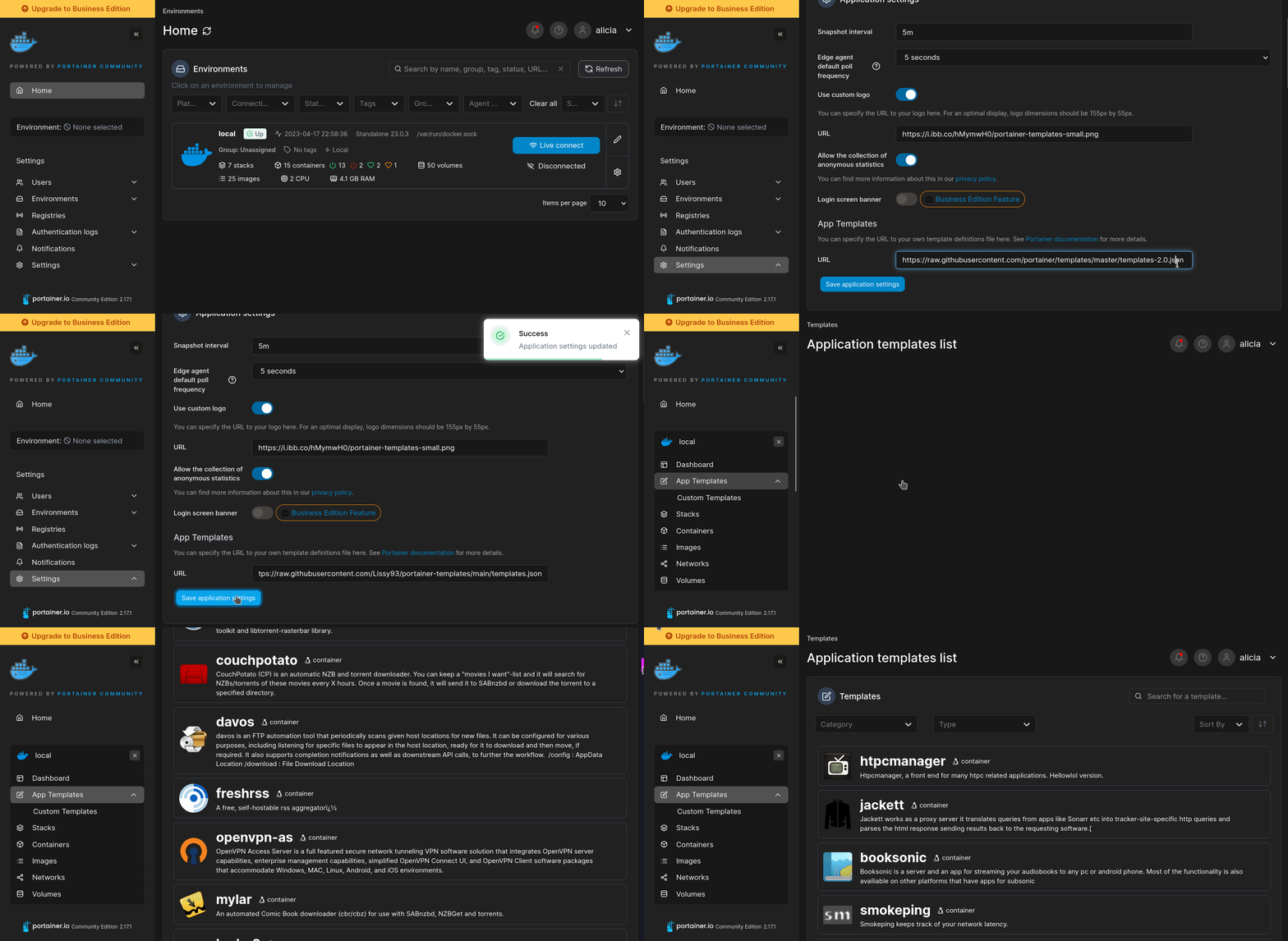
Import all app templates into your Portainer instance, for easy 1-click deploys
- Ensure both Docker and Portainer are installed, and up-to-date
- Log into your Portainer web UI
- Under Settings → App Templates, paste the below URL
- Head to Home → App Templates, and the list of apps will show up
- Select TEI Embeddings, fill in any config options, and hit Deploy
Template Import URL
https://raw.githubusercontent.com/Lissy93/portainer-templates/main/templates.json
Show Me
Original stackfile
The compose file this template deploys, straight from its repo:
name: tei

services:
  tei:
    image: ghcr.io/huggingface/text-embeddings-inference:cpu-1.9
    restart: unless-stopped
    environment:
      PORT: "5000"
      MODEL_ID: ${MODEL_ID:-BAAI/bge-small-en-v1.5}
      HUGGINGFACE_HUB_CACHE: /data
    ports:
      - "5000:5000"
    volumes:
      - modelcache:/data

volumes:
  modelcache:
Or deploy it directly from the source:
git clone https://github.com/deployable-sh/stacks
cd stacks
docker compose -f tei/compose.yaml up -d
More install options in our documentation, or see huggingface/text-embeddings-inference for app-specific guidance.
Text Embeddings Inference


A blazing fast inference solution for text embeddings models.
Benchmark for BAAI/bge-base-en-v1.5 on an NVIDIA A10 with a sequence length of 512 tokens:


Table of contents
- [Supported Models](#supported-models)
- [Docker](#docker)
- [Docker Images](#docker-images)
- [API Documentation](#api-documentation)
- [Using a private or gated model](#using-a-private-or-gated-model)
- [Air gapped deployment](#air-gapped-deployment)
- [Using Re-rankers models](#using-re-rankers-models)
- [Using Sequence Classification models](#using-sequence-classification-models)
- [Using SPLADE pooling](#using-splade-pooling)
- [Distributed Tracing](#distributed-tracing)
- [gRPC](#grpc)- [Apple Silicon (Homebrew)](#apple-silicon-homebrew)- [ARM64 / aarch64](#arm64--aarch64)Text Embeddings Inference (TEI) is a toolkit for deploying and serving open source text embeddings and sequence classification models. TEI enables high-performance extraction for the most popular models, including FlagEmbedding, Ember, GTE and E5. TEI implements many features such as:
- No model graph compilation step
- Metal support for local execution on Macs
- Small docker images and fast boot times. Get ready for true serverless!
- Token based dynamic batching
- Optimized transformers code for inference using Flash Attention,
- Safetensors weight loading
- ONNX weight loading
- Production ready (distributed tracing with Open Telemetry, Prometheus metrics)
Get Started
Supported Models
Text Embeddings
Text Embeddings Inference currently supports Nomic, BERT, CamemBERT, XLM-RoBERTa models with absolute positions, JinaBERT model with Alibi positions and Mistral, Alibaba GTE, Qwen2 models with Rope positions, MPNet, ModernBERT, Qwen3, and Gemma3.Below are some examples of the currently supported models:
To explore the list of best performing text embeddings models, visit the Massive Text Embedding Benchmark (MTEB) Leaderboard.
Sequence Classification and Re-Ranking
Text Embeddings Inference currently supports CamemBERT, and XLM-RoBERTa Sequence Classification models with absolute positions.Below are some examples of the currently supported models:
| Task | Model Type | Model ID |
|---|---|---|
| Re-Ranking | XLM-RoBERTa | BAAI/bge-reranker-large |
| Re-Ranking | XLM-RoBERTa | BAAI/bge-reranker-base |
| Re-Ranking | GTE | Alibaba-NLP/gte-multilingual-reranker-base |
| Re-Ranking | ModernBert | Alibaba-NLP/gte-reranker-modernbert-base |
| Sentiment Analysis | RoBERTa | SamLowe/roberta-base-goemotions |
Docker
model=Qwen/Qwen3-Embedding-0.6B
volume=$PWD/data # share a volume with the Docker container to avoid downloading weights every run

docker run --gpus all -p 8080:80 -v $volume:/data --pull always ghcr.io/huggingface/text-embeddings-inference:cuda-1.9 --model-id $model
And then you can make requests like
curl 127.0.0.1:8080/embed \
    -X POST \
    -d '{"inputs":"What is Deep Learning?"}' \
    -H 'Content-Type: application/json'
Note: To use GPUs, you need to install the NVIDIA Container Toolkit. NVIDIA drivers on your machine need to be compatible with CUDA version 12.2 or higher.
To see all options to serve your models:
$ text-embeddings-router --help
Text Embedding Webserver

Usage: text-embeddings-router [OPTIONS] --model-id <MODEL_ID>

Options:
      --model-id <MODEL_ID>
          The Hugging Face model ID, can be any model listed on <https://huggingface.co/models> with the `text-embeddings-inference` tag (meaning it's compatible with Text Embeddings Inference).

          Alternatively, the specified ID can also be a path to a local directory containing the necessary model files saved by the `save_pretrained(...)` methods of either Transformers or Sentence Transformers.

          [env: MODEL_ID=]

      --revision <REVISION>
          The actual revision of the model if you're referring to a model on the hub. You can use a specific commit id or a branch like `refs/pr/2`

          [env: REVISION=]

      --tokenization-workers <TOKENIZATION_WORKERS>
          Optionally control the number of tokenizer workers used for payload tokenization, validation and truncation. Default to the number of CPU cores on the machine

          [env: TOKENIZATION_WORKERS=]

      --dtype <DTYPE>
          The dtype to be forced upon the model

          [env: DTYPE=]
          [possible values: float16, float32]

      --served-model-name <SERVED_MODEL_NAME>
          The name of the model that is being served. If not specified, defaults to `--model-id`. It is only used for the OpenAI-compatible endpoints via HTTP

          [env: SERVED_MODEL_NAME=]

      --pooling <POOLING>
          Optionally control the pooling method for embedding models.

          If `pooling` is not set, the pooling configuration will be parsed from the model `1_Pooling/config.json` configuration.

          If `pooling` is set, it will override the model pooling configuration

          [env: POOLING=]

          Possible values:
          - cls:        Select the CLS token as embedding
          - mean:       Apply Mean pooling to the model embeddings
          - splade:     Apply SPLADE (Sparse Lexical and Expansion) to the model embeddings. This option is only available if the loaded model is a `ForMaskedLM` Transformer model
          - last-token: Select the last token as embedding

      --max-concurrent-requests <MAX_CONCURRENT_REQUESTS>
          The maximum amount of concurrent requests for this particular deployment. Having a low limit will refuse clients requests instead of having them wait for too long and is usually good to handle backpressure correctly

          [env: MAX_CONCURRENT_REQUESTS=]
          [default: 512]

      --max-batch-tokens <MAX_BATCH_TOKENS>
          **IMPORTANT** This is one critical control to allow maximum usage of the available hardware.

          This represents the total amount of potential tokens within a batch.

          For `max_batch_tokens=1000`, you could fit `10` queries of `total_tokens=100` or a single query of `1000` tokens.

          Overall this number should be the largest possible until the model is compute bound. Since the actual memory overhead depends on the model implementation, text-embeddings-inference cannot infer this number automatically.

          [env: MAX_BATCH_TOKENS=]
          [default: 16384]

      --max-batch-requests <MAX_BATCH_REQUESTS>
          Optionally control the maximum number of individual requests in a batch

          [env: MAX_BATCH_REQUESTS=]

      --max-client-batch-size <MAX_CLIENT_BATCH_SIZE>
          Control the maximum number of inputs that a client can send in a single request

          [env: MAX_CLIENT_BATCH_SIZE=]
          [default: 32]

      --auto-truncate
          Control automatic truncation of inputs that exceed the model's maximum supported size. Defaults to `true` (truncation enabled). Set to `false` to disable truncation; when disabled and the model's maximum input length exceeds `--max-batch-tokens`, the server will refuse to start with an error instead of silently truncating sequences.

          Unused for gRPC servers

          [env: AUTO_TRUNCATE=]

      --default-prompt-name <DEFAULT_PROMPT_NAME>
          The name of the prompt that should be used by default for encoding. If not set, no prompt will be applied.

          Must be a key in the `sentence-transformers` configuration `prompts` dictionary.

          For example if ``default_prompt_name`` is "query" and the ``prompts`` is {"query": "query: ", ...}, then the sentence "What is the capital of France?" will be encoded as "query: What is the capital of France?" because the prompt text will be prepended before any text to encode.

          The argument '--default-prompt-name <DEFAULT_PROMPT_NAME>' cannot be used with '--default-prompt <DEFAULT_PROMPT>`

          [env: DEFAULT_PROMPT_NAME=]

      --default-prompt <DEFAULT_PROMPT>
          The prompt that should be used by default for encoding. If not set, no prompt will be applied.

          For example if ``default_prompt`` is "query: " then the sentence "What is the capital of France?" will be encoded as "query: What is the capital of France?" because the prompt text will be prepended before any text to encode.

          The argument '--default-prompt <DEFAULT_PROMPT>' cannot be used with '--default-prompt-name <DEFAULT_PROMPT_NAME>`

          [env: DEFAULT_PROMPT=]

      --dense-path <DENSE_PATH>
          Optionally, define the path to the Dense module required for some embedding models.

          Some embedding models require an extra `Dense` module which contains a single Linear layer and an activation function. By default, those `Dense` modules are stored under the `2_Dense` directory, but there might be cases where different `Dense` modules are provided, to convert the pooled embeddings into different dimensions, available as `2_Dense_<dims>` e.g. https://huggingface.co/NovaSearch/stella_en_400M_v5.

          Note that this argument is optional, only required to be set if there is no `modules.json` file or when you want to override a single Dense module path, only when running with the `candle` backend.

          [env: DENSE_PATH=]

      --hf-token <HF_TOKEN>
          Your Hugging Face Hub token. If neither `--hf-token` nor `HF_TOKEN` are set, the token will be read from the `$HF_HOME/token` path, if it exists. This ensures access to private or gated models, and allows for a more permissive rate limiting

          [env: HF_TOKEN=]

      --hostname <HOSTNAME>
          The IP address to listen on

          [env: HOSTNAME=]
          [default: 0.0.0.0]

      -p, --port <PORT>
          The port to listen on

          [env: PORT=]
          [default: 3000]

      --uds-path <UDS_PATH>
          The name of the unix socket some text-embeddings-inference backends will use as they communicate internally with gRPC

          [env: UDS_PATH=]
          [default: /tmp/text-embeddings-inference-server]

      --huggingface-hub-cache <HUGGINGFACE_HUB_CACHE>
          The location of the huggingface hub cache. Used to override the location if you want to provide a mounted disk for instance

          [env: HUGGINGFACE_HUB_CACHE=]

      --payload-limit <PAYLOAD_LIMIT>
          Payload size limit in bytes

          Default is 2MB

          [env: PAYLOAD_LIMIT=]
          [default: 2000000]

      --api-key <API_KEY>
          Set an api key for request authorization.

          By default the server responds to every request. With an api key set, the requests must have the Authorization header set with the api key as Bearer token.

          [env: API_KEY=]

      --json-output
          Outputs the logs in JSON format (useful for telemetry)

          [env: JSON_OUTPUT=]

      --disable-spans
          Whether or not to include the log trace through spans

          [env: DISABLE_SPANS=]

      --otlp-endpoint <OTLP_ENDPOINT>
          The grpc endpoint for opentelemetry. Telemetry is sent to this endpoint as OTLP over gRPC. e.g. `http://localhost:4317`

          [env: OTLP_ENDPOINT=]

      --otlp-service-name <OTLP_SERVICE_NAME>
          The service name for opentelemetry. e.g. `text-embeddings-inference.server`

          [env: OTLP_SERVICE_NAME=]
          [default: text-embeddings-inference.server]

      --prometheus-port <PROMETHEUS_PORT>
          The Prometheus port to listen on

          [env: PROMETHEUS_PORT=]
          [default: 9000]

      --cors-allow-origin <CORS_ALLOW_ORIGIN>
          Unused for gRPC servers

          [env: CORS_ALLOW_ORIGIN=]

  -h, --help
          Print help (see a summary with '-h')

  -V, --version
          Print version
Docker Images
Text Embeddings Inference ships with multiple Docker images that you can use to target a specific backend:| Architecture | Platform | Image |
|---|---|---|
| CPU | x8664 | ghcr.io/huggingface/text-embeddings-inference:cpu-1.9 |
| CPU | aarch64 | ghcr.io/huggingface/text-embeddings-inference:cpu-arm64-1.9 |
| Volta | x8664 | NOT SUPPORTED |
| Turing (T4, RTX 2000 series, ...) | x8664 | ghcr.io/huggingface/text-embeddings-inference:turing-1.9 (experimental) |
| Ampere 8.0 (A100, A30) | x8664 | ghcr.io/huggingface/text-embeddings-inference:1.9 |
| Ampere 8.6 (A10, A40, ...) | x8664 | ghcr.io/huggingface/text-embeddings-inference:86-1.9 |
| Ada Lovelace (RTX 4000 series, ...) | x8664 | ghcr.io/huggingface/text-embeddings-inference:89-1.9 |
| Hopper (H100) | x8664 | ghcr.io/huggingface/text-embeddings-inference:hopper-1.9 |
| Blackwell 10.0 (B200, GB200, ...) | x8664 | ghcr.io/huggingface/text-embeddings-inference:100-1.9 (experimental) |
| Blackwell 12.0 (GeForce RTX 50X0, ...) | x8664 | ghcr.io/huggingface/text-embeddings-inference:120-1.9 (experimental) |
| Blackwell 12.1 (DGX Spark GB10, ...) | multi | ghcr.io/huggingface/text-embeddings-inference:121-1.9 (experimental) |
Warning: Flash Attention is turned off by default for the Turing image as it suffers from precision issues. You can turn Flash Attention v1 ON by using the
USE_FLASH_ATTENTION=True environment variable.API documentation
You can consult the OpenAPI documentation of thetext-embeddings-inference REST API using the /docs route.
The Swagger UI is also available
at: https://huggingface.github.io/text-embeddings-inference.Using a private or gated model
You have the option to utilize theHF_TOKEN environment variable for configuring the token employed by
text-embeddings-inference. This allows you to gain access to protected resources.For example:
- Go to https://huggingface.co/settings/tokens
- Copy your CLI READ token
- Export
HF_TOKEN=<your CLI READ token>
or with Docker:
model=<your private model>
volume=$PWD/data # share a volume with the Docker container to avoid downloading weights every run
token=<your CLI READ token>

docker run --gpus all -e HF_TOKEN=$token -p 8080:80 -v $volume:/data --pull always ghcr.io/huggingface/text-embeddings-inference:cuda-1.9 --model-id $model
Air gapped deployment
To deploy Text Embeddings Inference in an air-gapped environment, first download the weights and then mount them inside the container using a volume.For example:
# (Optional) create a `models` directory
mkdir models
cd models

# Make sure you have git-lfs installed (https://git-lfs.com)
git lfs install
git clone https://huggingface.co/Qwen/Qwen3-Embedding-0.6B

# Set the models directory as the volume path
volume=$PWD

# Mount the models directory inside the container with a volume and set the model ID
docker run --gpus all -p 8080:80 -v $volume:/data --pull always ghcr.io/huggingface/text-embeddings-inference:cuda-1.9 --model-id /data/Qwen3-Embedding-0.6B
Using Re-rankers models
text-embeddings-inference v0.4.0 added support for CamemBERT, RoBERTa, XLM-RoBERTa, and GTE Sequence Classification models.
Re-rankers models are Sequence Classification cross-encoders models with a single class that scores the similarity
between a query and a text.See this blogpost by the LlamaIndex team to understand how you can use re-rankers models in your RAG pipeline to improve downstream performance.
model=BAAI/bge-reranker-large
volume=$PWD/data # share a volume with the Docker container to avoid downloading weights every run

docker run --gpus all -p 8080:80 -v $volume:/data --pull always ghcr.io/huggingface/text-embeddings-inference:cuda-1.9 --model-id $model
And then you can rank the similarity between a query and a list of texts with:
curl 127.0.0.1:8080/rerank \
    -X POST \
    -d '{"query": "What is Deep Learning?", "texts": ["Deep Learning is not...", "Deep learning is..."]}' \
    -H 'Content-Type: application/json'
Using Sequence Classification models
You can also use classic Sequence Classification models likeSamLowe/roberta-base-go_emotions:model=SamLowe/roberta-base-go_emotions
volume=$PWD/data # share a volume with the Docker container to avoid downloading weights every run
docker run --gpus all -p 8080:80 -v $volume:/data --pull always ghcr.io/huggingface/text-embeddings-inference:cuda-1.9 --model-id $modelOnce you have deployed the model you can use the
predict endpoint to get the emotions most associated with an input:curl 127.0.0.1:8080/predict \
-X POST \
-d '{"inputs":"I like you."}' \
-H 'Content-Type: application/json'Using SPLADE pooling
You can choose to activate SPLADE pooling for Bert and Distilbert MaskedLM architectures:model=naver/efficient-splade-VI-BT-large-query
volume=$PWD/data # share a volume with the Docker container to avoid downloading weights every run
docker run --gpus all -p 8080:80 -v $volume:/data --pull always ghcr.io/huggingface/text-embeddings-inference:cuda-1.9 --model-id $model --pooling spladeOnce you have deployed the model you can use the
/embed_sparse endpoint to get the sparse embedding:curl 127.0.0.1:8080/embed_sparse \
-X POST \
-d '{"inputs":"I like you."}' \
-H 'Content-Type: application/json'Distributed Tracing
text-embeddings-inference is instrumented with distributed tracing using OpenTelemetry. You can use this feature
by setting the address to an OTLP collector with the --otlp-endpoint argument.gRPC
text-embeddings-inference offers a gRPC API as an alternative to the default HTTP API for high performance
deployments. The API protobuf definition can be
found here.You can use the gRPC API by adding the
-grpc tag to any TEI Docker image. For example:model=Qwen/Qwen3-Embedding-0.6B
volume=$PWD/data # share a volume with the Docker container to avoid downloading weights every run
docker run --gpus all -p 8080:80 -v $volume:/data --pull always ghcr.io/huggingface/text-embeddings-inference:cuda-1.9-grpc --model-id $modelgrpcurl -d '{"inputs": "What is Deep Learning"}' -plaintext 0.0.0.0:8080 tei.v1.Embed/EmbedLocal install
Apple Silicon (Homebrew)
On Apple Silicon (M1/M2/M3/M4), you can install a prebuilt binary via Homebrew:brew install text-embeddings-inferenceThen launch Text Embeddings Inference with Metal acceleration:
model=Qwen/Qwen3-Embedding-0.6B

text-embeddings-router --model-id $model --port 8080
CPU
You can also opt to installtext-embeddings-inference locally.First install Rust:
curl --proto '=https' --tlsv1.2 -sSf https://sh.rustup.rs | shThen run:
# On x86 with ONNX backend (recommended)
cargo install --path router -F ort
# On x86 with Intel backend
cargo install --path router -F mkl
# On M1 or M2
cargo install --path router -F metal
You can now launch Text Embeddings Inference on CPU with:
model=Qwen/Qwen3-Embedding-0.6B

text-embeddings-router --model-id $model --port 8080
Note: on some machines, you may also need the OpenSSL libraries and gcc. On Linux machines, run:
sudo apt-get install libssl-dev gcc -yCUDA
GPUs with CUDA compute capabilities < 7.5 are not supported (V100, Titan V, GTX 1000 series, ...).Make sure you have CUDA and the NVIDIA drivers installed. NVIDIA drivers on your device need to be compatible with CUDA version 12.2 or higher. You also need to add the NVIDIA binaries to your path:
export PATH=$PATH:/usr/local/cuda/binThen run the following (might take a while as it needs to compile the CUDA kernels):
# On Turing GPUs (T4, RTX 2000 series ... )
cargo install --path router -F candle-cuda-turing

# On Ampere, Ada Lovelace, Hopper and Blackwell
cargo install --path router -F candle-cuda
You can now launch Text Embeddings Inference on GPU as follows:
model=Qwen/Qwen3-Embedding-0.6B

text-embeddings-router --model-id $model --port 8080
Docker
You can build the CPU container with Docker as:docker build -f Dockerfile .To build the CUDA containers, you need to know the compute cap of the GPU you will be using at runtime, to build the image accordingly:
# Get submodule dependencies
git submodule update --init

# Example for Turing (T4, RTX 2000 series, ...)
runtime_compute_cap=75

# Example for Ampere (A100, ...)
runtime_compute_cap=80

# Example for Ampere (A10, ...)
runtime_compute_cap=86

# Example for Ada Lovelace (RTX 4000 series, ...)
runtime_compute_cap=89

# Example for Hopper (H100, ...)
runtime_compute_cap=90

# Example for Blackwell (B200, GB200, ...)
runtime_compute_cap=100

# Example for Blackwell (GeForce RTX 50X0, RTX PRO 6000, ...)
runtime_compute_cap=120

# Example for Blackwell GB10 (DGX Spark)
runtime_compute_cap=121

docker build . -f Dockerfile-cuda --build-arg CUDA_COMPUTE_CAP=$runtime_compute_cap
ARM64 / aarch64
CPU-only (Apple Silicon, Ampere, Graviton)
For ARM64 hosts without NVIDIA GPUs, use the CPU Dockerfile. Inference runs on CPU cores only (no Metal/MPS support via Docker).docker build . -f Dockerfile-arm64 --platform=linux/arm64CUDA on ARM64 (DGX Spark, Jetson)
For ARM64 hosts with NVIDIA GPUs, buildDockerfile-cuda with the appropriate compute
capability and --platform linux/arm64:# DGX Spark (GB10, sm_121)
docker build . -f Dockerfile-cuda \
--build-arg CUDA_COMPUTE_CAP=121 \
--platform linux/arm64
# Future ARM64 + Blackwell devices (sm_120)
docker build . -f Dockerfile-cuda \
--build-arg CUDA_COMPUTE_CAP=120 \
--platform linux/arm64AMD Instinct GPUs (ROCm)
TEI supports AMD Instinct GPUs (MI200, MI300 series) via ROCm.model=BAAI/bge-base-en-v1.5
volume=$PWD/data
docker run \
--device /dev/kfd --device /dev/dri \
--group-add video \
--ipc=host \
-p 8080:80 \
-v $volume:/data \
--pull always \
ghcr.io/huggingface/text-embeddings-inference:rocm-latest \
--model-id $model --dtype bfloat16For full setup instructions, see the AMD Instinct GPU guide.
Examples
Serve TEI Embeddings on your own domain behind Caddy, Nginx or Traefik. Fill in your domain and copy the result. It's a starting point, some apps need their own base URL or extra headers set too.
Proxying tei-embeddings.example.com to http://tei:5000
Add this to your Caddyfile
tei-embeddings.example.com {
	reverse_proxy http://tei:5000
}Check the logs first
Nine times out of ten the logs tell you exactly what went wrong.
- In Portainer, go to Containers, click the container, then Logs. Or run
docker logs <container> - Exit codes help too:
137means killed, usually out of memory.126or127means the command inside the image is broken.
Port already in use
If deployment fails with "Bind for 0.0.0.0:5000 failed: port is already allocated", something else on your server is using that port.
- Find what's using it:
sudo ss -tlnp | grep :5000 - Stop the other service, or pick a different host port. In
5000:5000only the left number is yours to change, the right one belongs to the app.
Running but the page won't load
The container is up but nothing appears in your browser.
- Use your server's real IP:
http://your-server-ip:5000. The 0.0.0.0 link Portainer shows isn't a real address. - Give it a minute after first deploy, tei can take a while to initialise.
- Make sure your firewall allows the port, e.g.
sudo ufw allow 5000
Image won't pull
Test the pull directly on the host: docker pull ghcr.io/huggingface/text-embeddings-inference:cpu-1.9
- "manifest unknown" means the tag no longer exists.
- "toomanyrequests" is the Docker Hub rate limit. Log in with
docker loginto raise it. - "no space left on device" means a full disk. Reclaim space with
docker system prune
"exec format error"
This means the image was built for a different CPU architecture than your server.
- This image supports:
amd64 - Check yours with
uname -m: x86_64 is amd64, aarch64 is arm64. Raspberry Pi and other ARM boards are the usual culprits.
Container keeps restarting
The unless-stopped restart policy relaunches the app after every crash, so the real error can scroll past.
- Check the logs right after a restart, the last few lines before it died are the useful ones.
- Get the exit code with
docker inspect <container> --format '{{.State.ExitCode}}' - Still stuck? Redeploy once with the restart policy set to
noso the failure stays visible.
Stack won't deploy
Compose stacks fail fast on small mistakes, and Portainer shows the reason just above the editor.
- YAML only accepts spaces for indentation, a single tab breaks the whole file.
Raise an issue
Found something which isn't working as it should? Here's how to report it.
- Bug within the app: Open an issue on huggingface/text-embeddings-inference
- Template not working: Open an issue on deployable-sh/stacks
- This website not working: Open an issue on lissy93/portainer-templates
A Compose stack
TEI Embeddings is a Compose stack, a set of containers defined in one file and brought up together by Portainer, then started and stopped as a single app.
The app image
An image is the app packed up ready to go, everything TEI Embeddings needs bundled into one download. This template pulls ghcr.io/huggingface/text-embeddings-inference:cpu-1.9, which Docker fetches once (about 228 MB) and then starts your own copy from.
Where the image comes from
Docker pulls its images from registries, public libraries of ready-built apps. TEI Embeddings's comes from the GitHub Container Registry, published by huggingface.
Version tags
The bit after the colon in the image name is the version tag. This one pins cpu-1.9, so every redeploy gives you that exact build until you bump it yourself.
Which machines it runs on
Every image is built for particular CPU types. This one ships for amd64, so it runs on regular x86 PCs and servers, though not ARM boards like a Raspberry Pi.
Ports
A port is the door the app answers on. A mapping like 5000:5000 means it's reachable on port 5000 of your server, where the left number is yours to change and the right one belongs to the app. It opens:
5000:5000
Volumes
A volume is where TEI Embeddings keeps its files so they survive an update or a restart. Without one, anything it saves would sit inside the container and vanish the moment it's recreated. This template mounts:
/datakept in themodelcachevolume Docker manages
Environment variables
Environment variables are the settings you hand over when you deploy, things like a password or a timezone. TEI Embeddings takes 3 of them, all with defaults you can leave alone or tweak:
PORT, defaults to5000MODEL_ID, defaults toBAAI/bge-small-en-v1.5HUGGINGFACE_HUB_CACHE, defaults to/data
Restart policy
The restart policy here is unless-stopped, so Docker restarts TEI Embeddings after a crash or reboot, but leaves it off when you stop it on purpose. You can change this on the deploy screen. The choices are no (never restart), on-failure (only after a crash), unless-stopped (restart unless you stop it), and always (bring it back no matter what).
Networking
Nothing custom is set, so TEI Embeddings sits on Docker's default bridge network: its own private space that reaches the outside world only through the ports it publishes.
Container name
Once it's deployed, Portainer names the container tei. That's what you'll spot in the containers list and use in commands like docker logs tei.
Platform
The platform is linux, the kind of system the container is built to run on. Docker and Portainer handle this on a normal Linux server.
Open source license
TEI Embeddings is open source, released under the Apache-2.0 license. In plain terms the code is out in the open, so you're free to run it and change it to fit what you need.
Portainer app templates
Zooming out, this whole page comes from a Portainer app template: a short recipe telling Portainer how to set TEI Embeddings up. Add the template list to Portainer once, then deploying TEI Embeddings is a click rather than a wall of config.