
![NUT Server]() NUT Server
NUT Server
Container
The purpose of NUT Server is to monitor a UPS attached device
Image details
Configuration
TypeContainerlinuxinstantlinux/nut-upsd:latest3493:3493/tcpPUID=1000PGID=1000SERIAL=noneNAME=noneVENDOR ID=noneAPI_PASSWORD=noneDESCRIPTION=noneunless-stoppedTemplate by novaspirit
Report issueNotes
Check our Github page: https://github.com/pi-hosted/pi-hosted
Official Webpage: https://networkupstools.org
Official Docker Documentation: https://hub.docker.com/r/instantlinux/nut-upsd
Standalone Install
Select an install method, to see config/commands for deploying NUT Server
Install on Portainer
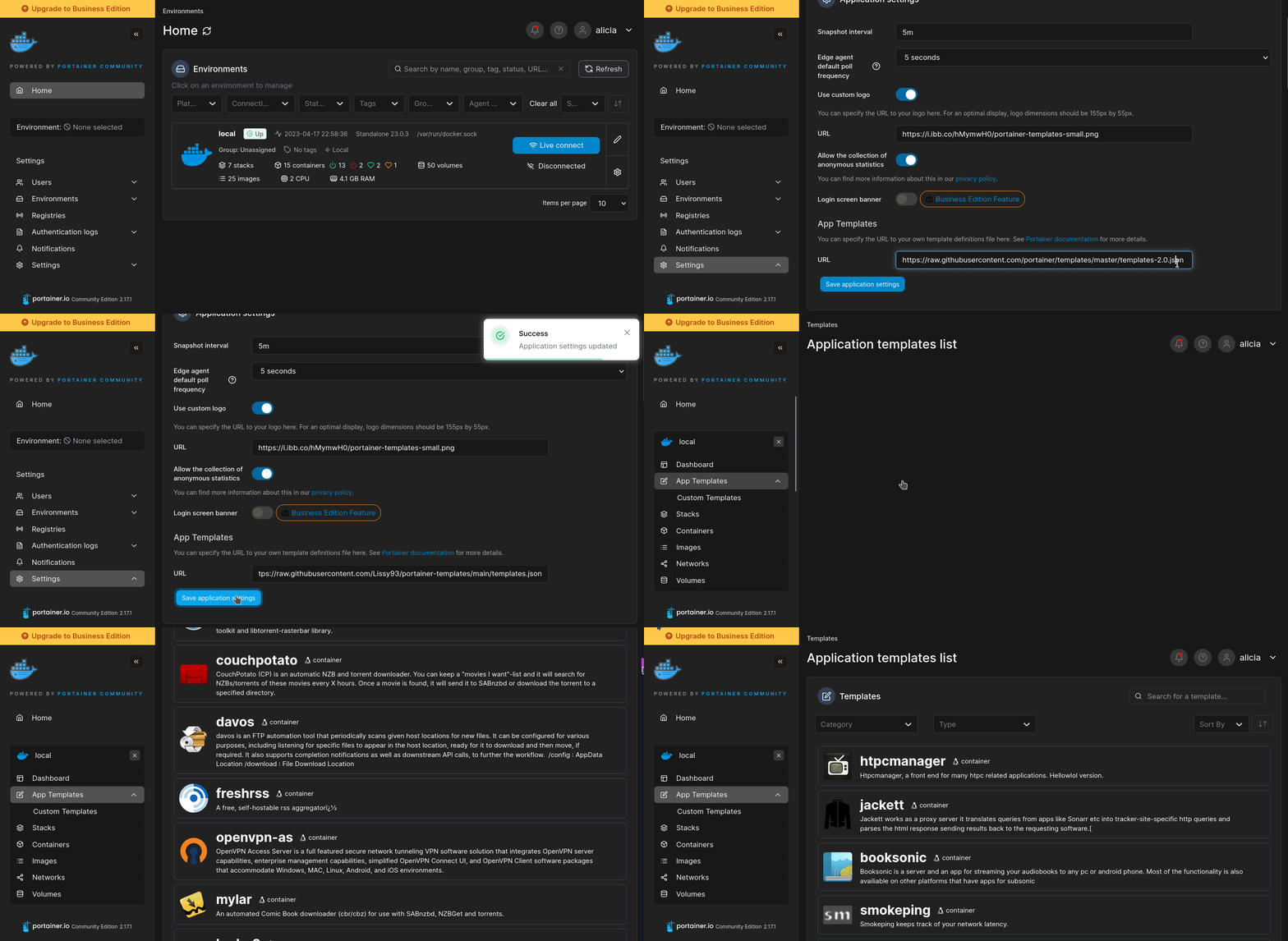
Import all app templates into your Portainer instance, for easy 1-click deploys
- Ensure both Docker and Portainer are installed, and up-to-date
- Log into your Portainer web UI
- Under Settings → App Templates, paste the below URL
- Head to Home → App Templates, and the list of apps will show up
- Select NUT Server, fill in any config options, and hit Deploy
Template Import URL
https://raw.githubusercontent.com/Lissy93/portainer-templates/main/templates.json
Show Me
More install options in our documentation.
nut-upsd





The Network UPS Tools (nut) package in an Alpine container, with enough configuration to support Nagios monitoring of your UPS units. This multi-architecture image supports Intel/AMD and ARM (Raspberry Pi etc).
Usage
See the kubernetes.yaml / docker-compose.yml files provided here in the source directory; this needs to run in privileged mode in order to access USB devices.Pick a random password for the API user and place it in a Docker secret (if you're not using swarm or kubernetes, put it in the filepath as shown at bottom of docker-compose.yml, e.g. /var/adm/admin/secrets/nut-upsd-password).
This will expose TCP port 3493; to reach it with the standard Nagios plugin, set up a service to invoke:
/usr/lib/nagios/plugins/check_ups -H <dockerhost> -u <name> [ -p <port> ]As a read-only service intended for monitoring, this container makes no attempt to lock down network security.
Verified with the most-common type of UPS, the APC consumer-grade product; Tripp Lite models also (probably) work. CyberPower models need a MAXAGE parameter set longer than default (25). Note that the usbhid-ups driver for APC requires you to provide the correct 12-digit hardware serial number. All other parameter defaults will work.
If you have a different model of UPS, contents of the files ups.conf, upsd.conf, upsmon.conf, and/or upsd.users can be overridden by mounting them to /etc/nut/local.
If you have more than one UPS connected to a host, run more than one copy of this container and bind the container port 3493 from each to a separate TCP port.
This repo has complete instructions for building a kubernetes cluster where you can launch with helm or kubernetes.yaml using make and customizing Makefile.vars after cloning this repo:
This make target is defined in Makefile.instances
make nut-01Variables
These variables can be passed to the image from kubernetes.yaml or docker-compose.yml as needed:Variable | Default | Description | -------- | ------- | ----------- | ACTIONS | | One or more user actions allowed (
set, fsd)
APIUSER | upsmon| API user
APIPASSWORD | | API password, if not using secret
DESCRIPTION | UPS | user-assigned description
DRIVER | usbhid-ups | driver (see compatibility list)
GROUP | nut | local group
INSTCMDS | | all or list of allowed commands, see cmdvartab CMDDESC values
MAXAGE | 15 | seconds before declaring driver non-responsive
NAME | ups | user-assigned config name
NOTIFYCMD | | full path of script to run upon notification
NUTDEBUGLEVEL | 0 | verbosity of debug messages
NUTQUIETINITSSL | true | inhibit superfluous startup warning
NUTQUIETINITUPSNOTIFY | true | inhibit superfluous startup warning
POLLINTERVAL | | Poll Interval for ups.conf
POLLONLY | | Disable USB interrupt reads
PORT | auto | device port (e.g. /dev/ttyUSB0) on host
SDORDER | | UPS shutdown sequence, set to -1 to disable shutdown
SECRETNAME | nut-upsd-password | name of secret to use for API user
SERIAL | | hardware serial number of UPS
SERVER | primary | primary instance shuts down after secondaries
ULIMIT | 2048 | open-files ulimit
USER | nut | local user
VENDORID | | vendor ID for ups.confNotes
To define a notify script, volume-mount it via your docker-compose file under /usr/local/bin or in your helm values overrides and set the NOTIFYCMD environment variable. (Don't mount any executable scripts under /etc/nut, put them under /usr/local).If you need a driver other than
usbhid-ups, the full list of supported drivers can be listed as follows:
docker run --rm --entrypoint /bin/ls instantlinux/nut-upsd /usr/lib/nutMYDRIVER=liebert
docker run --rm --entrypoint /usr/lib/nut/$MYDRIVER instantlinux/nut-upsd -h
Network UPS Tools - Liebert MultiLink UPS driver 1.02 (3.15.0_alpha20210804-3402-gced1683082)
Warning: This is an experimental driver.
Some features may not function correctly.
usage: liebert -a <id> [OPTIONS]
-a <id> - autoconfig using ups.conf section <id>
- note: -x after -a overrides ups.conf settings
-V - print version, then exit
-L - print parseable list of driver variables
-D - raise debugging level
-q - raise log level threshold
-h - display this help
-k - force shutdown
-i <int> - poll interval
-r <dir> - chroot to <dir>
-u <user> - switch to <user> (if started as root)
-x <var>=<val> - set driver variable <var> to <val>
- example: -x cable=940-0095B
Acceptable values for -x or ups.conf in this driver:
Override manufacturer name : -x mfr=<value>
Override model name : -x model=<value>For Tripp Lite models, you may need to specify VENDORID 09ae in the environment. Also check to see if you need a POLLINTERVAL setting. For any make or model, here's how to identify the idVendor and iSerial values from a root shell on your host:
# lsusb
 ...
Bus 001 Device 005: ID 051d:0002 American Power Conversion Uninterruptible Power Supply
# lsusb -D /dev/bus/usb/001/005
Device: ID 051d:0002 American Power Conversion Uninterruptible Power Supply
 ...
  idVendor           0x051d American Power Conversion
  idProduct          0x0002 Uninterruptible Power Supply
  bcdDevice            0.90
  iManufacturer           1 American Power Conversion
  iProduct                2 Back-UPS RS 1500G FW:865.L6 .D USB FW:L6
  iSerial                 3 4B1624P26350
If you require udev rules to set permissions, configure your host prior to running the container. For example:
cat >/etc/udev/rules.d/99-usb-serial.rules <<EOF
ACTION=="add", SUBSYSTEM=="usb", ATTRS{idVendor}==“09ae”, ATTRS{idProduct}==“2012”, MODE="0660", GROUP="nut"
EOF
udevadm control --reload-rules && udevadm trigger
When starting up under Debian trixie, an out-of-memory error can be prevented by setting the nofile ulimit to a smaller value than system default: see issue #1672. The default is set here to 2048.
If you see this error message on startup:
Unable to use old-style MONITOR line without a username
Convert it and add a username to upsd.users - see the documentationnut-upsd-password).Secrets
If the API user needs a password, you have two ways to specify it: pass the value itself as environment variable APIPASSWORD (which isn't secure), or define a Docker secret as follows:| Secret | Description |
|---|---|
| nut-upsd-password | Password for API user |
Contributing
If you want to make improvements to this image, see CONTRIBUTING.

Serve NUT Server on your own domain behind Caddy, Nginx or Traefik. Fill in your domain and copy the result. It's a starting point, some apps need their own base URL or extra headers set too.
Proxying nut-server.example.com to http://NUT Server:3493
Add this to your Caddyfile
nut-server.example.com {
	reverse_proxy http://NUT Server:3493
}Check the logs first
Nine times out of ten the logs tell you exactly what went wrong.
- In Portainer, go to Containers, click the container, then Logs. Or run
docker logs NUT Server - Exit codes help too:
137means killed, usually out of memory.126or127means the command inside the image is broken.
Port already in use
If deployment fails with "Bind for 0.0.0.0:3493 failed: port is already allocated", something else on your server is using that port.
- Find what's using it:
sudo ss -tlnp | grep :3493 - Stop the other service, or pick a different host port. In
3493:3493only the left number is yours to change, the right one belongs to the app.
Running but the page won't load
The container is up but nothing appears in your browser.
- Use your server's real IP:
http://your-server-ip:3493. The 0.0.0.0 link Portainer shows isn't a real address. - Give it a minute after first deploy, NUT Server can take a while to initialise.
- Make sure your firewall allows the port, e.g.
sudo ufw allow 3493
Image won't pull
Test the pull directly on the host: docker pull instantlinux/nut-upsd:latest
- "manifest unknown" means the tag no longer exists. This template uses
latest, so try pinning a specific version instead. - "toomanyrequests" is the Docker Hub rate limit. Log in with
docker loginto raise it. - "no space left on device" means a full disk. Reclaim space with
docker system prune
"exec format error"
This means the image was built for a different CPU architecture than your server.
- This image supports:
amd64, arm64, arm/v7, arm/v6 - Check yours with
uname -m: x86_64 is amd64, aarch64 is arm64. Raspberry Pi and other ARM boards are the usual culprits.
Container keeps restarting
The unless-stopped restart policy relaunches the app after every crash, so the real error can scroll past.
- Check the logs right after a restart, the last few lines before it died are the useful ones.
- Get the exit code with
docker inspect NUT Server --format '{{.State.ExitCode}}' - Still stuck? Redeploy once with the restart policy set to
noso the failure stays visible.
Data disappears when the container is recreated
This template doesn't define any volumes, so everything NUT Server saves lives inside the container and is lost on update or recreate.
- Add a volume mapping for NUT Server's data folder before storing anything you care about.
Raise an issue
Found something which isn't working as it should? Here's how to report it.
- Bug within the app: Open an issue within NUT Server's repo
- Template not working: Open an issue on novaspirit/pi-hosted
- This website not working: Open an issue on lissy93/portainer-templates
A single container
NUT Server runs as one container, the simplest kind of app here. Just the one image to pull and nothing else wired up alongside it.
The app image
An image is the app packed up ready to go, everything NUT Server needs bundled into one download. This template pulls instantlinux/nut-upsd:latest, which Docker fetches once (about 0 MB) and then starts your own copy from.
Where the image comes from
Docker pulls its images from registries, public libraries of ready-built apps. NUT Server's comes from Docker Hub, published by instantlinux.
Version tags
The bit after the colon in the image name is the version tag. Here it's latest, which always points at the newest build, so a redeploy can bump you to a newer release without you asking. Newest right now is 0.1.14. Pin a specific tag if you would rather stay on one version.
Which machines it runs on
Every image is built for particular CPU types. This one ships for amd64, arm64, arm/v7, arm/v6, so it runs on both regular x86 servers and ARM boards like a Raspberry Pi.
Ports
A port is the door the app answers on. A mapping like 3493:3493 means it's reachable on port 3493 of your server, where the left number is yours to change and the right one belongs to the app. It opens:
3493:3493
No stored data
This template doesn't mount any storage, so whatever NUT Server writes stays inside the container and is wiped if it's recreated or updated. That's fine for something stateless, but add a volume before trusting it with anything you want to keep.
Environment variables
Environment variables are the settings you hand over when you deploy, things like a password or a timezone. NUT Server takes 7 of them, all with defaults you can leave alone or tweak:
PUID, defaults to1000PGID, defaults to1000SERIAL, defaults tononeNAME, defaults tononeVENDOR ID, defaults tononeAPI_PASSWORD, defaults tononeDESCRIPTION, defaults tonone
Restart policy
The restart policy here is unless-stopped, so Docker restarts NUT Server after a crash or reboot, but leaves it off when you stop it on purpose. You can change this on the deploy screen. The choices are no (never restart), on-failure (only after a crash), unless-stopped (restart unless you stop it), and always (bring it back no matter what).
Users and permissions
The PUID and PGID settings tell it which user and group to act as on your host. Point them at your own account (find yours with id $USER) so the files it writes into your mounted folders come out owned by you rather than root.
Networking
Nothing custom is set, so NUT Server sits on Docker's default bridge network: its own private space that reaches the outside world only through the ports it publishes.
Container name
Once it's deployed, Portainer names the container NUT Server. That's what you'll spot in the containers list and use in commands like docker logs NUT Server.
Platform
The platform is linux, the kind of system the container is built to run on. Docker and Portainer handle this on a normal Linux server.
Portainer app templates
Zooming out, this whole page comes from a Portainer app template: a short recipe telling Portainer how to set NUT Server up. Add the template list to Portainer once, then deploying NUT Server is a click rather than a wall of config.