
![LibreTranslate]() LibreTranslate
LibreTranslate
Stack
Machine translation server with a page for translating text and documents, plus a JSON API for other apps to call. Runs its own models, so nothing you translate leaves the box. Source: https://github.com/LibreTranslate/LibreTranslate
Image details
Source details
Configuration
TypeComposelinuxlibretranslate/libretranslate:latest${LIBRETRANSLATE_PORT:-5100}:5000/home/libretranslate/.local : libretranslate-modelsLT_LOAD_ONLY=${LIBRETRANSLATE_LANGUAGES:-en,es,fr,de}LT_UPDATE_MODELS=trueLIBRETRANSLATE_LANGUAGES=en,es,fr,deLIBRETRANSLATE_PORT=5100unless-stoppedTemplate by NotAFlightRisk·Source
Report issueNotes
http://<your-host>:5100 (or whichever port you picked). The first start downloads models for the languages you listed, about 900 MB for the default four, so give it a minute or two before the page answers. There are no accounts, so anyone who can reach it can use it and its API (reference at /docs). Keep it on your LAN, or see the docs for API keys and rate limits. To add languages later, change the list and update the stack, and the new ones download on the next start. Each start also checks for model updates. The models live in the libretranslate-models volume. Codes: supported languages. Docs: docs.libretranslate.comStandalone Install
Select an install method, to see config/commands for deploying LibreTranslate
Install on Portainer
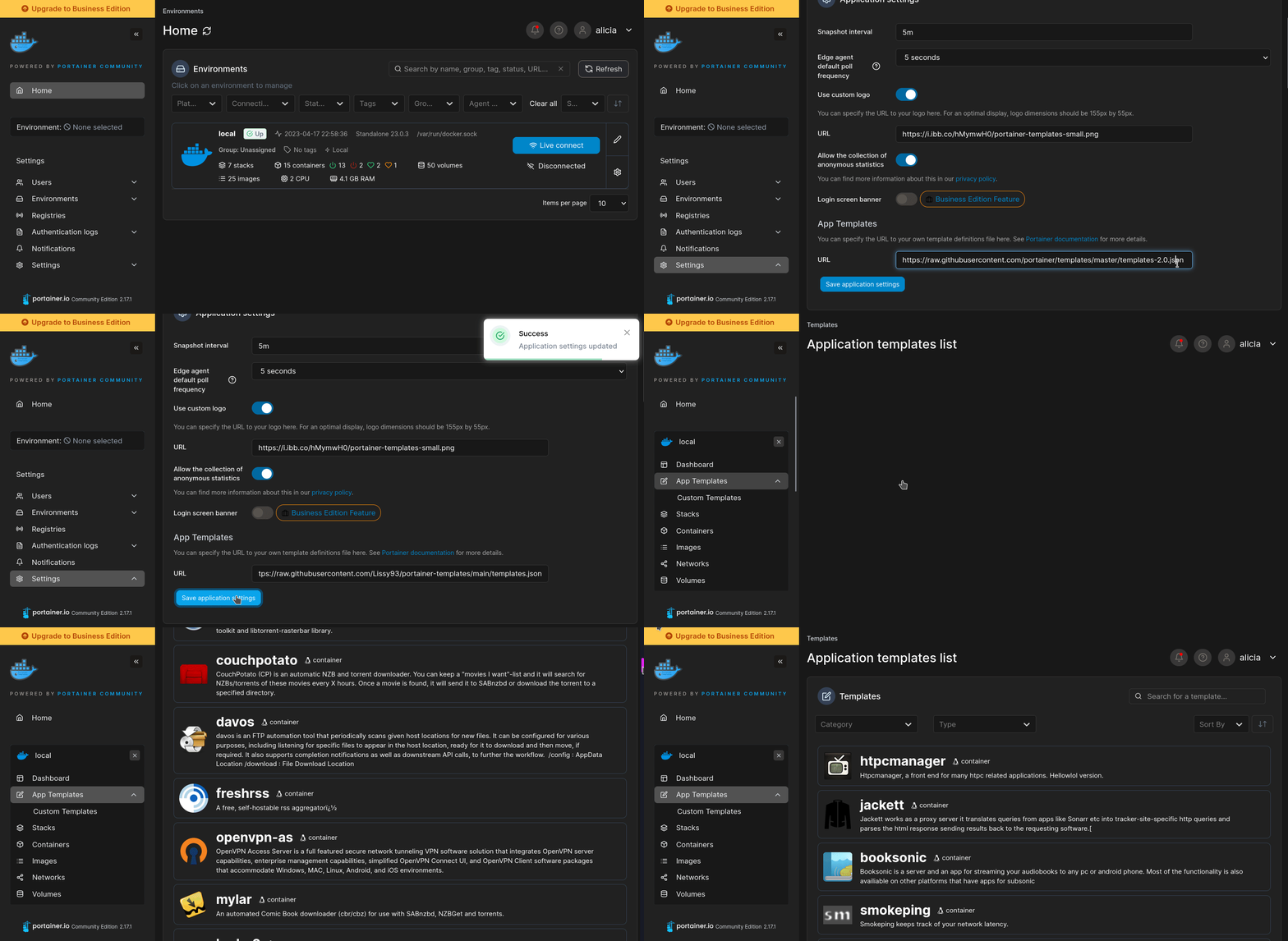
Import all app templates into your Portainer instance, for easy 1-click deploys
- Ensure both Docker and Portainer are installed, and up-to-date
- Log into your Portainer web UI
- Under Settings → App Templates, paste the below URL
- Head to Home → App Templates, and the list of apps will show up
- Select LibreTranslate, fill in any config options, and hit Deploy
Template Import URL
https://raw.githubusercontent.com/Lissy93/portainer-templates/main/templates.json
Show Me
Original stackfile
The compose file this template deploys, straight from its repo:
services:
  libretranslate:
    image: libretranslate/libretranslate:latest
    restart: unless-stopped
    ports:
      - "${LIBRETRANSLATE_PORT:-5100}:5000"
    environment:
      LT_LOAD_ONLY: ${LIBRETRANSLATE_LANGUAGES:-en,es,fr,de}
      LT_UPDATE_MODELS: "true"
    healthcheck:
      test: ["CMD-SHELL", "./venv/bin/python scripts/healthcheck.py"]
      interval: 10s
      timeout: 4s
      retries: 4
      start_period: 5s
    volumes:
      - libretranslate-models:/home/libretranslate/.local

volumes:
  libretranslate-models:
Or deploy it directly from the source:
git clone https://github.com/NotAFlightRisk/portainer-templates-extras
cd portainer-templates-extras
docker compose -f apps/libretranslate/compose.yml up -d
More install options in our documentation, or see LibreTranslate/LibreTranslate for app-specific guidance.
LibreTranslate
Try it online! | API Docs | Community Forum




Free and Open Source Machine Translation API, entirely self-hosted. Unlike other APIs, it doesn't rely on proprietary providers such as Google or Azure to perform translations.

Try it online! | API Docs
API Examples
Request:const res = await fetch("https://libretranslate.com/translate", {
method: "POST",
body: JSON.stringify({
q: "Hello!",
source: "en",
target: "es"
}),
headers: { "Content-Type": "application/json" }
});
console.log(await res.json());Response:
{
    "translatedText": "¡Hola!"
}
Install and Run
You can run your own API server in just a few lines of setup!Make sure you have installed Python (3.8 or higher is recommended), then simply issue:
pip install libretranslate
libretranslate [args]
Then open a web browser to http://localhost:5000
If you're on Windows, we recommend you Run with Docker instead.
On Ubuntu 20.04 you can also use the install script available on https://github.com/argosopentech/LibreTranslate-init
Build and Run
If you want to make some changes to the code, you can build from source, and run the API:git clone https://github.com/uav4geo/LibreTranslate
cd LibreTranslate
pip install -e .
libretranslate [args]
# Or
python main.py [args]Then open a web browser to http://localhost:5000
Run with Docker
Simply run:docker run -ti --rm -p 5000:5000 libretranslate/libretranslateThen open a web browser to http://localhost:5000
Build with Docker
docker build [--build-arg with_models=true] -t libretranslate .If you want to run the Docker image in a complete offline environment, you need to add the
--build-arg with_models=true parameter. Then the language models get downloaded during the build process of the image. Otherwise these models get downloaded on the first run of the image/container.Run the built image:
docker run -it -p 5000:5000 libretranslate [args]Or build and run using
docker-compose:docker-compose up -d --buildFeel free to change thedocker-compose.ymlfile to adapt it to your deployment needs, or use an extradocker-compose.prod.ymlfile for your deployment configuration.
Arguments
| Argument | Description | Default | Env. name |
|---|---|---|---|
| --host | Set host to bind the server to | 127.0.0.1 | LTHOST |
| --port | Set port to bind the server to | 5000 | LTPORT |
| --char-limit | Set character limit | No limit | LTCHARLIMIT |
| --req-limit | Set maximum number of requests per minute per client | No limit | LTREQLIMIT |
| --batch-limit | Set maximum number of texts to translate in a batch request | No limit | LTBATCHLIMIT |
| --ga-id | Enable Google Analytics on the API client page by providing an ID | No tracking | LTGAID |
| --debug | Enable debug environment | False | LTDEBUG |
| --ssl | Whether to enable SSL | False | LTSSL |
| --frontend-language-source | Set frontend default language - source | en | LTFRONTENDLANGUAGESOURCE |
| --frontend-language-target | Set frontend default language - target | es | LTFRONTENDLANGUAGETARGET |
| --frontend-timeout | Set frontend translation timeout | 500 | LTFRONTENDTIMEOUT |
| --api-keys | Enable API keys database for per-user rate limits lookup | Don't use API keys | LTAPIKEYS |
| --require-api-key-origin | Require use of an API key for programmatic access to the API, unless the request origin matches this domain | No restrictions on domain origin | LTREQUIREAPIKEYORIGIN |
| --load-only | Set available languages | all from argostranslate | LTLOADONLY |
Note that each argument has an equivalent env. variable that can be used instead. The env. variables overwrite the default values but have lower priority than the command aguments. They are particularly useful if used with Docker. Their name is the upper-snake case of the command arguments' ones, with a
LT prefix.Run with Gunicorn
pip install gunicorn
gunicorn --bind 0.0.0.0:5000 'wsgi:app'
You can pass application arguments directly to Gunicorn via:
gunicorn --bind 0.0.0.0:5000 'wsgi:app(api_keys=True)'Manage API Keys
LibreTranslate supports per-user limit quotas, e.g. you can issue API keys to users so that they can enjoy higher requests limits per minute (if you also set--req-limit). By default all users are rate-limited based on --req-limit, but passing an optional api_key parameter to the REST endpoints allows a user to enjoy higher request limits.To use API keys simply start LibreTranslate with the
--api-keys option.Add New Keys
To issue a new API key with 120 requests per minute limits:ltmanage keys add 120Remove Keys
ltmanage keys remove <api-key>View Keys
ltmanage keysLanguage Bindings
You can use the LibreTranslate API using the following bindings:- Rust: https://github.com/DefunctLizard/libretranslate-rs - Node.js: https://github.com/franciscop/translate - .Net: https://github.com/sigaloid/LibreTranslate.Net - Go: https://github.com/SnakeSel/libretranslate - Python: https://github.com/argosopentech/LibreTranslate-py
More coming soon!
Discourse Plugin
You can use this discourse translator plugin to translate Discourse topics. To install it simply modify/var/discourse/containers/app.yml:## Plugins go here
## see https://meta.discourse.org/t/19157 for details
hooks:
after_code:
- exec:
cd: $home/plugins
cmd:
- git clone https://github.com/discourse/docker_manager.git
- git clone https://github.com/LibreTranslate/discourse-translator
...Then issue
./launcher rebuild app. From the Discourse's admin panel then select "LibreTranslate" as a translation provider and set the relevant endpoint configurations.Mirrors
This is a list of online resources that serve the LibreTranslate API. Some require an API key. If you want to add a new URL, please open a pull request.URL |API Key Required|Contact|Cost --- | --- | --- | --- libretranslate.com|:heavycheckmark:|UAV4GEO| $9 / month, 80 requests / minute limit libretranslate.de|-|- translate.mentality.rip|-|- translate.astian.org|-|- translate.argosopentech.com|-|-
Roadmap
Help us by opening a pull request!- x A docker image (thanks @vemonet !)
- x Auto-detect input language (thanks @vemonet !)
- X User authentication / tokens
- Language bindings for every computer language
- Improved translations
FAQ
Can I use your API server at libretranslate.com for my application in production?
The API on libretranslate.com should be used for testing, personal or infrequent use. If you're going to run an application in production, please get in touch to get an API key or discuss other options.Can I use this behind a reverse proxy, like Apache2?
Yes, here is an example Apache2 config that redirects a subdomain (with HTTPS certificate) to LibreTranslate running on a docker at localhost.sudo docker run -ti --rm -p 127.0.0.1:5000:5000 libretranslate/libretranslate127.0.0.1 on the above command if you want to be able to access it from domain.tld:5000, in addition to subdomain.domain.tld (this can be helpful to determine if there is an issue with Apache2 or the docker container). Add
--restart unless-stopped if you want this docker to start on boot, unless manually stopped.Apache config
Replace YOURDOMAIN with your full domain; for example,
translate.domain.tld or libretranslate.domain.tld. Remove
# on the ErrorLog and CustomLog lines to log requests.#Libretranslate
#Redirect http to https
<VirtualHost *:80>
ServerName http://[YOUR_DOMAIN]
Redirect / https://[YOUR_DOMAIN]
# ErrorLog ${APACHE_LOG_DIR}/error.log
# CustomLog ${APACHE_LOG_DIR}/tr-access.log combined
</VirtualHost>
#https
<VirtualHost *:443>
ServerName https://[YOUR_DOMAIN]
ProxyPass / http://127.0.0.1:5000/
ProxyPassReverse / http://127.0.0.1:5000/
SSLEngine on
SSLCertificateFile /etc/letsencrypt/live/[YOUR_DOMAIN]/fullchain.pem
SSLCertificateKeyFile /etc/letsencrypt/live/[YOUR_DOMAIN]/privkey.pem
SSLCertificateChainFile /etc/letsencrypt/live/[YOUR_DOMAIN]/fullchain.pem
# ErrorLog ${APACHE_LOG_DIR}/tr-error.log
# CustomLog ${APACHE_LOG_DIR}/tr-access.log combined
</VirtualHost>Add this to an existing site config, or a new file in
/etc/apache2/sites-available/new-site.conf and run sudo a2ensite new-site.conf. To get a HTTPS subdomain certificate, install
certbot (snap), run sudo certbot certonly --manual --preferred-challenges dns and enter your information (with subdomain.domain.tld as the domain). Add a DNS TXT record with your domain registrar when asked. This will save your certificate and key to /etc/letsencrypt/live/{subdomain.domain.tld}/. Alternatively, comment the SSL lines out if you don't want to use HTTPS.
Credits
This work is largely possible thanks to Argos Translate, which powers the translation engine.License
GNU Affero General Public License v3Check the logs first
Nine times out of ten the logs tell you exactly what went wrong.
- In Portainer, go to Containers, click the container, then Logs. Or run
docker logs <container> - Exit codes help too:
137means killed, usually out of memory.126or127means the command inside the image is broken.
Image won't pull
Test the pull directly on the host: docker pull libretranslate/libretranslate:latest
- "manifest unknown" means the tag no longer exists. This template uses
latest, so try pinning a specific version instead. - "toomanyrequests" is the Docker Hub rate limit. Log in with
docker loginto raise it. - "no space left on device" means a full disk. Reclaim space with
docker system prune
"exec format error"
This means the image was built for a different CPU architecture than your server.
- This image supports:
amd64, arm64 - Check yours with
uname -m: x86_64 is amd64, aarch64 is arm64. Raspberry Pi and other ARM boards are the usual culprits.
Container keeps restarting
The unless-stopped restart policy relaunches the app after every crash, so the real error can scroll past.
- Check the logs right after a restart, the last few lines before it died are the useful ones.
- Get the exit code with
docker inspect <container> --format '{{.State.ExitCode}}' - Still stuck? Redeploy once with the restart policy set to
noso the failure stays visible.
Stack won't deploy
Compose stacks fail fast on small mistakes, and Portainer shows the reason just above the editor.
- YAML only accepts spaces for indentation, a single tab breaks the whole file.
Raise an issue
Found something which isn't working as it should? Here's how to report it.
- Bug within the app: Open an issue on LibreTranslate/LibreTranslate
- Template not working: Open an issue on NotAFlightRisk/portainer-templates-extras
- This website not working: Open an issue on lissy93/portainer-templates
A Compose stack
LibreTranslate is a Compose stack, a set of containers defined in one file and brought up together by Portainer, then started and stopped as a single app.
The app image
An image is the app packed up ready to go, everything LibreTranslate needs bundled into one download. This template pulls libretranslate/libretranslate:latest, which Docker fetches once (about 1.8 GB) and then starts your own copy from.
Where the image comes from
Docker pulls its images from registries, public libraries of ready-built apps. LibreTranslate's comes from Docker Hub, published by libretranslate.
Version tags
The bit after the colon in the image name is the version tag. Here it's latest, which always points at the newest build, so a redeploy can bump you to a newer release without you asking. Newest right now is v1.9.6-cuda. Pin a specific tag if you would rather stay on one version.
Which machines it runs on
Every image is built for particular CPU types. This one ships for amd64, arm64, so it runs on both regular x86 servers and ARM boards like a Raspberry Pi.
Volumes
A volume is where LibreTranslate keeps its files so they survive an update or a restart. Without one, anything it saves would sit inside the container and vanish the moment it's recreated. This template mounts:
/home/libretranslate/.localkept in thelibretranslate-modelsvolume Docker manages
Environment variables
Environment variables are the settings you hand over when you deploy, things like a password or a timezone. LibreTranslate takes 4 of them, all with defaults you can leave alone or tweak:
LT_LOAD_ONLY, defaults toen,es,fr,deLT_UPDATE_MODELS, defaults totrueLIBRETRANSLATE_LANGUAGES, defaults toen,es,fr,de. Two-letter codes, comma separated, like en,es,fr,de,it,ja. Each one is a couple of hundred MB of models to download.LIBRETRANSLATE_PORT, defaults to5100. Host port for the web UI
Restart policy
The restart policy here is unless-stopped, so Docker restarts LibreTranslate after a crash or reboot, but leaves it off when you stop it on purpose. You can change this on the deploy screen. The choices are no (never restart), on-failure (only after a crash), unless-stopped (restart unless you stop it), and always (bring it back no matter what).
Health check
A health check is how Docker tells whether LibreTranslate is really working, not just switched on. It runs ./venv/bin/python scripts/healthcheck.py every 10s and flags the container as unhealthy if that keeps failing.
Networking
Nothing custom is set, so LibreTranslate sits on Docker's default bridge network: its own private space that reaches the outside world only through the ports it publishes.
Container name
Once it's deployed, Portainer names the container libretranslate. That's what you'll spot in the containers list and use in commands like docker logs libretranslate.
Platform
The platform is linux, the kind of system the container is built to run on. Docker and Portainer handle this on a normal Linux server.
Open source license
LibreTranslate is open source, released under the AGPL-3.0 license. In plain terms the code is out in the open, so you're free to run it and change it to fit what you need.
Portainer app templates
Zooming out, this whole page comes from a Portainer app template: a short recipe telling Portainer how to set LibreTranslate up. Add the template list to Portainer once, then deploying LibreTranslate is a click rather than a wall of config.