
![libreddit]() libreddit
libreddit
Container
An alternative private front-end to Reddit
Image details
Source details
Configuration
TypeContainerlinuxlibreddit/libreddit:armv78088:8080/tcp/config : /portainer/Files/AppData/Config/libredditunless-stoppedTemplate by novaspirit
Report issueNotes
Check our Github page: https://github.com/pi-hosted/pi-hosted
Official Webpage: https://libreddit.silkky.cloud/
Official Docker Documentation: https://github.com/spikecodes/libreddit#2-docker
Standalone Install
Select an install method, to see config/commands for deploying libreddit
Install on Portainer
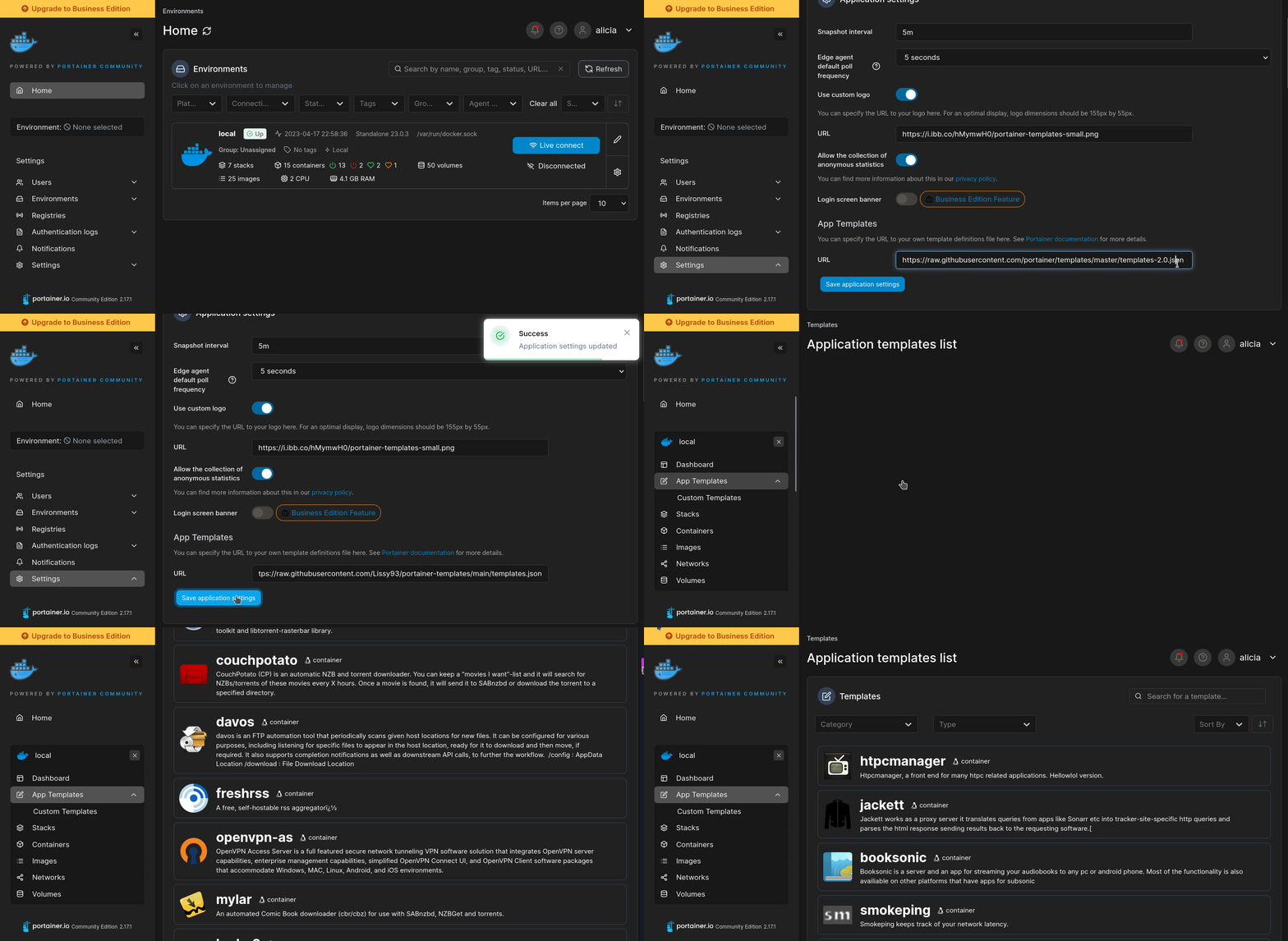
Import all app templates into your Portainer instance, for easy 1-click deploys
- Ensure both Docker and Portainer are installed, and up-to-date
- Log into your Portainer web UI
- Under Settings → App Templates, paste the below URL
- Head to Home → App Templates, and the list of apps will show up
- Select libreddit, fill in any config options, and hit Deploy
Template Import URL
https://raw.githubusercontent.com/Lissy93/portainer-templates/main/templates.json
Show Me
More install options in our documentation, or see spikecodes/libreddit for app-specific guidance.
Libreddit
An alternative private front-end to Reddit
⚠️ Why do I get TOO MANY REQUESTS errors? ⚠️
As of July 12th, 2023, Libreddit is currently not operational as Reddit's API changes, that were designed to kill third-party apps and content scrapers who don't pay large fees, went into effect. Read the full announcement here.
One of the project maintainers is working towards keeping this project alive to some extent: https://github.com/libreddit/libreddit/issues/836

10-second pitch: Libreddit is a portmanteau of "libre" (meaning freedom) and "Reddit". It is a private front-end like Invidious but for Reddit. Browse the coldest takes of r/unpopularopinion without being tracked.
- 🚀 Fast: written in Rust for blazing-fast speeds and memory safety
- ☁️ Light: no JavaScript, no ads, no tracking, no bloat
- 🕵 Private: all requests are proxied through the server, including media
- 🔒 Secure: strong Content Security Policy prevents browser requests to Reddit
I appreciate any donations! Your support allows me to continue developing Libreddit.


Bitcoin:
bc1qwyxjnafpu3gypcpgs025cw9wa7ryudtecmwa6yMonero:
45FJrEuFPtG2o7QZz2Nps77TbHD4sPqxViwbdyV9A6ktfHiWs47UngG5zXPcLoDXAc8taeuBgeNjfeprwgeXYXhN3C9tVSRInstances
🔗 Want to automatically redirect Reddit links to Libreddit? Use LibRedirect or Privacy Redirect!Follow this link for an up-to-date table of instances in Markdown format. This list is also available as a machine-readable JSON.
Both files are part of the libreddit-instances repository. To contribute your self-hosted instance to the list, see the libreddit-instances README.
About
Find Libreddit on 💬 Matrix, 🐋 Docker, :octocat: GitHub, and 🦊 GitLab.Built with
- Rust - Programming language
- Hyper - HTTP server and client
- Askama - Templating engine
- Rustls - TLS library
Info
Libreddit hopes to provide an easier way to browse Reddit, without the ads, trackers, and bloat. Libreddit was inspired by other alternative front-ends to popular services such as Invidious for YouTube, Nitter for Twitter, and Bibliogram for Instagram.Libreddit currently implements most of Reddit's (signed-out) functionalities but still lacks a few features.
How does it compare to Teddit?
Teddit is another awesome open source project designed to provide an alternative frontend to Reddit. There is no connection between the two, and you're welcome to use whichever one you favor. Competition fosters innovation and Teddit's release has motivated me to build Libreddit into an even more polished product.If you are looking to compare, the biggest differences I have noticed are:
- Libreddit is themed around Reddit's redesign whereas Teddit appears to stick much closer to Reddit's old design. This may suit some users better as design is always subjective.
- Libreddit is written in Rust for speed and memory safety. It uses Hyper, a speedy and lightweight HTTP server/client implementation.
Comparison
This section outlines how Libreddit compares to Reddit.Speed
Lasted tested Nov 11, 2022.Results from Google PageSpeed Insights (Libreddit Report, Reddit Report).
| Libreddit | ||
|---|---|---|
| Requests | 60 | 83 |
| Speed Index | 2.0s | 10.4s |
| Time to Interactive | 2.8s | 12.4s |
Privacy
- IP address
- User-agent string
- Browser type
- Operating system
- Referral URLs
- Device information (e.g., device IDs)
- Device settings
- Pages visited
- Links clicked
- The requested URL
- Search terms
Location: The same privacy policy goes on to describe that location data may be collected through the use of:
- GPS (consensual)
- Bluetooth (consensual)
- Content associated with a location (consensual)
- Your IP Address
Cookies: Reddit's cookie notice documents the array of cookies used by Reddit including/regarding:
- Authentication
- Functionality
- Analytics and Performance
- Advertising
- Third-Party Cookies
- Third-Party Site
Libreddit
For transparency, I hope to describe all the ways Libreddit handles user privacy.Server
- Logging: In production (when running the binary, hosting with docker, or using the official instances), Libreddit logs nothing. When debugging (running from source without
--release), Libreddit logs post IDs fetched to aid with troubleshooting.
- Cookies: Libreddit uses optional cookies to store any configured settings in the settings menu. These are not cross-site cookies and the cookies hold no personal data.
Official instance (libreddit.spike.codes)
The official instance is hosted at https://libreddit.spike.codes.- Server: The official instance runs a production binary, and thus logs nothing.
- DNS: The domain for the official instance uses Cloudflare as the DNS resolver. However, this site is not proxied through Cloudflare, and thus Cloudflare doesn't have access to user traffic.
- Hosting: The official instance is hosted on Replit, which monitors usage to prevent abuse. I can understand if this invalidates certain users' threat models, and therefore, self-hosting, using unofficial instances, and browsing through Tor are welcomed.
Installation
1) Cargo
Make sure Rust stable is installed along withcargo, Rust's package manager.cargo install libreddit2) Docker
Deploy the Docker image of Libreddit:docker pull libreddit/libreddit
docker run -d --name libreddit -p 8080:8080 libreddit/libredditDeploy using a different port (in this case, port 80):
docker pull libreddit/libreddit
docker run -d --name libreddit -p 80:8080 libreddit/libreddit
To deploy on
arm64 platforms, simply replace libreddit/libreddit in the commands above with libreddit/libreddit:arm.To deploy on
armv7 platforms, simply replace libreddit/libreddit in the commands above with libreddit/libreddit:armv7.3) AUR
For ArchLinux users, Libreddit is available from the AUR aslibreddit-git.yay -S libreddit-git4) NetBSD/pkgsrc
For NetBSD users, Libreddit is available from the official repositories.pkgin install libredditOr, if you prefer to build from source
cd /usr/pkgsrc/libreddit
make install
5) GitHub Releases
If you're on Linux and none of these methods work for you, you can grab a Linux binary from the newest release.6) Replit/Heroku/Glitch
Warning These are free hosting options, but they are not private and will monitor server usage to prevent abuse. If you need a free and easy setup, this method may work best for you.


Deployment
Once installed, deploy Libreddit to0.0.0.0:8080 by running:libredditInstance settings
Assign a default value for each instance-specific setting by passing environment variables to Libreddit in the formatLIBREDDIT_{X}. Replace {X} with the setting name (see list below) in capital letters.| Name | Possible values | Default value | Description |
|---|---|---|---|
SFWONLY | "on", "off" | off | Enables SFW-only mode for the instance, i.e. all NSFW content is filtered. |
BANNER | String | (empty) | Allows the server to set a banner to be displayed. Currently this is displayed on the instance info page. |
ROBOTSDISABLEINDEXING | "on", "off" | off | Disables indexing of the instance by search engines. |
PUSHSHIFTFRONTEND | String | www.unddit.com | Allows the server to set the Pushshift frontend to be used with "removed" links. |
Default User Settings
Assign a default value for each user-modifiable setting by passing environment variables to Libreddit in the formatLIBREDDIT_DEFAULT_{Y}. Replace {Y} with the setting name (see list below) in capital letters.| Name | Possible values | Default value |
|---|---|---|
THEME | "system", "light", "dark", "black", "dracula", "nord", "laserwave", "violet", "gold", "rosebox", "gruvboxdark", "gruvboxlight" | system |
FRONTPAGE | "default", "popular", "all" | default |
LAYOUT | "card", "clean", "compact" | card |
WIDE | "on", "off" | off |
POSTSORT | "hot", "new", "top", "rising", "controversial" | hot |
COMMENTSORT | "confidence", "top", "new", "controversial", "old" | confidence |
SHOWNSFW | "on", "off" | off |
BLURNSFW | "on", "off" | off |
USEHLS | "on", "off" | off |
HIDEHLSNOTIFICATION | "on", "off" | off |
AUTOPLAYVIDEOS | "on", "off" | off |
SUBSCRIPTIONS | +-delimited list of subreddits (sub1+sub2+sub3+...) | (none) |
HIDEAWARDS | "on", "off" | off |
DISABLEVISITREDDITCONFIRMATION | "on", "off" | off |
You can also configure Libreddit with a configuration file. An example
libreddit.toml can be found below:LIBREDDIT_DEFAULT_WIDE = "on"
LIBREDDIT_DEFAULT_USE_HLS = "on"Examples
LIBREDDIT_DEFAULT_SHOW_NSFW=on libredditLIBREDDIT_DEFAULT_WIDE=on LIBREDDIT_DEFAULT_THEME=dark libreddit -rProxying using NGINX
Note If you're proxying Libreddit through an NGINX Reverse Proxy, addto your NGINX configuration file above yourproxy_http_version 1.1;proxy_passline.
systemd
You can use the systemd service available incontrib/libreddit.service
(install it on /etc/systemd/system/libreddit.service).That service can be optionally configured in terms of environment variables by creating a file in
/etc/libreddit.conf. Use the contrib/libreddit.conf as a
template. You can also add the LIBREDDIT_DEFAULT__{X} settings explained
above.When "Proxying using NGINX" where the proxy is on the same machine, you should guarantee nginx waits for this service to start. Edit
/etc/systemd/system/libreddit.service.d/reverse-proxy.conf:[Unit]
Before=nginx.serviceBuilding
git clone https://github.com/libreddit/libreddit
cd libreddit
cargo runServe libreddit on your own domain behind Caddy, Nginx or Traefik. Fill in your domain and copy the result. It's a starting point, some apps need their own base URL or extra headers set too.
Proxying libreddit.example.com to http://libreddit:8080
Add this to your Caddyfile
libreddit.example.com {
	reverse_proxy http://libreddit:8080
}Check the logs first
Nine times out of ten the logs tell you exactly what went wrong.
- In Portainer, go to Containers, click the container, then Logs. Or run
docker logs libreddit - Exit codes help too:
137means killed, usually out of memory.126or127means the command inside the image is broken.
Port already in use
If deployment fails with "Bind for 0.0.0.0:8088 failed: port is already allocated", something else on your server is using that port.
- Find what's using it:
sudo ss -tlnp | grep :8088 - Stop the other service, or pick a different host port. In
8088:8080only the left number is yours to change, the right one belongs to the app.
Running but the page won't load
The container is up but nothing appears in your browser.
- Use your server's real IP:
http://your-server-ip:8088. The 0.0.0.0 link Portainer shows isn't a real address. - Give it a minute after first deploy, libreddit can take a while to initialise.
- Make sure your firewall allows the port, e.g.
sudo ufw allow 8088
Permission denied on volumes
If the logs show "permission denied", the app can't write to its data folder on the host.
- Fix the ownership:
sudo chown -R 1000:1000 /portainer/Files/AppData/Config/libreddit
Image won't pull
Test the pull directly on the host: docker pull libreddit/libreddit:armv7
- "manifest unknown" means the tag no longer exists.
- "toomanyrequests" is the Docker Hub rate limit. Log in with
docker loginto raise it. - "no space left on device" means a full disk. Reclaim space with
docker system prune
"exec format error"
This means the image was built for a different CPU architecture than your server.
- This image supports:
amd64, arm64, arm/v7 - Check yours with
uname -m: x86_64 is amd64, aarch64 is arm64. Raspberry Pi and other ARM boards are the usual culprits.
Container keeps restarting
The unless-stopped restart policy relaunches the app after every crash, so the real error can scroll past.
- Check the logs right after a restart, the last few lines before it died are the useful ones.
- Get the exit code with
docker inspect libreddit --format '{{.State.ExitCode}}' - Still stuck? Redeploy once with the restart policy set to
noso the failure stays visible.
Raise an issue
Found something which isn't working as it should? Here's how to report it.
- Bug within the app: Open an issue on spikecodes/libreddit
- Template not working: Open an issue on novaspirit/pi-hosted
- This website not working: Open an issue on lissy93/portainer-templates
A single container
libreddit runs as one container, the simplest kind of app here. Just the one image to pull and nothing else wired up alongside it.
The app image
An image is the app packed up ready to go, everything libreddit needs bundled into one download. This template pulls libreddit/libreddit:armv7, which Docker fetches once (about 7 MB) and then starts your own copy from.
Where the image comes from
Docker pulls its images from registries, public libraries of ready-built apps. libreddit's comes from Docker Hub, published by libreddit.
Version tags
The bit after the colon in the image name is the version tag. This one pins armv7, so every redeploy gives you that exact build until you bump it yourself.
Which machines it runs on
Every image is built for particular CPU types. This one ships for amd64, arm64, arm/v7, so it runs on both regular x86 servers and ARM boards like a Raspberry Pi.
Ports
A port is the door the app answers on. A mapping like 8088:8080 means it's reachable on port 8088 of your server, where the left number is yours to change and the right one belongs to the app. Once it's running, open http://your-server-ip:8088 in a browser. It opens:
8088:8080, likely the web interface
Volumes
A volume is where libreddit keeps its files so they survive an update or a restart. Without one, anything it saves would sit inside the container and vanish the moment it's recreated. This template mounts:
/configfrom/portainer/Files/AppData/Config/libredditon the host
Restart policy
The restart policy here is unless-stopped, so Docker restarts libreddit after a crash or reboot, but leaves it off when you stop it on purpose. You can change this on the deploy screen. The choices are no (never restart), on-failure (only after a crash), unless-stopped (restart unless you stop it), and always (bring it back no matter what).
Networking
Nothing custom is set, so libreddit sits on Docker's default bridge network: its own private space that reaches the outside world only through the ports it publishes.
Container name
Once it's deployed, Portainer names the container libreddit. That's what you'll spot in the containers list and use in commands like docker logs libreddit.
Platform
The platform is linux, the kind of system the container is built to run on. Docker and Portainer handle this on a normal Linux server.
Open source license
libreddit is open source, released under the AGPL-3.0 license. In plain terms the code is out in the open, so you're free to run it and change it to fit what you need.
Portainer app templates
Zooming out, this whole page comes from a Portainer app template: a short recipe telling Portainer how to set libreddit up. Add the template list to Portainer once, then deploying libreddit is a click rather than a wall of config.