
![Jellystat]() Jellystat
Stack
Statistics for Jellyfin (and Emby): who watched what, when and on which device, with live sessions, per-library and per-user stats, play history and charts of when people actually watch. Source: https://github.com/CyferShepard/Jellystat
Source details
Configuration
TypeComposelinuxJELLYSTAT_JWT_SECRET=''JELLYSTAT_DB_PASSWORD=''JELLYSTAT_TZ=UTCJELLYSTAT_PORT=3060unless-stoppedTemplate by NotAFlightRisk·Source
Report issueNotes
openssl rand -hex 32 and openssl rand -hex 16), and keep both the same on every redeploy. Open it on port 3060: the first visitor makes the Jellystat login, then it asks for your Jellyfin address and an API key (Jellyfin's Dashboard --> API Keys). Do both steps in one go, as anyone can redo the first one until Jellyfin's connected. The address has to be one this container can reach, like http://192.168.1.20:8096, not localhost. It only counts plays from when it's running, but Settings --> Tasks --> Import Playback Reporting Plugin Data brings in older ones if you use that plugin. A few things answer without a login (who's watching right now, your Jellyfin admin users, recently added), so keep it on your own network. Stats live in Postgres (the postgres-data volume), and backups from Settings --> Backup go in jellystat-backups. It checks GitHub for updates and loads a font from Google. Docs: github.com/CyferShepard/JellystatServices
jellystat
Configuration
Imagecyfershepard/jellystat:latest${JELLYSTAT_PORT:-3060}:3000/app/backend/backup-data : jellystat-backupsJWT_SECRET=${JELLYSTAT_JWT_SECRET:?Set a JWT secret}POSTGRES_IP=postgresPOSTGRES_PORT=5432POSTGRES_DB=jellystatPOSTGRES_USER=jellystatPOSTGRES_PASSWORD=${JELLYSTAT_DB_PASSWORD:?Set a database password}TZ=${JELLYSTAT_TZ:-UTC}unless-stoppedImage details
postgres
Configuration
Imagepostgres:18-alpine/var/lib/postgresql : postgres-dataPOSTGRES_DB=jellystatPOSTGRES_USER=jellystatPOSTGRES_PASSWORD=${JELLYSTAT_DB_PASSWORD:?Set a database password}TZ=${JELLYSTAT_TZ:-UTC}unless-stoppedImage details
Standalone Install
Select an install method, to see config/commands for deploying Jellystat
Install on Portainer
Import all app templates into your Portainer instance, for easy 1-click deploys
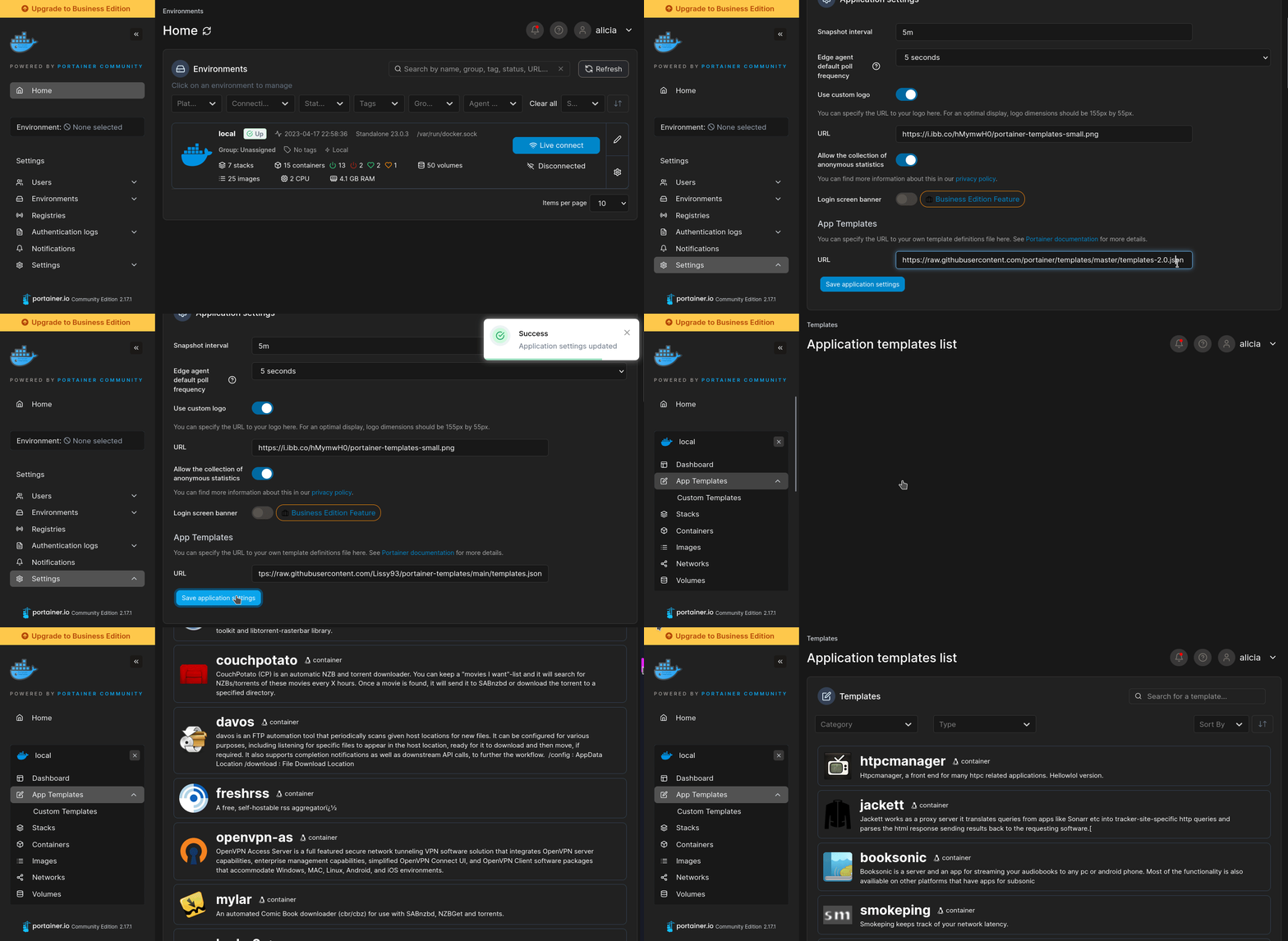
- Ensure both Docker and Portainer are installed, and up-to-date
- Log into your Portainer web UI
- Under Settings → App Templates, paste the below URL
- Head to Home → App Templates, and the list of apps will show up
- Select Jellystat, fill in any config options, and hit Deploy
Template Import URL
https://raw.githubusercontent.com/Lissy93/portainer-templates/main/templates.json
Show Me
Original stackfile
The compose file this template deploys, straight from its repo:
services:
  jellystat:
    image: cyfershepard/jellystat:latest
    restart: unless-stopped
    ports:
      - "${JELLYSTAT_PORT:-3060}:3000"
    environment:
      JWT_SECRET: ${JELLYSTAT_JWT_SECRET:?Set a JWT secret}
      POSTGRES_IP: postgres
      POSTGRES_PORT: 5432
      POSTGRES_DB: jellystat
      POSTGRES_USER: jellystat
      POSTGRES_PASSWORD: ${JELLYSTAT_DB_PASSWORD:?Set a database password}
      TZ: ${JELLYSTAT_TZ:-UTC}
    volumes:
      - jellystat-backups:/app/backend/backup-data
    depends_on:
      postgres:
        condition: service_healthy

  postgres:
    image: postgres:18-alpine
    restart: unless-stopped
    shm_size: 1gb
    environment:
      POSTGRES_DB: jellystat
      POSTGRES_USER: jellystat
      POSTGRES_PASSWORD: ${JELLYSTAT_DB_PASSWORD:?Set a database password}
      TZ: ${JELLYSTAT_TZ:-UTC}
    volumes:
      - postgres-data:/var/lib/postgresql
    healthcheck:
      test: ["CMD-SHELL", "pg_isready -U jellystat -d jellystat"]
      interval: 10s
      timeout: 5s
      retries: 5

volumes:
  jellystat-backups:
  postgres-data:
Or deploy it directly from the source:
git clone https://github.com/NotAFlightRisk/portainer-templates-extras
cd portainer-templates-extras
docker compose -f apps/jellystat/compose.yml up -d
More install options in our documentation, or see CyferShepard/Jellystat for app-specific guidance.
Container Documentation
jellystat Documentation
Jellystat is a free and open source Statistics App for Jellyfin!
postgres Documentation
The PostgreSQL object-relational database system provides reliability and data integrity.
Check the logs first
Nine times out of ten the logs tell you exactly what went wrong.
- In Portainer, go to Containers, click the container, then Logs. Or run
docker logs <container> - Exit codes help too:
137means killed, usually out of memory.126or127means the command inside the image is broken.
Image won't pull
Test the pull directly on the host: docker pull cyfershepard/jellystat:latest
- "manifest unknown" means the tag no longer exists. This template uses
latest, so try pinning a specific version instead. - "toomanyrequests" is the Docker Hub rate limit. Log in with
docker loginto raise it. - "no space left on device" means a full disk. Reclaim space with
docker system prune
"exec format error"
This means the image was built for a different CPU architecture than your server.
- Check yours with
uname -m: x86_64 is amd64, aarch64 is arm64. Raspberry Pi and other ARM boards are the usual culprits.
Container keeps restarting
The unless-stopped restart policy relaunches the app after every crash, so the real error can scroll past.
- Check the logs right after a restart, the last few lines before it died are the useful ones.
- Get the exit code with
docker inspect <container> --format '{{.State.ExitCode}}' - Still stuck? Redeploy once with the restart policy set to
noso the failure stays visible.
Stack won't deploy
Compose stacks fail fast on small mistakes, and Portainer shows the reason just above the editor.
- YAML only accepts spaces for indentation, a single tab breaks the whole file.
Raise an issue
Found something which isn't working as it should? Here's how to report it.
- Bug within the app: Open an issue on CyferShepard/Jellystat
- Template not working: Open an issue on NotAFlightRisk/portainer-templates-extras
- This website not working: Open an issue on lissy93/portainer-templates
A Compose stack
Jellystat is a Compose stack, a set of containers (2 of them) defined in one file and brought up together by Portainer, then started and stopped as a single app.
The services
This stack is built from 2 containers that run side by side. Here's each one, with the image it runs and anything it waits for first:
jellystatrunscyfershepard/jellystat:latest, starts after postgrespostgresrunspostgres:18-alpine
Volumes
A volume is where Jellystat keeps its files so they survive an update or a restart. Without one, anything it saves would sit inside the container and vanish the moment it's recreated. This template mounts:
/app/backend/backup-datakept in thejellystat-backupsvolume Docker manages/var/lib/postgresqlkept in thepostgres-datavolume Docker manages
Environment variables
Environment variables are the settings you hand over when you deploy, things like a password or a timezone. Jellystat takes 7 of them, and 2 need a value before it'll start properly:
JWT_SECRET, needs a valuePOSTGRES_IP, defaults topostgresPOSTGRES_PORT, defaults to5432POSTGRES_DB, defaults tojellystatPOSTGRES_USER, defaults tojellystatPOSTGRES_PASSWORD, needs a valueTZ, defaults toUTC
Restart policy
The restart policy here is unless-stopped, so Docker restarts Jellystat after a crash or reboot, but leaves it off when you stop it on purpose. You can change this on the deploy screen. The choices are no (never restart), on-failure (only after a crash), unless-stopped (restart unless you stop it), and always (bring it back no matter what).
Networking
Portainer puts these services on one shared private network, so they can find each other by name (like jellystat) while only the ports above are open to you.
Platform
The platform is linux, the kind of system the container is built to run on. Docker and Portainer handle this on a normal Linux server.
Open source license
Jellystat is open source, released under the MIT license. In plain terms the code is out in the open, so you're free to run it and change it to fit what you need.
Portainer app templates
Zooming out, this whole page comes from a Portainer app template: a short recipe telling Portainer how to set Jellystat up. Add the template list to Portainer once, then deploying Jellystat is a click rather than a wall of config.