
![DockRoute]() DockRoute
DockRoute
Container
External-DNS for plain Docker hosts: watches running containers, reads dockroute. labels and reconciles the matching DNS records — and Cloudflare Tunnel routes — in a pluggable provider. TXT-based ownership means it never alters records it cannot prove it manages. Source: https://github.com/Dockroute/Dockroute
Image details
Source details
Configuration
TypeContainerlinuxghcr.io/dockroute/dockroute:latest/var/run/docker.sock : /var/run/docker.sockDOCKROUTE_PROVIDER=logDOCKROUTE_OWNER_ID=defaultDOCKROUTE_POLICY=syncDOCKROUTE_DEFAULT_TARGET=DOCKROUTE_DOMAIN_FILTER=DOCKROUTE_RESYNC_SECONDS=60CLOUDFLARE_API_TOKEN=CLOUDFLARE_ACCOUNT_ID=CLOUDFLARE_TUNNEL_ID=unless-stoppedNotes
Standalone Install
Select an install method, to see config/commands for deploying DockRoute
Install on Portainer
Import all app templates into your Portainer instance, for easy 1-click deploys
- Ensure both Docker and Portainer are installed, and up-to-date
- Log into your Portainer web UI
- Under Settings → App Templates, paste the below URL
- Head to Home → App Templates, and the list of apps will show up
- Select DockRoute, fill in any config options, and hit Deploy
Template Import URL
https://raw.githubusercontent.com/Lissy93/portainer-templates/main/templates.json
Show Me
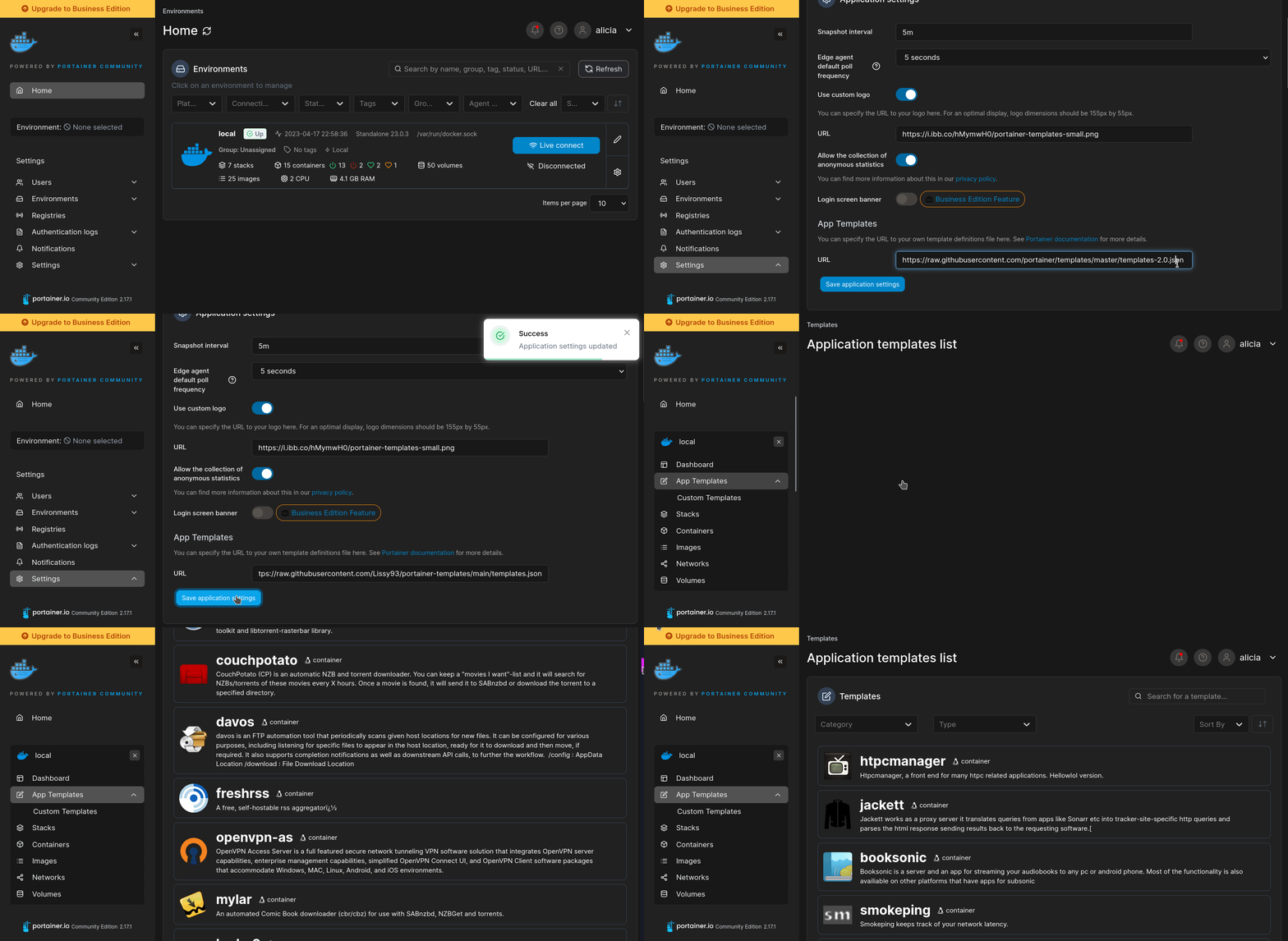
More install options in our documentation, or see Dockroute/Dockroute for app-specific guidance.
dockroute


External-DNS for plain Docker hosts: dockroute watches your running containers, reads
dockroute.* labels and reconciles the matching DNS
records — and Cloudflare Tunnel routes — in a pluggable provider.Your Docker Compose file is the source of truth; dockroute makes the provider match it, and never alters what it cannot prove it manages (ExternalDNS-style TXT ownership).
Status: MVP + Cloudflare. DNS records, TXT ownership, sync policies and Cloudflare Tunnel routes work end to end. See ARCHITECTURE.md.
Quick start
Label a container:services:
whoami:
image: traefik/whoami
labels:
dockroute.enabled: "true"
dockroute.hostname: "whoami.example.com"
# publish through an existing Cloudflare Tunnel:
dockroute.tunnel.service: "http://whoami:80"Run dockroute next to it:
services:
  dockroute:
    image: ghcr.io/dockroute/dockroute:latest
    environment:
      DOCKROUTE_PROVIDER: cloudflare
      DOCKROUTE_OWNER_ID: home-lab
      CLOUDFLARE_API_TOKEN: ${CLOUDFLARE_API_TOKEN}
      # only needed for tunnel publishing:
      CLOUDFLARE_ACCOUNT_ID: ${CLOUDFLARE_ACCOUNT_ID}
      CLOUDFLARE_TUNNEL_ID: ${CLOUDFLARE_TUNNEL_ID}
    volumes:
      - /var/run/docker.sock:/var/run/docker.sock:ro
    # No user/group setup needed: the entrypoint detects the socket's group,
    # grants it to the app user and drops privileges before starting.
Or start with the zero-credential dry run:
bun install
DOCKROUTE_DEFAULT_TARGET=192.168.1.10 bun start   # provider=log by default
Labels
| Label | Required | Default | Description |
|---|---|---|---|
dockroute.enabled | yes | — | true opts the container in |
dockroute.hostname | yes | — | FQDN(s), comma-separated |
dockroute.type | no | A | A, AAAA or CNAME |
dockroute.target | no | DOCKROUTEDEFAULTTARGET | Record value; must match dockroute.type (IPv4 / IPv6 / hostname) |
dockroute.ttl | no | 300 | TTL in seconds |
dockroute.tunnel.service | no | — | Origin URL; publish via Cloudflare Tunnel instead of a plain record |
dockroute.cloudflare.proxied | no | false | Proxy plain records through Cloudflare |
Configuration
| Variable | Default | Description |
|---|---|---|
DOCKERSOCK | /var/run/docker.sock | Docker Engine socket path |
DOCKROUTEPROVIDER | log | log (dry-run) or cloudflare |
DOCKROUTEDEFAULTTARGET | — | Fallback target when label is omitted |
DOCKROUTERESYNCSECONDS | 60 | Interval of the periodic full reconcile |
DOCKROUTEOWNERID | default | Ownership id — lets several instances share a zone safely |
DOCKROUTEPOLICY | sync | sync, upsert-only or create-only |
DOCKROUTEDELETEGRACESECONDS | 60 | How long a record must stay gone before it is deleted (0 = delete at once) |
DOCKROUTETXTPREFIX | dockroute- | Ownership TXT name prefix |
DOCKROUTEDOMAINFILTER | — | Comma-separated zone allowlist |
CLOUDFLAREAPITOKEN | — | Token with Zone→DNS→Edit (+ Account→Cloudflare Tunnel→Edit for tunnels) |
CLOUDFLAREACCOUNTID | — | For tunnel publishing |
CLOUDFLARETUNNELID | — | For tunnel publishing (existing tunnel, you run cloudflared) |
DOCKROUTEHEARTBEATPATH | /tmp/dockroute-heartbeat | Where the reconcile loop writes its liveness heartbeat (read by the image's HEALTHCHECK) |
Health check
The image ships a DockerHEALTHCHECK (bun run src/healthcheck.ts): every
successful reconcile touches a heartbeat file, and the check fails if it goes
stale for longer than 3 × DOCKROUTE_RESYNC_SECONDS (minimum 90s). That
means docker ps / docker inspect — and orchestrators that watch container
health — report unhealthy when the Docker socket goes unreachable or the
provider keeps failing to sync, not just when the process itself crashes.No extra configuration is needed; running behind
docker compose or
CasaOS/Arcane/Portainer picks it up automatically from the image. Bring your
own healthcheck: block only if you want different thresholds:services:
dockroute:
image: ghcr.io/dockroute/dockroute:latest
healthcheck:
interval: 30s
timeout: 10s
start_period: 30s
retries: 3Safety model
- Every record dockroute creates gets a companion TXT record
_dockroute-a.whoami.example.com) carrying its owner id.- Records without that proof of ownership are never modified, deleted or
- Orphan cleanup (container gone → records removed) only happens under the
sync policy and only for records this instance owns.- Deletions wait out
DOCKROUTE_DELETE_GRACE_SECONDS(default 60) of
- Tunnel ingress rules that dockroute did not create are preserved verbatim;
Troubleshooting
DockRoute skips a misconfigured or conflicting entry instead of stopping the whole reconcile. Match the warning indocker logs dockroute to the table
below, fix that entry, and the next reconcile will try it again.| Log message | What it means | What to do |
|---|---|---|
labels <container>: dockroute.enabled but no dockroute.hostname, skipping | The container opted in without a usable hostname. | Add a non-empty dockroute.hostname label. |
labels <container>: dockroute.tunnel.service set, ignoring dockroute.type/dockroute.target | Tunnel publishing is enabled, so the plain-record type and target labels are unused. | Remove dockroute.type and dockroute.target, or remove dockroute.tunnel.service if a plain DNS record was intended. |
labels <container>: invalid dockroute.tunnel.service "<service>" (expected http://, https://, tcp://, ssh://), skipping | The tunnel origin is not a valid URL with a supported scheme. | Set dockroute.tunnel.service to a complete http://, https://, tcp:// or ssh:// URL. |
labels <container>: unsupported record type "<type>", skipping | dockroute.type is not supported. | Set it to A, AAAA or CNAME. |
labels <container>: no dockroute.target and no default target, skipping | A plain DNS record has no target. | Add dockroute.target or set DOCKROUTEDEFAULTTARGET. |
labels <container>: dockroute.target "<target>" is not a valid <requirement>, skipping | The target does not match dockroute.type: A needs an IPv4 address, AAAA an IPv6 address, and CNAME a hostname rather than an IP. | Correct dockroute.target, or DOCKROUTEDEFAULTTARGET when the container inherits it, or set dockroute.type to the type that matches the value. |
labels <container>: invalid dockroute.ttl "<ttl>", using 300 | The TTL is not a positive number, so DockRoute falls back to 300 seconds. | Set dockroute.ttl to a positive numeric value, or omit it to use the default. |
reconciler duplicate desired entry <type>:<hostname>: first container wins, skipping entry from <source> | More than one container claims the same hostname and record type. | Keep that claim on one container only; the first container in the reconcile wins. |
reconciler duplicate hostname <hostname>: already published via tunnel, skipping <type> record from <source> | The same hostname is requested as both a tunnel route and a plain DNS record. | Choose one publication method and remove the duplicate claim; the tunnel route wins the reconcile. |
cloudflare <hostname>: no matching zone, skipping | None of the Cloudflare zones visible after DOCKROUTEDOMAINFILTER matches the hostname. | Check the hostname, DOCKROUTEDOMAINFILTER, and that the API token can access the intended zone. |
cloudflare conflict on <type> <hostname>: <reason> — skipping | A pre-existing DNS record or ownership TXT proves the record is unmanaged or belongs to another owner. | Resolve the pre-existing record or ownership TXT deliberately: remove it if safe so DockRoute can recreate it, or use the owning DockRoute instance/owner id. Do not weaken the ownership check. |
cloudflare <N> tunnel route(s) requested but CLOUDFLAREACCOUNTID/CLOUDFLARETUNNELID are not set — skipping tunnel sync | Tunnel labels are present but DockRoute cannot identify the Cloudflare account and tunnel. | Set both CLOUDFLAREACCOUNTID and CLOUDFLARETUNNELID, or remove the tunnel labels. |
cloudflare tunnel route <hostname>: an unmanaged ingress rule claims this hostname — skipping | The existing tunnel configuration already has an ingress rule for that hostname that DockRoute cannot prove it manages. | Remove or rename the pre-existing rule if it is safe to do so, or stop asking DockRoute to publish the same hostname. |
Ownership conflicts are a safety feature, not an adoption failure. In particular, a data record with no DockRoute ownership TXT, or a record/TXT owned by a different
DOCKROUTE_OWNER_ID, is skipped by design. A dangling
ownership TXT from another owner is treated the same way. Resolve the existing
record or ownership deliberately; do not bypass the ownership checks.Docker socket preflight errors already include their remedy in the error text. If the socket is missing, is not a Unix socket, or cannot be read, follow the mount,
DOCKER_SOCK, or group-access instruction printed with that error.Development
bun install
bun test            # unit tests (in-memory fakes, no real HTTP)
bun run typecheck   # strict TypeScript
bun run lint        # Biome — bun run lint:fix to auto-fix
See CONTRIBUTING.md for the ground rules (ownership safety, anti-corruption layer, testing style) and how to add a provider.
License
MITCheck the logs first
Nine times out of ten the logs tell you exactly what went wrong.
- In Portainer, go to Containers, click the container, then Logs. Or run
docker logs dockroute - Exit codes help too:
137means killed, usually out of memory.126or127means the command inside the image is broken.
Can't reach the Docker socket
dockroute talks to Docker through /var/run/docker.sock. If the logs show
"permission denied while trying to connect to the Docker daemon socket", the app's user can't access it.
- Check the socket exists on the host:
ls -l /var/run/docker.sock - Run the container as root, or add the docker group's id to the container with
group_add.
Image won't pull
Test the pull directly on the host: docker pull ghcr.io/dockroute/dockroute:latest
- "manifest unknown" means the tag no longer exists. This template uses
latest, so try pinning a specific version instead. - "toomanyrequests" is the Docker Hub rate limit. Log in with
docker loginto raise it. - "no space left on device" means a full disk. Reclaim space with
docker system prune
"exec format error"
This means the image was built for a different CPU architecture than your server.
- This image supports:
amd64, arm64 - Check yours with
uname -m: x86_64 is amd64, aarch64 is arm64. Raspberry Pi and other ARM boards are the usual culprits.
Container keeps restarting
The unless-stopped restart policy relaunches the app after every crash, so the real error can scroll past.
- Check the logs right after a restart, the last few lines before it died are the useful ones.
- Get the exit code with
docker inspect dockroute --format '{{.State.ExitCode}}' - Still stuck? Redeploy once with the restart policy set to
noso the failure stays visible.
Required settings are blank
DOCKROUTE_DEFAULT_TARGET, DOCKROUTE_DOMAIN_FILTER, CLOUDFLARE_API_TOKEN, CLOUDFLARE_ACCOUNT_ID, CLOUDFLARE_TUNNEL_ID have no default value, and dockroute may crash or misbehave if left empty.
- Fill them in on the deploy screen before hitting deploy.
Raise an issue
Found something which isn't working as it should? Here's how to report it.
- Bug within the app: Open an issue on Dockroute/Dockroute
- Template not working: Open an issue within the template's repo
- This website not working: Open an issue on lissy93/portainer-templates
A single container
DockRoute runs as one container, the simplest kind of app here. Just the one image to pull and nothing else wired up alongside it.
The app image
An image is the app packed up ready to go, everything DockRoute needs bundled into one download. This template pulls ghcr.io/dockroute/dockroute:latest, which Docker fetches once (about 106 MB) and then starts your own copy from.
Where the image comes from
Docker pulls its images from registries, public libraries of ready-built apps. DockRoute's comes from the GitHub Container Registry, published by dockroute.
Version tags
The bit after the colon in the image name is the version tag. Here it's latest, which always points at the newest build, so a redeploy can bump you to a newer release without you asking. Pin a specific tag if you would rather stay on one version.
Which machines it runs on
Every image is built for particular CPU types. This one ships for amd64, arm64, so it runs on both regular x86 servers and ARM boards like a Raspberry Pi.
Volumes
A volume is where DockRoute keeps its files so they survive an update or a restart. Without one, anything it saves would sit inside the container and vanish the moment it's recreated. This template mounts:
/var/run/docker.sockfrom/var/run/docker.sockon the host, read-only (a socket it talks to, not storage)
Environment variables
Environment variables are the settings you hand over when you deploy, things like a password or a timezone. DockRoute takes 9 of them, and 5 need a value before it'll start properly:
DOCKROUTE_PROVIDER, pick one oflog, cloudflare. DNS provider ('log' is a credential-free dry run that only prints the desired state)DOCKROUTE_OWNER_ID, defaults todefault. Ownership id written to companion TXT records (lets several instances share a zone safely)DOCKROUTE_POLICY, pick one ofsync, upsert-only, create-only. Sync policy — sync creates/updates/deletes owned records, upsert-only never deletes, create-only never updates or deletesDOCKROUTE_DEFAULT_TARGET, needs a value. Default target — fallback record value (IP or CNAME target) when a container omits the dockroute.target labelDOCKROUTE_DOMAIN_FILTER, needs a value. Domain filter — comma-separated allowlist of DNS zones DockRoute may touch (blank = every zone the token can see)DOCKROUTE_RESYNC_SECONDS, defaults to60. Resync interval in seconds (periodic full reconcile that backs up the event stream)CLOUDFLARE_API_TOKEN, needs a value. Cloudflare API token — required when provider is cloudflare (Zone → DNS → Edit)CLOUDFLARE_ACCOUNT_ID, needs a value. Cloudflare account ID (only needed for Cloudflare Tunnel publishing)CLOUDFLARE_TUNNEL_ID, needs a value. Cloudflare tunnel ID — an existing tunnel; you keep running cloudflared yourself (only needed for Tunnel publishing)
Restart policy
The restart policy here is unless-stopped, so Docker restarts DockRoute after a crash or reboot, but leaves it off when you stop it on purpose. You can change this on the deploy screen. The choices are no (never restart), on-failure (only after a crash), unless-stopped (restart unless you stop it), and always (bring it back no matter what).
Networking
Nothing custom is set, so DockRoute sits on Docker's default bridge network: its own private space that reaches the outside world only through the ports it publishes.
Container name
Once it's deployed, Portainer names the container dockroute. That's what you'll spot in the containers list and use in commands like docker logs dockroute.
Platform
The platform is linux, the kind of system the container is built to run on. Docker and Portainer handle this on a normal Linux server.
Open source license
DockRoute is open source, released under the MIT license. In plain terms the code is out in the open, so you're free to run it and change it to fit what you need.
Portainer app templates
Zooming out, this whole page comes from a Portainer app template: a short recipe telling Portainer how to set DockRoute up. Add the template list to Portainer once, then deploying DockRoute is a click rather than a wall of config.