
![cairn]() cairn
cairn
Container
The directory page for the people you host services for: no account, multilingual, live status, one tiny container. Source: https://github.com/MorganKryze/cairn
Image details
Source details
Configuration
TypeContainerlinuxghcr.io/morgankryze/cairn:latest8080:8080/tcp/configunless-stoppedNotes
Standalone Install
Select an install method, to see config/commands for deploying cairn
Install on Portainer
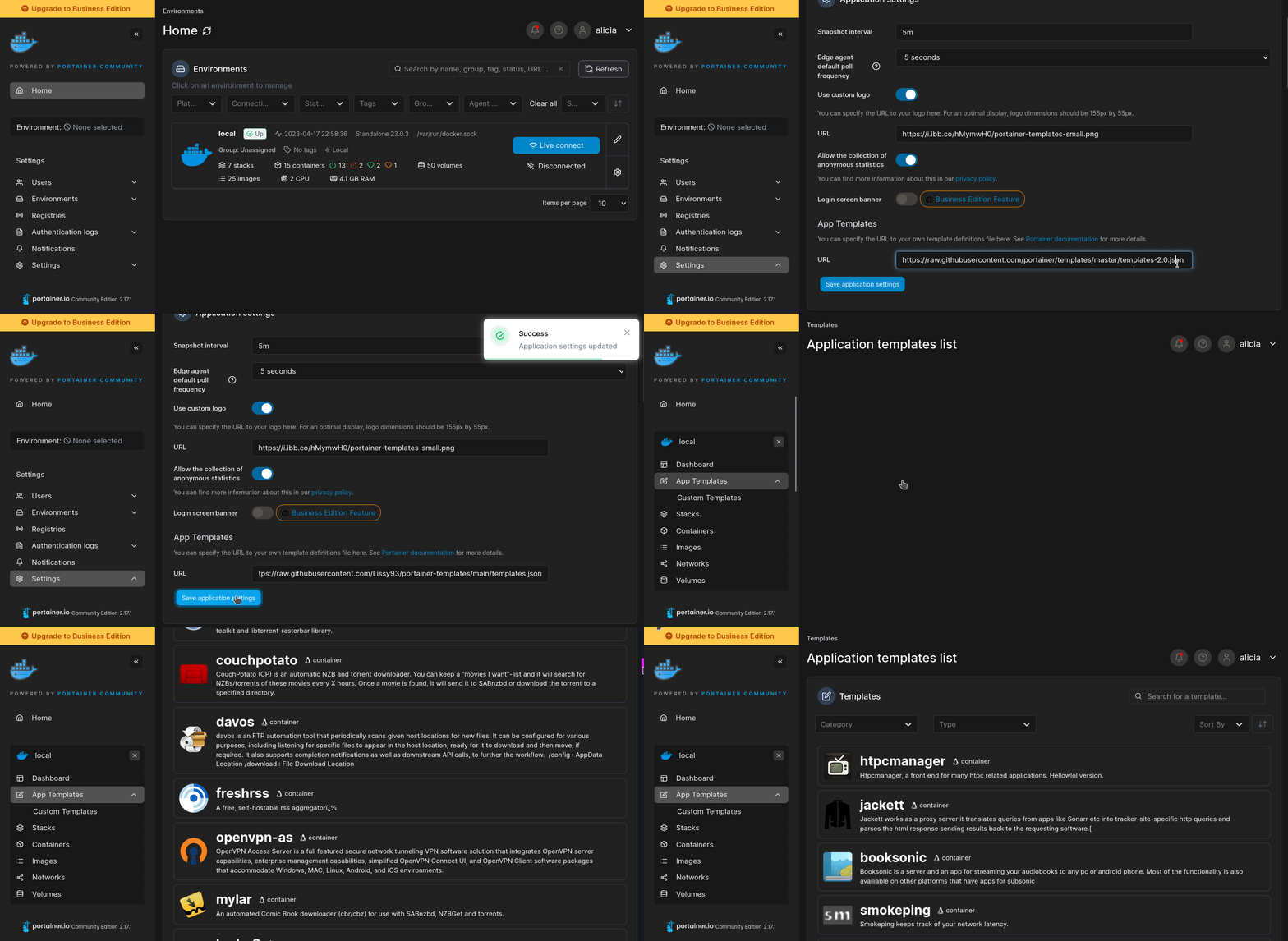
Import all app templates into your Portainer instance, for easy 1-click deploys
- Ensure both Docker and Portainer are installed, and up-to-date
- Log into your Portainer web UI
- Under Settings → App Templates, paste the below URL
- Head to Home → App Templates, and the list of apps will show up
- Select cairn, fill in any config options, and hit Deploy
Template Import URL
https://raw.githubusercontent.com/Lissy93/portainer-templates/main/templates.json
Show Me
More install options in our documentation, or see MorganKryze/cairn for app-specific guidance.
 cairn
cairn
The directory page for the people you host services for.












A cairn is a small stack of stones left by hikers who walked the trail before you, so you find your way without digging.

Your family, your clients, your friends: they don't want a dashboard, they want to know what this place is, what each tool does, and whether it works right now. cairn is that page. Written in their language, readable without an account or a manual, and boring for you to operate.
Features
What your visitors get
- 👋 A welcome note in your words: who hosts this, for whom, how to reach
- 🗂️ Tools grouped by need, one plain sentence each, with a "Learn more"
- 🚦 Live status pills fed by the monitor you already run. Your server does
- 🏷️ A word for where a service stands: coming soon, beta, new, deprecated,
- 🌍 Their language: the server reads it from the browser, a switcher pins
- 🔍 Search from anywhere: start typing, or ⌘K. A name finds that one
- 📱 At home on a phone: one-handed layout, and a header that steps aside as
- ♿ Built to stay readable: WCAG AA contrast in both themes, a skip link,
- 🌗 Calm typography, light and dark, and every feature still works with
CI measures the contrast in a real browser on every pull request. No audit has covered cairn as a whole, and no screen reader user has tried it yet. If you use one, tell us what breaks.
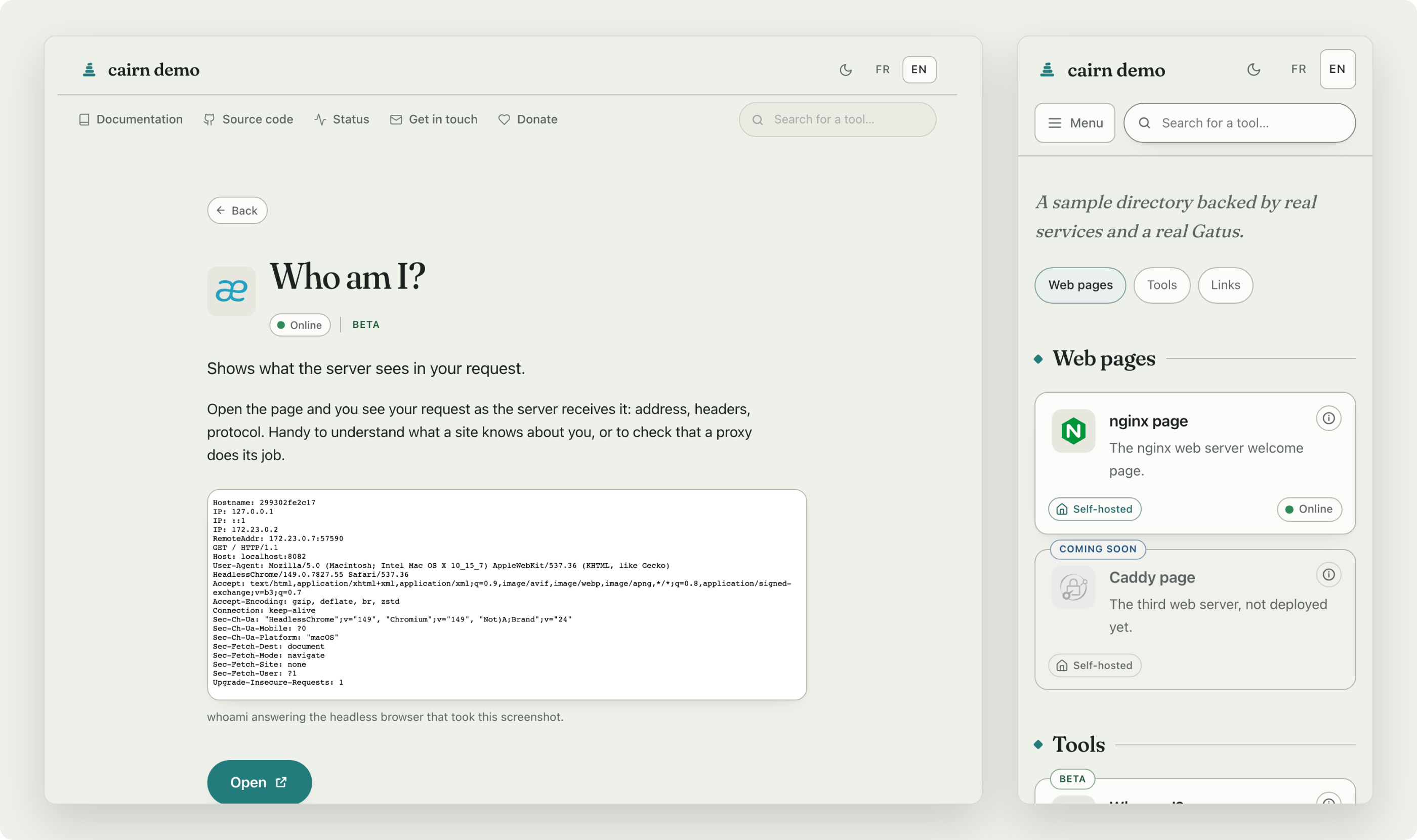
Behind a card when a visitor wants more than one sentence, and the same page in a hand.
What you get as the operator
- 📦 One static binary, no database, in an image of about 5 MB to pull.
- 📝 YAML mounted read-only, and cairn picks up an edit within seconds. A
- 📜 Legal pages served by cairn itself, in ordinary
- 🌐 A domain, a subdomain, or a sub-path of one you already use. cairn
Status monitoring
Whatever already tells you it is up. cairn does not ask you to change monitors. It reads the one you run, and the pills come from your server, never from the visitor's browser.| Self-hosted | Gatus · Uptime Kuma · Cachet · Statping-ng · Upptime |
| Hosted | Atlassian Statuspage · Instatus · UptimeRobot · Better Stack · StatusCake |
Every one was read from a live instance, not from a manual. Anything else publishing a list of names and states takes six lines of config, and which monitors cairn reads also says what cannot be read, and why.

|
Gatus gets the warmest handshake, and has earned it. It is the only one cairn integrates with both ways, since cairn -emit-gatus
writes its endpoint config out of your services, and the only one whose pills
link to a page per service rather than to one page for everything. If you have
no monitor yet, start there. |
Security
Secure by subtraction: the safest surface is the one that isn't there. cairn stores nothing, signs no one in, and takes no input it has to trust.- 🪨
FROM scratch, non-root: no shell, no package manager, no libc in the
- 🛡️ Runs locked down:
read_only,cap_drop: ALLand a self-probing
- 🧱 A strict Content-Security-Policy (
default-src 'none', inline
- 🔌 No outbound requests of its own, so it is air-gap friendly. The
- 🔬 A watched supply chain:
govulncheck, a Trivy image scan and CodeQL on
- 🧪 More test than product, and every check has to fail before it earns
- ✍️ Artifacts you can check: cosign signature, SLSA provenance and an SBOM
Quickstart
Nothing to write, nothing to mount, just look at it:docker run --rm -p 8080:8080 morgankryze/cairn:stableThat is a running cairn on
# config/services.yaml
- id: pdf
  url: https://pdf.example.org
  icon: stirling-pdf
  name: PDF toolbox
  desc: Merge, split, compress your PDFs.
(Want two languages?
name: { fr: Boîte à outils PDF, en: PDF toolbox };
every text key works both ways. See Languages.)# compose.yaml
services:
cairn:
image: morgankryze/cairn:latest
ports:
- 8080:8080
volumes:
- ./config:/config:rodocker compose up -dOpen
Prefer to see it live first? A public instance runs at
git clone https://github.com/MorganKryze/cairn.git && cd cairn/demo
docker compose up -d --build
Documentation
Everything lives in docs/. Each page teaches the why before the how. Start anywhere.| Start | Getting started, the five-minute path · Upgrading, what a new version can refuse and how to fix it |
| Configure | Services · Site · Text · Theming · Languages |
| Deploy | Docker Compose · Podman · Bare binary · Kubernetes · Helm · Air-gapped · Reverse proxies |
| Recipes | Status page · Icons · Multiple files · Migration |
| Look up | Reference · FAQ · Comparison |
For your AI assistant
Those pages are indexed on Context7, so an assistant with the Context7 MCP server can pull cairn's real documentation instead of inventing config keys that never existed. Ask it formorgankryze/cairn by
name.Scope
Not a dashboard, on purpose. cairn is a directory, not a control panel: no auth, no widgets, no Docker socket, no admin UI. If the audience is you, the admin, Homepage or Homer will make you happier; the comparison is honest about it.Contributing
cairn is young and opinionated, and other people's eyes make it better. Ideas and bugs in the issues, code and docs through contributing, within the scope above. And if cairn serves your people well, a coffee keeps its maintainer walking the trail.Contributors
Following the all-contributors convention, which counts every kind of contribution rather than only the commits: an issue that names a real problem, a bug report with the screenshot that cracks it, and a translation are all work.
 MorganKryze 💻 📖 🎨 🤔 🚧 |
 AntonPalmqvist 🐛 🤔 🌍 |
 rbourgeat 💻 🤔 |
💻 code · 📖 documentation · 🌍 translation · 🎨 design · 🤔 ideas · 🐛 bug reports · 🚧 maintenance
The avatars come from GitHub itself rather than from a third-party image service, for the reason the coverage badge is self-hosted: nothing about this repository should depend on somebody else's uptime to render. Adding yourself here is part of a pull request, not an afterthought.
Colophon
A colophon tells how the book was made, so here is mine: Go, plain YAML, Fraunces for the headings, and Claude Code drafting at my side, never on autopilot. The taste, the reviews and the final word stay mine; the tests, the CI and the public history keep me honest.License
Free software under GPL-3.0: use it, modify it, share it. What you redistribute stays under the same license, source included. Hosting your own instance is not distribution and asks nothing of you.Serve cairn on your own domain behind Caddy, Nginx or Traefik. Fill in your domain and copy the result. It's a starting point, some apps need their own base URL or extra headers set too.
Proxying cairn.example.com to http://cairn:8080
Add this to your Caddyfile
cairn.example.com {
	reverse_proxy http://cairn:8080
}Check the logs first
Nine times out of ten the logs tell you exactly what went wrong.
- In Portainer, go to Containers, click the container, then Logs. Or run
docker logs cairn - Exit codes help too:
137means killed, usually out of memory.126or127means the command inside the image is broken.
Port already in use
If deployment fails with "Bind for 0.0.0.0:8080 failed: port is already allocated", something else on your server is using that port.
- Find what's using it:
sudo ss -tlnp | grep :8080 - Stop the other service, or pick a different host port. In
8080:8080only the left number is yours to change, the right one belongs to the app.
Running but the page won't load
The container is up but nothing appears in your browser.
- Use your server's real IP:
http://your-server-ip:8080. The 0.0.0.0 link Portainer shows isn't a real address. - Give it a minute after first deploy, cairn can take a while to initialise.
- Make sure your firewall allows the port, e.g.
sudo ufw allow 8080
Image won't pull
Test the pull directly on the host: docker pull ghcr.io/morgankryze/cairn:latest
- "manifest unknown" means the tag no longer exists. This template uses
latest, so try pinning a specific version instead. - "toomanyrequests" is the Docker Hub rate limit. Log in with
docker loginto raise it. - "no space left on device" means a full disk. Reclaim space with
docker system prune
"exec format error"
This means the image was built for a different CPU architecture than your server.
- This image supports:
amd64, arm64 - Check yours with
uname -m: x86_64 is amd64, aarch64 is arm64. Raspberry Pi and other ARM boards are the usual culprits.
Container keeps restarting
The unless-stopped restart policy relaunches the app after every crash, so the real error can scroll past.
- Check the logs right after a restart, the last few lines before it died are the useful ones.
- Get the exit code with
docker inspect cairn --format '{{.State.ExitCode}}' - Still stuck? Redeploy once with the restart policy set to
noso the failure stays visible.
Raise an issue
Found something which isn't working as it should? Here's how to report it.
- Bug within the app: Open an issue on MorganKryze/cairn
- Template not working: Open an issue within the template's repo
- This website not working: Open an issue on lissy93/portainer-templates
A single container
cairn runs as one container, the simplest kind of app here. Just the one image to pull and nothing else wired up alongside it.
The app image
An image is the app packed up ready to go, everything cairn needs bundled into one download. This template pulls ghcr.io/morgankryze/cairn:latest, which Docker fetches once (about 5 MB) and then starts your own copy from.
Where the image comes from
Docker pulls its images from registries, public libraries of ready-built apps. cairn's comes from the GitHub Container Registry, published by morgankryze.
Version tags
The bit after the colon in the image name is the version tag. Here it's latest, which always points at the newest build, so a redeploy can bump you to a newer release without you asking. Pin a specific tag if you would rather stay on one version.
Which machines it runs on
Every image is built for particular CPU types. This one ships for amd64, arm64, so it runs on both regular x86 servers and ARM boards like a Raspberry Pi.
Ports
A port is the door the app answers on. A mapping like 8080:8080 means it's reachable on port 8080 of your server, where the left number is yours to change and the right one belongs to the app. Once it's running, open http://your-server-ip:8080 in a browser. It opens:
8080:8080, likely the web interface
Volumes
A volume is where cairn keeps its files so they survive an update or a restart. Without one, anything it saves would sit inside the container and vanish the moment it's recreated. This template mounts:
/configas a volume Docker manages for you
Restart policy
The restart policy here is unless-stopped, so Docker restarts cairn after a crash or reboot, but leaves it off when you stop it on purpose. You can change this on the deploy screen. The choices are no (never restart), on-failure (only after a crash), unless-stopped (restart unless you stop it), and always (bring it back no matter what).
Networking
Nothing custom is set, so cairn sits on Docker's default bridge network: its own private space that reaches the outside world only through the ports it publishes.
Container name
Once it's deployed, Portainer names the container cairn. That's what you'll spot in the containers list and use in commands like docker logs cairn.
Platform
The platform is linux, the kind of system the container is built to run on. Docker and Portainer handle this on a normal Linux server.
Open source license
cairn is open source, released under the GPL-3.0 license. In plain terms the code is out in the open, so you're free to run it and change it to fit what you need.
Portainer app templates
Zooming out, this whole page comes from a Portainer app template: a short recipe telling Portainer how to set cairn up. Add the template list to Portainer once, then deploying cairn is a click rather than a wall of config.