
![NetAlertX]() NetAlertX
NetAlertX
Stack
WIFI / LAN intruder detector. Scans for devices connected to your network and alerts you if new and unknown devices are found.
Image details
Configuration
TypeComposelinuxjokobsk/netalertx:latest/app/config : /portainer/Files/AppData/Config/netalertx/config/app/db : /portainer/Files/AppData/Config/netalertx/dbTZ=Europe/AthensPORT=20211unless-stoppedStandalone Install
Select an install method, to see config/commands for deploying NetAlertX
Install on Portainer
Import all app templates into your Portainer instance, for easy 1-click deploys
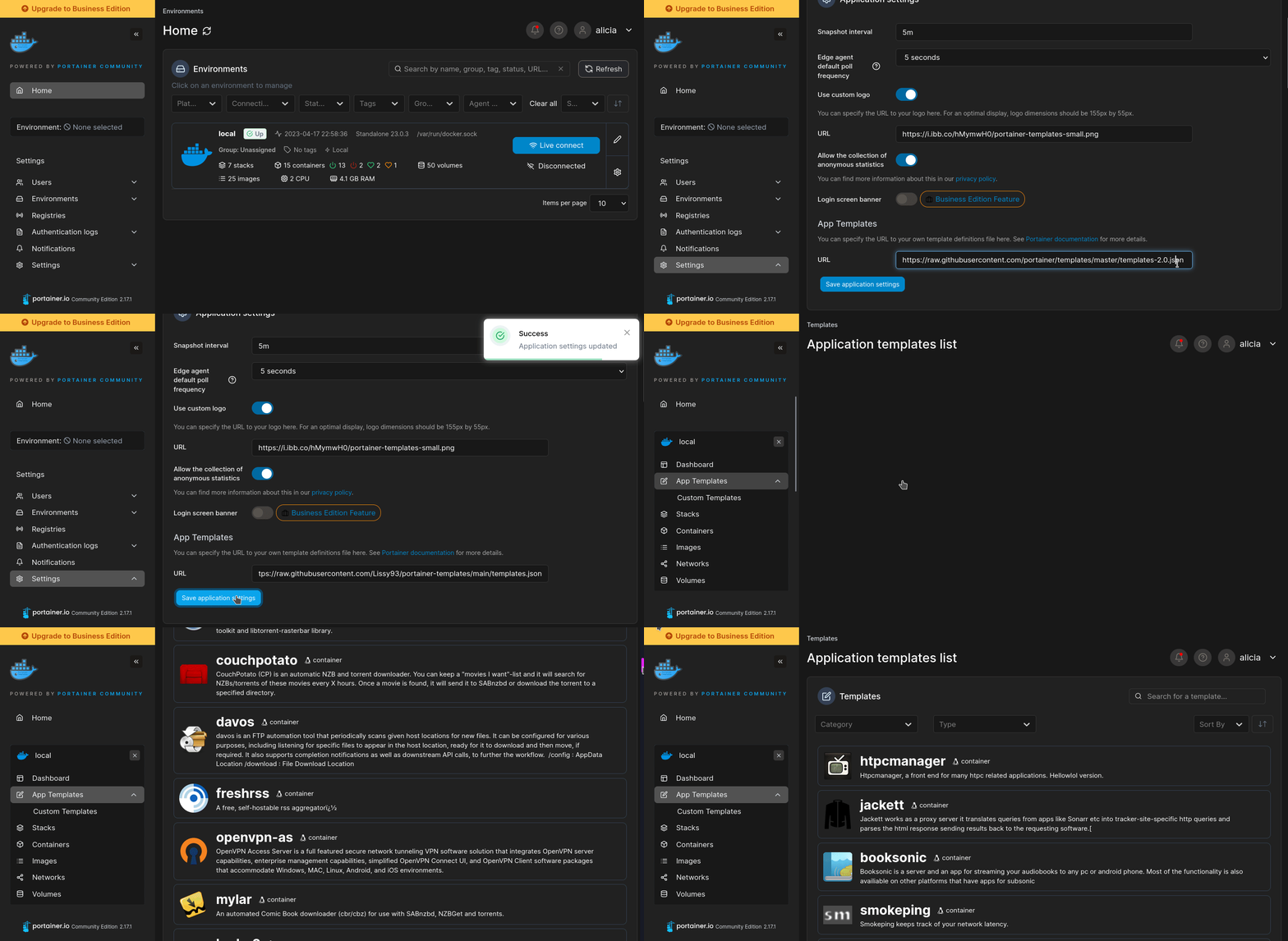
- Ensure both Docker and Portainer are installed, and up-to-date
- Log into your Portainer web UI
- Under Settings → App Templates, paste the below URL
- Head to Home → App Templates, and the list of apps will show up
- Select NetAlertX, fill in any config options, and hit Deploy
Template Import URL
https://raw.githubusercontent.com/Lissy93/portainer-templates/main/templates.json
Show Me
Original stackfile
The compose file this template deploys, straight from its repo:
services:
  netalertx:
    container_name: netalertx
    # use the below line if you want to test the latest dev image
    # image: "jokobsk/netalertx-dev:latest"
    image: "jokobsk/netalertx:latest"
    network_mode: "host"
    restart: unless-stopped
    volumes:
      - /portainer/Files/AppData/Config/netalertx/config:/app/config
      - /portainer/Files/AppData/Config/netalertx/db:/app/db
    environment:
      - TZ=Europe/Athens
      - PORT=20211
Or deploy it directly from the source:
git clone https://github.com/xneo1/portainer_templates
cd portainer_templates
docker compose -f Template/Stack/netalertx.yml up -d
More install options in our documentation.





NetAlertX - Network Visibility & Asset Intelligence Framework
---|| Docker guide || Releases || Docs || Plugins || Website

Head to https://netalertx.com/ for more gifs and screenshots 📷.
!NOTE There is also an experimental 🧪 bare-metal install method available.
📕 Basic Usage
!WARNING You will have to run the container on thehostnetwork and specifySCAN_SUBNETSunless you use other plugin scanners. The initial scan can take a few minutes, so please wait 5-10 minutes for the initial discovery to finish.
docker run -d --rm --network=host \
  -v /local_data_dir:/data \
  -v /etc/localtime:/etc/localtime \
  --tmpfs /tmp:uid=${NETALERTX_UID:-20211},gid=${NETALERTX_GID:-20211},mode=1700 \
  -e PORT=20211 \
  -e APP_CONF_OVERRIDE={"GRAPHQL_PORT":"20214"} \
  ghcr.io/netalertx/netalertx:latest
Runtime UID/GID: The image defaults to a service usernetalertx(UID/GID 20211). A separate readonly lock owner also uses UID/GID 20211 for 004/005 immutability. You can override the runtime UID/GID at build (ARG) or run (--user/ composeuser:) but must align writable mounts (/data,/tmp*) and tmpfsuid/gidto that choice.
See alternative docked-compose examples.
Default ports
| Default | Description | How to override |
|---|---|---|
20211 | Port of the web interface | -e PORT=20222 |
20212 | Port of the backend API server | -e APPCONFOVERRIDE={"GRAPHQLPORT":"20214"} or via the GRAPHQLPORT Setting |
Docker environment variables
| Variable | Description | Example/Default Value |
|---|---|---|
PUID | Runtime UID override, set to 0 to run as root. | 20211 |
PGID | Runtime GID override | 20211 |
PORT | Port of the web interface | 20211 |
LISTENADDR | Set the specific IP Address for the listener address for the nginx webserver (web interface). This could be useful when using multiple subnets to hide the web interface from all untrusted networks. | 0.0.0.0 |
LOADEDPLUGINS | Default plugins to load. Plugins cannot be loaded with APPCONFOVERRIDE, you need to use this variable instead and then specify the plugins settings with APPCONFOVERRIDE. | "PIHOLE","ASUSWRT" |
APPCONFOVERRIDE | JSON override for settings (except LOADEDPLUGINS). | {"SCANSUBNETS":"'192.168.1.0/24 --interface=eth1'","GRAPHQLPORT":"20212"} |
ALWAYSFRESHINSTALL | ⚠ If true will delete the content of the /db & /config folders. For testing purposes. Can be coupled with watchtower to have an always freshly installed netalertx/netalertx-dev image. | true |
You can override the default GraphQL port settingGRAPHQL_PORT(set to20212) by using theAPP_CONF_OVERRIDEenv variable.LOADED_PLUGINSand settings inAPP_CONF_OVERRIDEcan be specified via the UI as well.
Docker paths
!NOTE See also Backup strategies.
| Required | Path | Description |
|---|---|---|
| ✅ | :/data | Folder which needs to contain a /db and /config sub-folders. |
| ✅ | /etc/localtime:/etc/localtime:ro | Ensuring the timezone is the same as on the server. |
:/tmp/log | Logs folder useful for debugging if you have issues setting up the container | |
:/tmp/api | The API endpoint containing static (but regularly updated) json and other files. Path configurable via NETALERTXAPI environment variable. | |
:/app/front/plugins/<plugin>/ignoreplugin | Map a file ignoreplugin to ignore a plugin. Plugins can be soft-disabled via settings. More in the Plugin docs. | |
:/etc/resolv.conf | Use a custom resolv.conf file for better name resolution. |
Folder structure
Use separatedb and config directories, do not nest them:data
├── config
└── dbPermissions
If you are facing permissions issues run the following commands on your server. This will change the owner and assure sufficient access to the database and config files that are stored in the/local_data_dir/db and /local_data_dir/config folders (replace local_data_dir with the location where your /db and /config folders are located).# Use the runtime UID/GID you intend to run with (default 20211:20211)
sudo chown -R ${NETALERTX_UID:-20211}:${NETALERTX_GID:-20211} /local_data_dir
sudo chmod -R a+rwx /local_data_dirInitial setup
- If unavailable, the app generates a default
app.confandapp.dbfile on the first run. - The preferred way is to manage the configuration via the Settings section in the UI, if UI is inaccessible you can modify app.conf in the
/data/config/folder directly
Setting up scanners
You have to specify which network(s) should be scanned. This is done by entering subnets that are accessible from the host. If you use the defaultARPSCAN plugin, you have to specify at least one valid subnet and interface in the SCAN_SUBNETS setting. See the documentation on How to set up multiple SUBNETS, VLANs and what are limitations for troubleshooting and more advanced scenarios.If you are running PiHole you can synchronize devices directly. Check the PiHole configuration guide for details.
!NOTE You can bulk-import devices via the CSV import method.
Community guides
You can read or watch several community configuration guides in Chinese, Korean, German, or French.Please note these might be outdated. Rely on official documentation first.
Common issues
- Before creating a new issue, please check if a similar issue was already resolved.
- Check also common issues and debugging tips.
💙 Support me
| |
|  |
| --- | --- |
|
| --- | --- |- Bitcoin:
1N8tupjeCK12qRVU2XrV17WvKK7LCawyZM - Ethereum:
0x6e2749Cb42F4411bc98501406BdcD82244e3f9C7
📧 Email me at [email protected] if you want to get in touch or if I should add other sponsorship platforms.
Check the logs first
Nine times out of ten the logs tell you exactly what went wrong.
- In Portainer, go to Containers, click the container, then Logs. Or run
docker logs <container> - Exit codes help too:
137means killed, usually out of memory.126or127means the command inside the image is broken.
Permission denied on volumes
If the logs show "permission denied", the app can't write to its data folder on the host.
- Fix the ownership:
sudo chown -R 1000:1000 /portainer/Files/AppData/Config/netalertx/config(and the same for the other mapped folders)
Image won't pull
Test the pull directly on the host: docker pull jokobsk/netalertx:latest
- "manifest unknown" means the tag no longer exists. This template uses
latest, so try pinning a specific version instead. - "toomanyrequests" is the Docker Hub rate limit. Log in with
docker loginto raise it. - "no space left on device" means a full disk. Reclaim space with
docker system prune
"exec format error"
This means the image was built for a different CPU architecture than your server.
- This image supports:
amd64, arm64, arm/v7, arm/v6, arm64/v8 - Check yours with
uname -m: x86_64 is amd64, aarch64 is arm64. Raspberry Pi and other ARM boards are the usual culprits.
Container keeps restarting
The unless-stopped restart policy relaunches the app after every crash, so the real error can scroll past.
- Check the logs right after a restart, the last few lines before it died are the useful ones.
- Get the exit code with
docker inspect <container> --format '{{.State.ExitCode}}' - Still stuck? Redeploy once with the restart policy set to
noso the failure stays visible.
Stack won't deploy
Compose stacks fail fast on small mistakes, and Portainer shows the reason just above the editor.
- YAML only accepts spaces for indentation, a single tab breaks the whole file.
Raise an issue
Found something which isn't working as it should? Here's how to report it.
- Bug within the app: Open an issue within netalertx's repo
- Template not working: Open an issue on xneo1/portainer_templates
- This website not working: Open an issue on lissy93/portainer-templates
A Compose stack
NetAlertX is a Compose stack, a set of containers defined in one file and brought up together by Portainer, then started and stopped as a single app.
The app image
An image is the app packed up ready to go, everything NetAlertX needs bundled into one download. This template pulls jokobsk/netalertx:latest, which Docker fetches once (about 103 MB) and then starts your own copy from.
Where the image comes from
Docker pulls its images from registries, public libraries of ready-built apps. NetAlertX's comes from Docker Hub, published by jokobsk.
Version tags
The bit after the colon in the image name is the version tag. Here it's latest, which always points at the newest build, so a redeploy can bump you to a newer release without you asking. Newest right now is 26.9. Pin a specific tag if you would rather stay on one version.
Which machines it runs on
Every image is built for particular CPU types. This one ships for amd64, arm64, arm/v7, arm/v6, arm64/v8, so it runs on both regular x86 servers and ARM boards like a Raspberry Pi.
Volumes
A volume is where NetAlertX keeps its files so they survive an update or a restart. Without one, anything it saves would sit inside the container and vanish the moment it's recreated. This template mounts:
/app/configfrom/portainer/Files/AppData/Config/netalertx/configon the host/app/dbfrom/portainer/Files/AppData/Config/netalertx/dbon the host
Environment variables
Environment variables are the settings you hand over when you deploy, things like a password or a timezone. NetAlertX takes 2 of them, all with defaults you can leave alone or tweak:
TZ, defaults toEurope/AthensPORT, defaults to20211
Restart policy
The restart policy here is unless-stopped, so Docker restarts NetAlertX after a crash or reboot, but leaves it off when you stop it on purpose. You can change this on the deploy screen. The choices are no (never restart), on-failure (only after a crash), unless-stopped (restart unless you stop it), and always (bring it back no matter what).
Networking
Nothing custom is set, so NetAlertX sits on Docker's default bridge network: its own private space that reaches the outside world only through the ports it publishes.
Container name
Once it's deployed, Portainer names the container netalertx. That's what you'll spot in the containers list and use in commands like docker logs netalertx.
Platform
The platform is linux, the kind of system the container is built to run on. Docker and Portainer handle this on a normal Linux server.
Portainer app templates
Zooming out, this whole page comes from a Portainer app template: a short recipe telling Portainer how to set NetAlertX up. Add the template list to Portainer once, then deploying NetAlertX is a click rather than a wall of config.