
Factorio Server
Stack
Headless Factorio via factoriotools/factorio - the community-standard image. Saves, mods, and server settings live on the /factorio volume; a new map generates on first boot and the latest save loads thereafter.
Image details
Configuration
TypeComposelinuxfactoriotools/factorio:stable34197:34197/udp/factorio : factoriodataLOAD_LATEST_SAVE=trueGENERATE_NEW_SAVE=trueSAVE_NAME=${SAVE_NAME:-miget}UPDATE_MODS_ON_START=${UPDATE_MODS_ON_START:-false}unless-stoppedTemplate by deployable-sh·Source
Report issueStandalone Install
Select an install method, to see config/commands for deploying Factorio Server
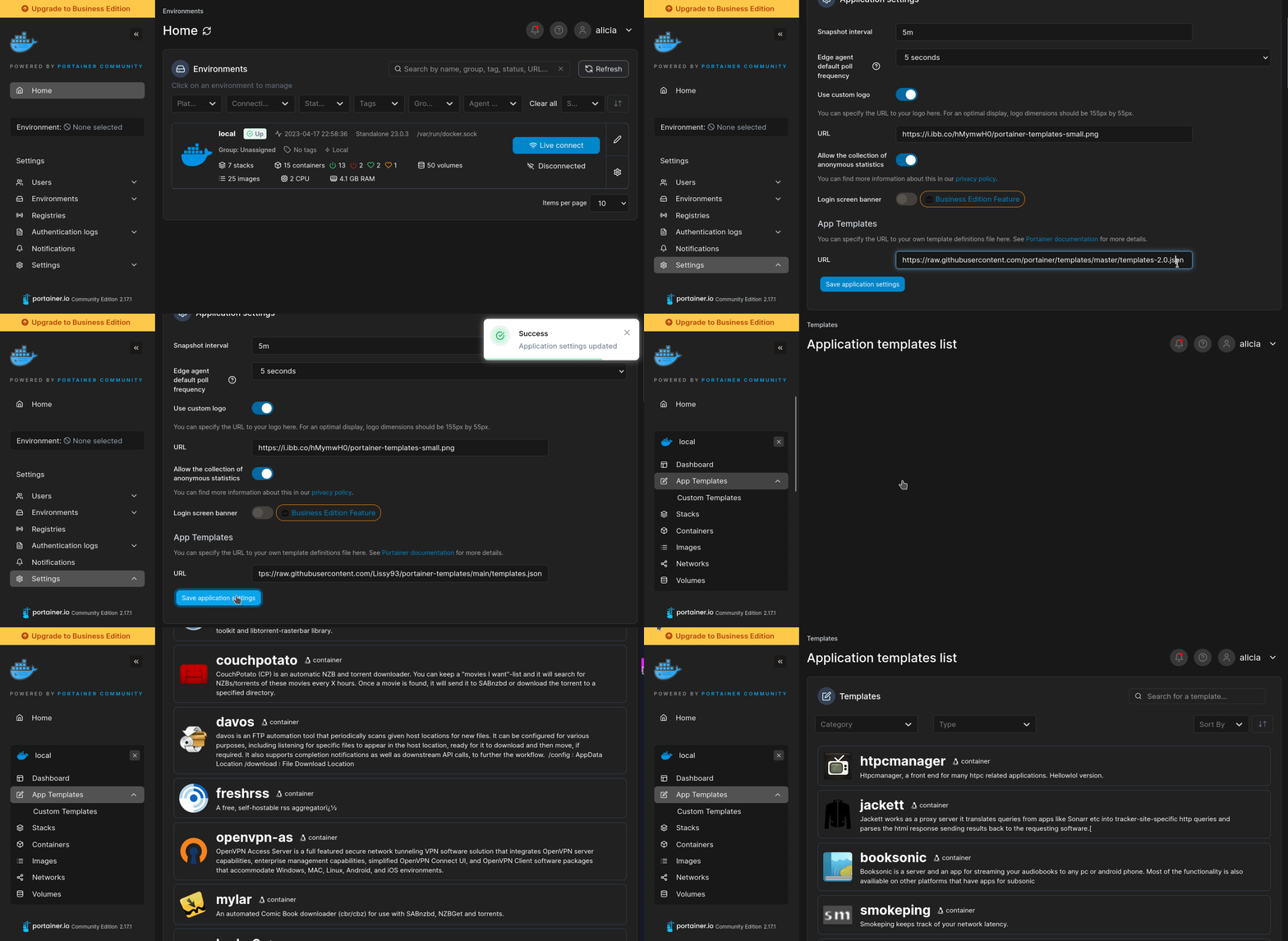
Install on Portainer
Import all app templates into your Portainer instance, for easy 1-click deploys
- Ensure both Docker and Portainer are installed, and up-to-date
- Log into your Portainer web UI
- Under Settings → App Templates, paste the below URL
- Head to Home → App Templates, and the list of apps will show up
- Select Factorio Server, fill in any config options, and hit Deploy
Template Import URL
https://raw.githubusercontent.com/Lissy93/portainer-templates/main/templates.json
Show Me
Original stackfile
The compose file this template deploys, straight from its repo:
name: factorio

services:
  factorio:
    image: factoriotools/factorio:stable
    restart: unless-stopped
    environment:
      LOAD_LATEST_SAVE: "true"
      GENERATE_NEW_SAVE: "true"
      SAVE_NAME: ${SAVE_NAME:-miget}
      UPDATE_MODS_ON_START: ${UPDATE_MODS_ON_START:-false}
    ports:
      - "34197:34197/udp"
    volumes:
      - factoriodata:/factorio

volumes:
  factoriodata:
Or deploy it directly from the source:
git clone https://github.com/deployable-sh/stacks
cd stacks
docker compose -f factorio/compose.yaml up -d
More install options in our documentation.
Factorio 


!NOTE Support for ARM is experimental. Expect crashes and lag if you try to run this on a raspberry pi.
中文
latest, 2.0.76
Tag descriptions
latest- most up-to-date version (may be experimental).stable- version declared stable on factorio.com (FFF-435 Since 2.0 versions gets released as experimental first, once stable it will be marked as stable).0.x- latest version in a branch.0.x.y- a specific version.0.x-z- incremental fix for that version.
What is Factorio?
Factorio is a game in which you build and maintain factories.You will be mining resources, researching technologies, building infrastructure, automating production and fighting enemies. Use your imagination to design your factory, combine simple elements into ingenious structures, apply management skills to keep it working and finally protect it from the creatures who don't really like you.
The game is very stable and optimized for building massive factories. You can create your own maps, write mods in Lua or play with friends via Multiplayer.
NOTE: This is only the server. The full game is available at Factorio.com, Steam, GOG.com and Humble Bundle.
Usage
Quick Start
Run the server to create the necessary folder structure and configuration files. For this example data is stored in/opt/factorio.sudo mkdir -p /opt/factorio
sudo chown 845:845 /opt/factorio
sudo docker run -d \
-p 34197:34197/udp \
-p 27015:27015/tcp \
-v /opt/factorio:/factorio \
--name factorio \
--restart=unless-stopped \
factoriotools/factorioFor those new to Docker, here is an explanation of the options:
-d- Run as a daemon ("detached").-p- Expose ports.-v- Mount/opt/factorioon the local file system to/factorioin the container.--restart- Restart the server if it crashes and at system start--name- Name the container "factorio" (otherwise it has a funny random name).
The
chown command is needed because in 0.16+, we no longer run the game server as root for security reasons, but rather as a 'factorio' user with user id 845. The host must therefore allow these files to be written by that user.Check the logs to see what happened:
docker logs factorioStop the server:
docker stop factorioNow there's a
server-settings.json file in the folder /opt/factorio/config. Modify this to your liking and restart the server:docker start factorioTry to connect to the server. Check the logs if it isn't working.
Console
To issue console commands to the server, start the server in interactive mode with-it. Open the console with docker attach and then type commands.docker run -d -it \
--name factorio \
factoriotools/factorio
docker attach factorioRCON (2.0.18+)
Alternativly (e.g. for scripting) the RCON connection can be used to send commands to the running factorio server. This does not require the RCON connection to be exposed.docker exec factorio rcon /hUpgrading
Before upgrading backup the save. It's easy to make a save in the client.Ensure
-v was used to run the server so the save is outside of the Docker container. The docker rm command completely destroys the container, which includes the save if it isn't stored in a data volume.Delete the container and refresh the image:
docker stop factorio
docker rm factorio
docker pull factoriotools/factorio
Now run the server as before. In about a minute the new version of Factorio should be up and running, complete with saves and config!
Saves
A new map named_autosave1.zip is generated the first time the server is started. The map-gen-settings.json and map-settings.json files in /opt/factorio/config are used for the map settings. On subsequent runs the newest save is used.To load an old save stop the server and run the command
touch oldsave.zip. This resets the date. Then restart the server. Another option is to delete all saves except one.To generate a new map stop the server, delete all of the saves and restart the server.
Specify a save directly (0.17.79-2+)
You can specify a specific save to load by configuring the server through a set of environment variables:To load an existing save set
SAVE_NAME to the name of your existing save file located within the saves directory, without the .zip extension:sudo docker run -d \
-p 34197:34197/udp \
-p 27015:27015/tcp \
-v /opt/factorio:/factorio \
-e LOAD_LATEST_SAVE=false \
-e SAVE_NAME=replaceme \
--name factorio \
--restart=unless-stopped \
factoriotools/factorioTo generate a new map set
GENERATE_NEW_SAVE=true and specify SAVE_NAME:sudo docker run -d \
-p 34197:34197/udp \
-p 27015:27015/tcp \
-v /opt/factorio:/factorio \
-e LOAD_LATEST_SAVE=false \
-e GENERATE_NEW_SAVE=true \
-e SAVE_NAME=replaceme \
--name factorio \
--restart=unless-stopped \
factoriotools/factorioTo generate a new map with a specific preset (e.g., death-world):
sudo docker run -d \
  -p 34197:34197/udp \
  -p 27015:27015/tcp \
  -v /opt/factorio:/factorio \
  -e LOAD_LATEST_SAVE=false \
  -e GENERATE_NEW_SAVE=true \
  -e SAVE_NAME=replaceme \
  -e PRESET=death-world \
  --name factorio \
  --restart=unless-stopped \
  factoriotools/factorio
Mods
Copy mods into the mods folder and restart the server.As of 0.17 a new environment variable was added `
UPDATE_MODS_ON_START which if set to true` will cause the mods get to updated on server start. If set a valid Factorio Username and Token must be supplied or else the server will not start. They can either be set as docker secrets, environment variables, or pulled from the server-settings.json file.To prevent specific mods from being automatically updated, you can use the `
UPDATE_IGNORE environment variable with a comma-separated list of mod names. For example: UPDATE_IGNORE=mod1,mod2,mod3` will skip updates for those three mods. This can be useful to prevent compatibility issues when certain mods should remain at specific versions. Be warned that it can also create compatibility issues.Note: When using the Space Age DLC, the built-in mods (
elevated-rails, quality, and space-age) are automatically skipped during mod updates to prevent conflicts. These mods are included with the DLC and should not be downloaded separately.Scenarios
If you want to launch a scenario from a clean start (not from a saved map) you'll need to start the docker image from an alternate entrypoint. To do this, use the example entrypoint file stored in the /factorio/entrypoints directory in the volume, and launch the image with the following syntax. Note that this is the normal syntax with the addition of the --entrypoint setting AND the additional argument at the end, which is the name of the Scenario in the Scenarios folder.docker run -d \
-p 34197:34197/udp \
-p 27015:27015/tcp \
-v /opt/factorio:/factorio \
--name factorio \
--restart=unless-stopped \
--entrypoint "/scenario.sh" \
factoriotools/factorio \
MyScenarioNameConverting Scenarios to Regular Maps
If you would like to export your scenario to a saved map, you can use the example entrypoint similar to the Scenario usage above. Factorio will run once, converting the Scenario to a saved Map in your saves directory. A restart of the docker image using the standard options will then load that map, just as if the scenario were just started by the Scenarios example noted above.docker run -d \
-p 34197:34197/udp \
-p 27015:27015/tcp \
-v /opt/factorio:/factorio \
--name factorio \
--restart=unless-stopped \
--entrypoint "/scenario2map.sh" \
factoriotools/factorio
MyScenarioNameRCON
Set the RCON password in therconpw file. A random password is generated if rconpw doesn't exist.To change the password, stop the server, modify
rconpw, and restart the server.To "disable" RCON don't expose port 27015, i.e. start the server without
-p 27015:27015/tcp. RCON is still running, but nobody can to connect to it.Whitelisting (0.15.3+)
Create fileconfig/server-whitelist.json and add the whitelisted users.[
"you",
"friend"
]Banlisting (0.17.1+)
Create fileconfig/server-banlist.json and add the banlisted users.[
"bad_person",
"other_bad_person"
]Adminlisting (0.17.1+)
Create fileconfig/server-adminlist.json and add the adminlisted users.[
"you",
"friend"
]Customize configuration files (0.17.x+)
Out-of-the box, factorio does not support environment variables inside the configuration files. A workaround is the usage ofenvsubst which generates the configuration files dynamically during startup from environment variables set in docker-compose:Example which replaces the server-settings.json:
factorio_1:
  image: factoriotools/factorio
  ports:
    - "34197:34197/udp"
  volumes:
   - /opt/factorio:/factorio
   - ./server-settings.json:/server-settings.json
  environment:
    - INSTANCE_NAME=Your Instance's Name
    - INSTANCE_DESC=Your Instance's Description
  entrypoint: /bin/sh -c "mkdir -p /factorio/config && envsubst < /server-settings.json > /factorio/config/server-settings.json && exec /docker-entrypoint.sh"
The
server-settings.json file may then contain the variable references like this:"name": "${INSTANCE_NAME}",
"description": "${INSTANCE_DESC}",Environment Variables
These are the environment variables which can be specified at container run time.| Variable Name | Description | Default | Available in |
|---|---|---|---|
| GENERATENEWSAVE | Generate a new save if one does not exist before starting the server | false | 0.17+ |
| LOADLATESTSAVE | Load latest when true. Otherwise load SAVENAME | true | 0.17+ |
| PORT | UDP port the server listens on | 34197 | 0.15+ |
| BIND | IP address (v4 or v6) the server listens on (IP\[:PORT) | 0.15+ | |
| RCONPORT | TCP port the rcon server listens on | 27015 | 0.15+ |
| SAVENAME | Name to use for the save file | autosave1 | 0.17+ |
| PRESET | Map generation preset when GENERATENEWSAVE is true | 0.17+ | |
| TOKEN | factorio.com token | 0.17+ | |
| UPDATEMODSONSTART | If mods should be updated before starting the server | 0.17+ | |
| UPDATEIGNORE | Comma-separated list of mod names to skip during automatic updates | 0.17+ | |
| USERNAME | factorio.com username | 0.17+ | |
| CONSOLELOGLOCATION | Saves the console log to the specifies location | ||
| DLCSPACEAGE | Enables or disables the mods for DLC Space Age in mod-list.json^1 | true | 2.0.8+ |
| MODS | Mod directory to use | /factorio/mods | 2.0.8+ |
Note: All environment variables are compared as strings
PRESET Values
ThePRESET environment variable is used when generating a new map (when GENERATE_NEW_SAVE=true). It corresponds to Factorio's built-in map generation presets. Common values include:default- Normal settingsrich-resources- Resources are more abundantmarathon- Recipes and technologies are more expensivedeath-world- Biters are more aggressive and numerousdeath-world-marathon- Combines death-world and marathon settingsrail-world- Resources are further apart, encouraging train usageribbon-world- Map height is limited for a unique challenge
If PRESET is not specified or left empty, the map will be generated using the settings from
map-gen-settings.json and map-settings.json without a preset.Container Details
The philosophy is to keep it simple.- The server should bootstrap itself.
- Prefer configuration files over environment variables.
- Use one volume for data.
Volumes
To keep things simple, the container uses a single volume mounted at/factorio. This volume stores configuration, mods, and saves.The files in this volume should be owned by the factorio user, uid 845.
factorio
|-- config
|   |-- map-gen-settings.json
|   |-- map-settings.json
|   |-- rconpw
|   |-- server-adminlist.json
|   |-- server-banlist.json
|   |-- server-settings.json
|   `-- server-whitelist.json
|-- mods
|   `-- fancymod.zip
`-- saves
    `-- _autosave1.zip
Docker Compose
Docker Compose is an easy way to run Docker containers.- docker-engine >= 1.10.0 is required
- docker-compose >=1.6.0 is required
First get a docker-compose.yml file. To get it from this repository:
git clone https://github.com/factoriotools/factorio-docker.git
cd factorio-docker/docker
Or make your own:
version: '2'
services:
  factorio:
    image: factoriotools/factorio
    ports:
     - "34197:34197/udp"
     - "27015:27015/tcp"
    volumes:
     - /opt/factorio:/factorio
Now cd to the directory with docker-compose.yml and run:
sudo mkdir -p /opt/factorio
sudo chown 845:845 /opt/factorio
sudo docker-compose up -d
Ports
34197/udp- Game server (required). This can be changed with thePORTenvironment variable.27015/tcp- RCON (optional).
LAN Games
Ensure thelan setting in server-settings.json is true."visibility":
{
"public": false,
"lan": true
},Start the container with the
--network=host option so clients can automatically find LAN games. Refer to the Quick Start to create the /opt/factorio directory.sudo docker run -d \
--network=host \
-p 34197:34197/udp \
-p 27015:27015/tcp \
-v /opt/factorio:/factorio \
--name factorio \
--restart=unless-stopped \
factoriotools/factorioDeploy to other plaforms
Vagrant
Vagrant is a easy way to setup a virtual machine (VM) to run Docker. The Factorio Vagrant box repository contains a sample Vagrantfile.For LAN games the VM needs an internal IP in order for clients to connect. One way to do this is with a public network. The VM uses DHCP to acquire an IP address. The VM must also forward port 34197.
config.vm.network "public_network"
config.vm.network "forwarded_port", guest: 34197, host: 34197
Amazon Web Services (AWS) Deployment
If you're looking for a simple way to deploy this to the Amazon Web Services Cloud, check out the Factorio Server Deployment (CloudFormation) repository. This repository contains a CloudFormation template that will get you up and running in AWS in a matter of minutes. Optionally it uses Spot Pricing so the server is very cheap, and you can easily turn it off when not in use.Using a reverse proxy
If you need to use a reverse proxy you can use the following nginx snippet:stream {
server {
listen 34197 udp reuseport;
proxy_pass my.upstream.host:34197;
}
}If your factorio host uses multiple IP addresses (very common with IPv6), you might additionally need to bind Factorio to a single IP (otherwise the UDP proxy might get confused with IP mismatches). To do that pass the
BIND envvar to the container: docker run --network=host -e BIND=2a02:1234::5678 ...Rootless Docker Support (Experimental)
Note: Rootless support is currently experimental. Please report any issues you encounter.
If you're experiencing permission issues or want better security, consider using the rootless images. These images are designed to work seamlessly with rootless Docker installations and avoid common permission problems.
What are Rootless Images?
The rootless images differ from regular images in several ways:- Run as UID 1000 (non-root) by default
- No dynamic UID/GID mapping (PUID/PGID not supported)
- No runtime chown operations
- All directories created with open permissions during build
Rootless Image Tags
Each regular tag has a corresponding rootless version with the-rootless suffix:latest-rootless(experimental)stable-rootless(experimental)2.0.55-rootless(experimental)
Quick Start with Rootless
docker run -d \
  -p 34197:34197/udp \
  -p 27015:27015/tcp \
  -v ~/factorio:/factorio \
  --name factorio \
  --restart=unless-stopped \
  factoriotools/factorio:stable-rootless
Key differences:
- No
chowncommand needed - No PUID/PGID environment variables
- Runs as UID 1000 by default
- No permission issues with volumes
When to Use Rootless Images
Consider using rootless images if you:- Are running Docker in rootless mode
- Experience permission issues with volume mounts
- Want to avoid containers running as root
- Don't need dynamic UID/GID mapping via PUID/PGID
Limitations
- PUID/PGID environment variables are not supported
- Fixed to UID 1000 (may not match your host user)
- Experimental feature - may have undiscovered issues
Troubleshooting
Permission Issues
If you're experiencing permission errors such as:chown: Operation not permittedPermission denied [/factorio/saves]Util.cpp:81: Operation not permitted- Files owned by unexpected UIDs (like 100844 instead of 845)
Please refer to our comprehensive Permission Issues Guide for detailed solutions. Common fixes include:
- Updating Docker to version 20.x or newer (this resolves many issues)
- Using the rootless image variants (e.g.,
factoriotools/factorio:stable-rootless) - Setting correct ownership for your specific Docker configuration
My server is listed in the server browser, but nobody can connect
Check the logs. If there is the lineOwn address is RIGHT IP:WRONG PORT, then this could be caused by the Docker proxy. If the the IP and port is correct it's probably a port forwarding or firewall issue instead.By default, Docker routes traffic through a proxy. The proxy changes the source UDP port, so the wrong port is detected. See the forum post Incorrect port detected for docker hosted server for details.
To fix the incorrect port, start the Docker service with the
--userland-proxy=false switch. Docker will route traffic with iptables rules instead of a proxy. Add the switch to the DOCKER_OPTS environment variable or ExecStart in the Docker systemd service definition. The specifics vary by operating system.When I run a server on a port besides 34197 nobody can connect from the server browser
Use thePORT environment variable to start the server on the a different port, .e.g. docker run -e "PORT=34198". This changes the source port on the packets used for port detection. -p 34198:34197 works fine for private servers, but the server browser detects the wrong port.Contributors
- dtandersen - Maintainer
- Fank - Programmer of the Factorio watchdog that keeps the version up-to-date.
- SuperSandro2000 - CI Guy, Maintainer and runner of the Factorio watchdog. Contributed version updates and wrote the Travis scripts.
- DBendit - Coded admin list, ban list support and contributed version updates
- Zopanix - Original Author
- Rfvgyhn - Coded randomly generated RCON password
- gnomus - Coded white listing support
- bplein - Coded scenario support
- jaredledvina - Contributed version updates
- carlbennett - Contributed version updates and bugfixes
Example 1: Enable all by using
true
Example 2: Enable all by listing the mod names space-age elevated-rails qualityExample 3: Enable only Elevated rails
elevated-railsCheck the logs first
Nine times out of ten the logs tell you exactly what went wrong.
- In Portainer, go to Containers, click the container, then Logs. Or run
docker logs <container> - Exit codes help too:
137means killed, usually out of memory.126or127means the command inside the image is broken.
Port already in use
If deployment fails with "Bind for 0.0.0.0:34197 failed: port is already allocated", something else on your server is using that port.
- Find what's using it:
sudo ss -tlnp | grep :34197 - Stop the other service, or pick a different host port. In
34197:34197only the left number is yours to change, the right one belongs to the app.
Image won't pull
Test the pull directly on the host: docker pull factoriotools/factorio:stable
- "manifest unknown" means the tag no longer exists.
- "toomanyrequests" is the Docker Hub rate limit. Log in with
docker loginto raise it. - "no space left on device" means a full disk. Reclaim space with
docker system prune
"exec format error"
This means the image was built for a different CPU architecture than your server.
- This image supports:
amd64, arm64 - Check yours with
uname -m: x86_64 is amd64, aarch64 is arm64. Raspberry Pi and other ARM boards are the usual culprits.
Container keeps restarting
The unless-stopped restart policy relaunches the app after every crash, so the real error can scroll past.
- Check the logs right after a restart, the last few lines before it died are the useful ones.
- Get the exit code with
docker inspect <container> --format '{{.State.ExitCode}}' - Still stuck? Redeploy once with the restart policy set to
noso the failure stays visible.
Stack won't deploy
Compose stacks fail fast on small mistakes, and Portainer shows the reason just above the editor.
- YAML only accepts spaces for indentation, a single tab breaks the whole file.
Raise an issue
Found something which isn't working as it should? Here's how to report it.
- Bug within the app: Open an issue within factorio's repo
- Template not working: Open an issue on deployable-sh/stacks
- This website not working: Open an issue on lissy93/portainer-templates
A Compose stack
Factorio Server is a Compose stack, a set of containers defined in one file and brought up together by Portainer, then started and stopped as a single app.
The app image
An image is the app packed up ready to go, everything Factorio Server needs bundled into one download. This template pulls factoriotools/factorio:stable, which Docker fetches once (about 214 MB) and then starts your own copy from.
Where the image comes from
Docker pulls its images from registries, public libraries of ready-built apps. Factorio Server's comes from Docker Hub, published by factoriotools.
Version tags
The bit after the colon in the image name is the version tag. This one pins stable, so every redeploy gives you that exact build until you bump it yourself.
Which machines it runs on
Every image is built for particular CPU types. This one ships for amd64, arm64, so it runs on both regular x86 servers and ARM boards like a Raspberry Pi.
Ports
A port is the door the app answers on. A mapping like 34197:34197 means it's reachable on port 34197 of your server, where the left number is yours to change and the right one belongs to the app. It opens:
34197:34197over UDP
Volumes
A volume is where Factorio Server keeps its files so they survive an update or a restart. Without one, anything it saves would sit inside the container and vanish the moment it's recreated. This template mounts:
/factoriokept in thefactoriodatavolume Docker manages
Environment variables
Environment variables are the settings you hand over when you deploy, things like a password or a timezone. Factorio Server takes 4 of them, all with defaults you can leave alone or tweak:
LOAD_LATEST_SAVE, defaults totrueGENERATE_NEW_SAVE, defaults totrueSAVE_NAME, defaults tomigetUPDATE_MODS_ON_START, defaults tofalse
Restart policy
The restart policy here is unless-stopped, so Docker restarts Factorio Server after a crash or reboot, but leaves it off when you stop it on purpose. You can change this on the deploy screen. The choices are no (never restart), on-failure (only after a crash), unless-stopped (restart unless you stop it), and always (bring it back no matter what).
Networking
Nothing custom is set, so Factorio Server sits on Docker's default bridge network: its own private space that reaches the outside world only through the ports it publishes.
Container name
Once it's deployed, Portainer names the container factorio. That's what you'll spot in the containers list and use in commands like docker logs factorio.
Platform
The platform is linux, the kind of system the container is built to run on. Docker and Portainer handle this on a normal Linux server.
Portainer app templates
Zooming out, this whole page comes from a Portainer app template: a short recipe telling Portainer how to set Factorio Server up. Add the template list to Portainer once, then deploying Factorio Server is a click rather than a wall of config.