
![CryptPad]() CryptPad
CryptPad
Stack
Collaboration suite, encrypted and open-source. Source: https://github.com/cryptpad/cryptpad
Image details
Source details
Configuration
TypeComposelinuxcryptpad/cryptpad:version-2026.5.13000:30003003:3003/cryptpad/blob : cryptpad-blob/cryptpad/block : cryptpad-block/cryptpad/customize : cryptpad-customize/cryptpad/data : cryptpad-data/cryptpad/datastore : cryptpad-datastoreCPAD_MAIN_DOMAIN=${CPAD_MAIN_DOMAIN}CPAD_SANDBOX_DOMAIN=${CPAD_SANDBOX_DOMAIN}CPAD_CONF=/cryptpad/config/config.jsunless-stoppedNotes
Standalone Install
Select an install method, to see config/commands for deploying CryptPad
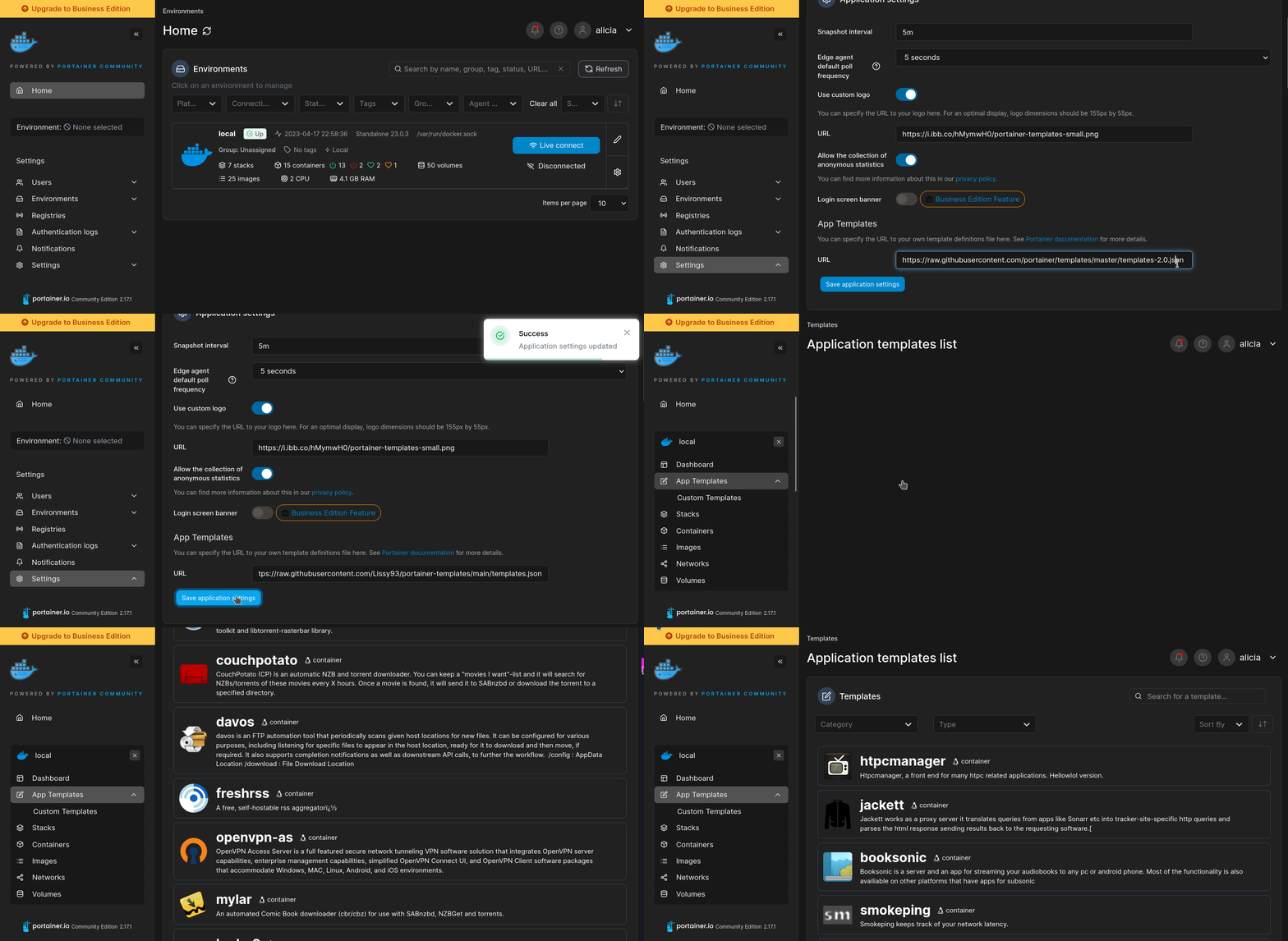
Install on Portainer
Import all app templates into your Portainer instance, for easy 1-click deploys
- Ensure both Docker and Portainer are installed, and up-to-date
- Log into your Portainer web UI
- Under Settings → App Templates, paste the below URL
- Head to Home → App Templates, and the list of apps will show up
- Select CryptPad, fill in any config options, and hit Deploy
Template Import URL
https://raw.githubusercontent.com/Lissy93/portainer-templates/main/templates.json
Show Me
Original stackfile
The compose file this template deploys, straight from its repo:
# SPDX-FileCopyrightText: 2023 XWiki CryptPad Team <[email protected]> and contributors
#
# SPDX-License-Identifier: AGPL-3.0-or-later

---
services:
  cryptpad:
    image: "cryptpad/cryptpad:version-2026.5.1"
    hostname: cryptpad
    restart: unless-stopped

    environment:
      # MAIN and SANDBOX must be two DIFFERENT origins (required for XSS sandboxing)
      - CPAD_MAIN_DOMAIN=${CPAD_MAIN_DOMAIN}
      - CPAD_SANDBOX_DOMAIN=${CPAD_SANDBOX_DOMAIN}
      - CPAD_CONF=/cryptpad/config/config.js

    volumes:
      - cryptpad-blob:/cryptpad/blob
      - cryptpad-block:/cryptpad/block
      - cryptpad-customize:/cryptpad/customize
      - cryptpad-data:/cryptpad/data
      - cryptpad-datastore:/cryptpad/datastore

    ports:
      - "3000:3000"
      - "3003:3003"

    ulimits:
      nofile:
        soft: 1000000
        hard: 1000000

volumes:
  cryptpad-blob:
  cryptpad-block:
  cryptpad-customize:
  cryptpad-data:
  cryptpad-datastore:
Or deploy it directly from the source:
git clone https://github.com/lissy93/portainer-templates
cd portainer-templates
docker compose -f sources/stacks/cryptpad.yml up -d
More install options in our documentation, or see cryptpad/cryptpad for app-specific guidance.
CryptPad
CryptPad is a collaboration suite that is end-to-end-encrypted and open-source. It is built to enable collaboration, synchronizing changes to documents in real time. Because all data is encrypted, the service and its administrators have no way of seeing the content being edited and stored.

Installation
For development
Our developer guide provides instructions for setting up a local instance without HTTPS or our more advanced security features.For production
Configuring CryptPad for production requires a little more work, but the process is described in our admin installation guide. From there you can find more information about customization and maintenance.Current version
The most recent version and all past release notes can be found here.Setup using Docker
You can findDockerfile, docker-compose.yml and docker-entrypoint.sh files at the root of this repository. We also publish every release on Docker Hub as AMD64 & ARM64 official images. Previously, Docker images were community maintained, had their own repository and weren't official supported. We changed that with v5.4.0 during July 2023. Thanks to @promasu for all the work on the community images.
Security
CryptPad offers a variety of collaborative tools that encrypt your data in your browser before it is sent to the server and your collaborators. In the event that the server is compromized the database holds encrypted data that is not of much value to attackers.The code which performs the encryption is still loaded from the host server like any other web page, so you still need to trust the administrator to keep their server secure and to send you the right code. An expert can download code from the server and check that it isn't doing anything malicious like leaking your encryption keys, which is why this is considered an active attack.
The platform is designed to minimize what data is exposed to its operators. User registration and account access is based on a cryptographic key that is derived from your username and password so the server never needs to see either and you don't need to worry about whether they are being stored securely. It is impossible to verify whether a server's operators are logging your IP or other activity, so if you consider this information sensitive it is safest to assume it is being recorded and access your preferred instance via Tor browser.
A correctly configured instance has safeguards to prevent collaborators from doing some nasty things like injecting scripts into collaborative documents or uploads. The project is actively maintained and bugs that our safeguards don't catch tend to get fixed quickly. For this reason it is best to only use instances that are running the most recent version, which is currently on a three-week release cycle. It is difficult for a non-expert to determine whether an instance is otherwise configured correctly, so we are actively working on allowing administrators to opt in to a public directory of servers that meet our strict criteria for safety.
Translations
CryptPad can be translated with nothing more than a web browser via our Weblate instance. See the state of the translated languages: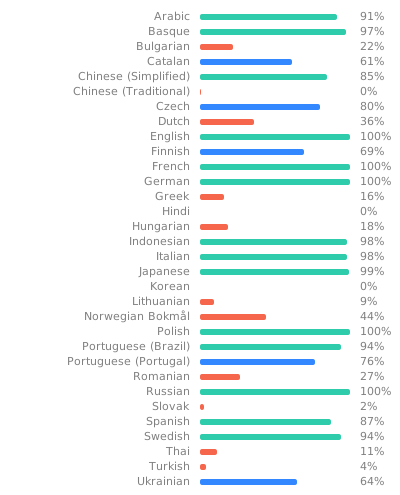
More information about this can be found in our translation guide.
Contacting Us
The best places to reach the development team and the community are the CryptPad Forum and the Matrix chatThe team is also on the fediverse: @[email protected]
Team
CryptPad is actively developed by a team at XWiki SAS, a company that has been building Open-Source software since 2004 with contributors from around the world. Between 2015 and 2019 it was funded by a research grant from the French state through BPI France. In the years since we have been funded by NLnet PET, NGI TRUST, NGI DAPSI, subscribers of CryptPad.fr, and donations to our Open-Collective campaign.Contributing
We love Open Source and we love contribution. Learn more about contributing.If you have any questions or comments, or if you're interested in contributing to CryptPad, come say hi in our Matrix channel.
This project is tested with BrowserStack.
License

This software is and will always be available under the GNU Affero General Public License as published by the Free Software Foundation, either version 3 of the License, or (at your option) any later version. If you wish to use this technology in a proprietary product, please contact [email protected].
Serve CryptPad on your own domain behind Caddy, Nginx or Traefik. Fill in your domain and copy the result. It's a starting point, some apps need their own base URL or extra headers set too.
Proxying cryptpad.example.com to http://cryptpad:3000
Add this to your Caddyfile
cryptpad.example.com {
	reverse_proxy http://cryptpad:3000
}Check the logs first
Nine times out of ten the logs tell you exactly what went wrong.
- In Portainer, go to Containers, click the container, then Logs. Or run
docker logs <container> - Exit codes help too:
137means killed, usually out of memory.126or127means the command inside the image is broken.
Port already in use
If deployment fails with "Bind for 0.0.0.0:3000 failed: port is already allocated", something else on your server is using that port.
- Find what's using it:
sudo ss -tlnp | grep :3000 - Stop the other service, or pick a different host port. In
3000:3000only the left number is yours to change, the right one belongs to the app.
Running but the page won't load
The container is up but nothing appears in your browser.
- Use your server's real IP:
http://your-server-ip:3000. The 0.0.0.0 link Portainer shows isn't a real address. - Give it a minute after first deploy, cryptpad can take a while to initialise.
- Make sure your firewall allows the port, e.g.
sudo ufw allow 3000
Image won't pull
Test the pull directly on the host: docker pull cryptpad/cryptpad:version-2026.5.1
- "manifest unknown" means the tag no longer exists.
- "toomanyrequests" is the Docker Hub rate limit. Log in with
docker loginto raise it. - "no space left on device" means a full disk. Reclaim space with
docker system prune
"exec format error"
This means the image was built for a different CPU architecture than your server.
- This image supports:
amd64, arm64 - Check yours with
uname -m: x86_64 is amd64, aarch64 is arm64. Raspberry Pi and other ARM boards are the usual culprits.
Container keeps restarting
The unless-stopped restart policy relaunches the app after every crash, so the real error can scroll past.
- Check the logs right after a restart, the last few lines before it died are the useful ones.
- Get the exit code with
docker inspect <container> --format '{{.State.ExitCode}}' - Still stuck? Redeploy once with the restart policy set to
noso the failure stays visible.
Stack won't deploy
Compose stacks fail fast on small mistakes, and Portainer shows the reason just above the editor.
- YAML only accepts spaces for indentation, a single tab breaks the whole file.
Raise an issue
Found something which isn't working as it should? Here's how to report it.
- Bug within the app: Open an issue on cryptpad/cryptpad
- Template not working: Open an issue within the template's repo
- This website not working: Open an issue on lissy93/portainer-templates
A Compose stack
CryptPad is a Compose stack, a set of containers defined in one file and brought up together by Portainer, then started and stopped as a single app.
The app image
An image is the app packed up ready to go, everything CryptPad needs bundled into one download. This template pulls cryptpad/cryptpad:version-2026.5.1, which Docker fetches once (about 217 MB) and then starts your own copy from.
Where the image comes from
Docker pulls its images from registries, public libraries of ready-built apps. CryptPad's comes from Docker Hub, published by cryptpad.
Version tags
The bit after the colon in the image name is the version tag. This one pins version-2026.5.1, so every redeploy gives you that exact build until you bump it yourself.
Which machines it runs on
Every image is built for particular CPU types. This one ships for amd64, arm64, so it runs on both regular x86 servers and ARM boards like a Raspberry Pi.
Ports
A port is the door the app answers on. A mapping like 3000:3000 means it's reachable on port 3000 of your server, where the left number is yours to change and the right one belongs to the app. Once it's running, open http://your-server-ip:3000 in a browser. It opens:
3000:3000, likely the web interface3003:3003
Volumes
A volume is where CryptPad keeps its files so they survive an update or a restart. Without one, anything it saves would sit inside the container and vanish the moment it's recreated. This template mounts:
/cryptpad/blobkept in thecryptpad-blobvolume Docker manages/cryptpad/blockkept in thecryptpad-blockvolume Docker manages/cryptpad/customizekept in thecryptpad-customizevolume Docker manages/cryptpad/datakept in thecryptpad-datavolume Docker manages/cryptpad/datastorekept in thecryptpad-datastorevolume Docker manages
Environment variables
Environment variables are the settings you hand over when you deploy, things like a password or a timezone. CryptPad takes 3 of them, all with defaults you can leave alone or tweak:
CPAD_MAIN_DOMAIN, pulled from your own environment. Main domain (full URL) — your public CryptPad addressCPAD_SANDBOX_DOMAIN, pulled from your own environment. Sandbox domain (full URL) — MUST be a DIFFERENT origin from the main domainCPAD_CONF, defaults to/cryptpad/config/config.js
Restart policy
The restart policy here is unless-stopped, so Docker restarts CryptPad after a crash or reboot, but leaves it off when you stop it on purpose. You can change this on the deploy screen. The choices are no (never restart), on-failure (only after a crash), unless-stopped (restart unless you stop it), and always (bring it back no matter what).
Networking
Nothing custom is set, so CryptPad sits on Docker's default bridge network: its own private space that reaches the outside world only through the ports it publishes.
Container name
Once it's deployed, Portainer names the container cryptpad. That's what you'll spot in the containers list and use in commands like docker logs cryptpad.
Platform
The platform is linux, the kind of system the container is built to run on. Docker and Portainer handle this on a normal Linux server.
Open source license
CryptPad is open source, released under the AGPL-3.0 license. In plain terms the code is out in the open, so you're free to run it and change it to fit what you need.
Portainer app templates
Zooming out, this whole page comes from a Portainer app template: a short recipe telling Portainer how to set CryptPad up. Add the template list to Portainer once, then deploying CryptPad is a click rather than a wall of config.